
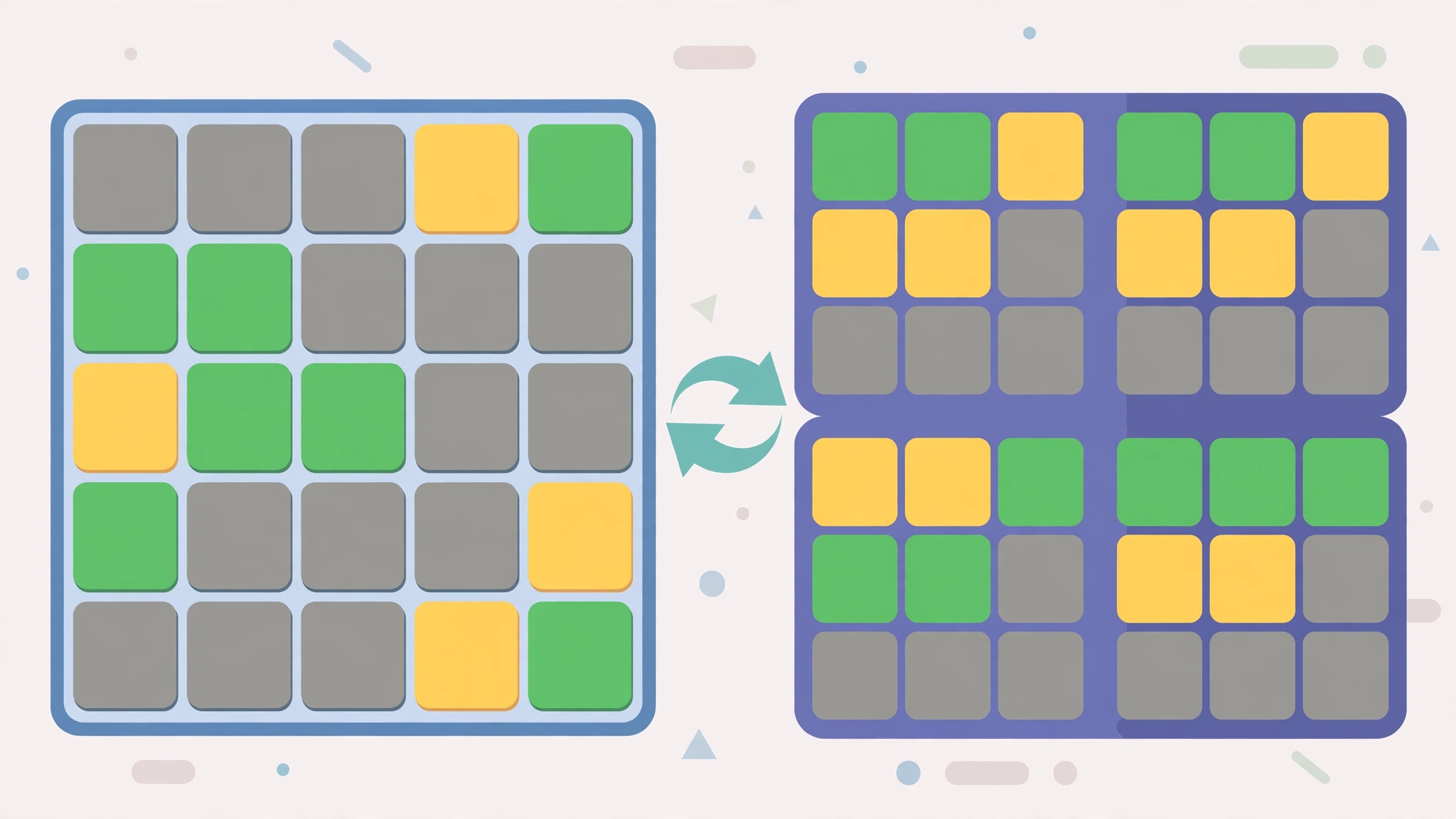
Type "wordle vs" into a search box and you will see the question players ask every day: Wordle vs what? Quordle, Octordle, Dordle, Plusword, Wordly, Strands, Connections — the Wordle family has grown into a small universe, and each game tweaks the formula in a different direction. This guide compares Wordle head-to-head with the biggest alternatives on rules, difficulty and daily limits, so you can find the game that actually fits you.
Why "Wordle vs" Is Such a Popular Search
Wordle's genius was its constraint: one 5-letter word, 6 guesses, once a day. That constraint is also its ceiling. Players who solve it in three guesses every morning start asking what is next — and the answer is a genre of games that keep Wordle's green-yellow-grey feedback while changing the variables: more words at once, longer words, unlimited play, or a completely different guessing mechanic. "Wordle vs X" is simply how players shop for their next daily ritual.
Wordle vs Quordle
Quordle is the most famous Wordle descendant: solve 4 five-letter words simultaneously in 9 guesses. It began as a prototype by David Mah in January 2022 and was taken over and developed by Freddie Meyer (Rock Paper Shotgun). Every guess applies to all four grids at once, so each guess is a compromise — a word that tests letters you need in grid one may waste information in grid four.
- Difficulty: meaningfully harder than Wordle. Nine guesses sounds generous until you realise you are effectively getting just over two guesses per word.
- Daily limit: one daily puzzle, plus a practice mode.
- Who wins: Wordle for the relaxed daily ritual; Quordle for players who want a genuine 15-minute brain workout.
If you want to go further up the ladder, the same family offers Octordle (8 words, 13 guesses), Sedecordle (16 words, 21 guesses) and Centordle (100 words, 108 guesses) — each one a bigger, crueller version of the same idea.
Wordle vs Dordle
Dordle sits between the two: 2 words at once in 7 guesses. Created by Guilherme Tows of Zaratustra Productions in early 2022 (HotHardware), it is the gentlest step up from Wordle and the best "first multi-Wordle" for players who find Quordle intimidating.
Wordle vs Plusword
Plusword is a different kind of alternative — a daily word puzzle built around crossword-style clues and word deduction rather than pure letter guessing. While Wordle asks you to find one hidden word from colour feedback alone, Plusword layers in clue-based solving that rewards vocabulary and lateral thinking.
- Gameplay feel: Wordle is a logic puzzle about letter positions; Plusword is a word puzzle about meaning and deduction.
- Audience: UK-focused daily players who enjoy crosswords will feel at home with Plusword; pure Wordle fans may find the clue-solving a gear shift.
- The verdict: they complement rather than replace each other — many players do both every morning.
(We have a full head-to-head here: our Plusword vs Wordle guide breaks down rules, difficulty and strategy side by side.)
Wordle vs Wordly
Wordly (wordly.org) is the "more Wordle" option: the same 6-guess, colour-feedback gameplay, but with unlimited puzzles, 4–6 letter options and multiple languages, plus a directory of hundreds of Wordle-style games. If your complaint about Wordle is "only one a day", Wordly is the direct answer — same satisfaction, no waiting for midnight.
Wordle vs Strands
Strands (NYT Games) abandons the guessing grid entirely: you get a 6×8 board of letters and must find all the theme words plus the "spangram" that ties them together. It plays like a word search with a crossword's brain.
- Skill tested: vocabulary breadth and pattern-spotting, not letter-position logic.
- Daily limit: one puzzle per day (with an archive for subscribers).
- Who wins: Wordle for the classic guessing loop; Strands for players who want a longer, more exploratory solve.
Wordle vs Connections
Connections, another NYT hit, gives you 16 words to sort into 4 groups of 4 by hidden theme, with 4 mistakes allowed. It is the trickiest game on this list — the categories are deliberately misleading (the famous "things that are also verbs" traps), and it has arguably overtaken Wordle as the internet's favourite daily argument-starter.
The Big Comparison Table
| Game | What you solve | Guesses / moves | Daily limit | Difficulty |
|---|---|---|---|---|
| Wordle | 1 five-letter word | 6 guesses | 1 per day | ★★☆☆☆ |
| Dordle | 2 words at once | 7 guesses | 1 daily + practice | ★★★☆☆ |
| Quordle | 4 words at once | 9 guesses | 1 daily + practice | ★★★★☆ |
| Octordle | 8 words at once | 13 guesses | 1 daily + practice | ★★★★★ |
| Plusword | Clue-based word deduction | Varies | Daily | ★★★☆☆ |
| Wordly | 1 word (4–6 letters) | 6 guesses | Unlimited | ★★☆☆☆ |
| Strands | Theme words + spangram | Unlimited mistakes-free play | 1 per day | ★★★☆☆ |
| Connections | 4 groups of 4 words | 4 mistakes | 1 per day | ★★★★☆ |
Which "Wordle vs" Winner Should You Play?
- You want the classic, unchanged: stick with Wordle. Nothing beats the original ritual.
- You want harder Wordle: Quordle (or Dordle as a stepping stone).
- You want unlimited Wordle: Wordly — same game, endless puzzles, more word lengths.
- You want words with meaning, not just letters: Plusword's clue-based deduction.
- You want a different kind of word brain: Strands for word-search vibes, Connections for lateral-thinking traps.
- You want to suffer: Centordle. One hundred words. One hundred and eight guesses. Good luck.
Can You Play More Than One a Day?
Absolutely — and most serious word-game players do. A common routine is Wordle + Quordle + Connections every morning (about 25 minutes total), with Wordly or Plusword filling any spare time. For a round-up of one-a-day challenges, see our daily puzzle games. The games share enough DNA that skill transfers between them: letter-frequency instincts from Wordle make you faster at Quordle, and vocabulary work in Plusword pays off in Strands. For more guessing tactics, see our word puzzle strategies.
What is the best alternative to Wordle?
Quordle is the most popular step up (4 words, 9 guesses). For unlimited play try Wordly; for a different style try Plusword or Connections.
Is Quordle harder than Wordle?
Yes — solving 4 simultaneous words in 9 guesses demands much tighter information management than one word in 6 guesses.
Wordle vs Quordle: which should I play?
Play Wordle for a quick daily ritual and Quordle when you want a longer challenge. Many players do both.
What is the difference between Wordle and Plusword?
Wordle is pure letter-position guessing; Plusword is a clue-based word deduction game with a crossword flavour. They test different skills.
Is there a Wordle with unlimited puzzles?
Yes — Wordly offers unlimited Wordle-style puzzles with 4–6 letter options and multiple languages.
Wordle vs Dordle vs Quordle: what’s the progression?
Dordle (2 words, 7 guesses) → Quordle (4 words, 9 guesses) → Octordle (8 words, 13 guesses) → Sedecordle (16) → Centordle (100). Each rung up is a serious difficulty jump.
Are Strands and Connections made by the same people as Wordle?
Yes — all three are New York Times Games titles. Quordle, Plusword, Wordly and Dordle are independent.
Can I play Wordle more than once a day?
The official NYT Wordle is one puzzle per day, but the archive and alternatives like Wordly give you unlimited similar play. **Sources:** plusword.co.uk/plusword-vs-wordle/ (Plusword vs Wordle rules comparison); plusword.co.uk/what-is-quordle/ (Quordle: 4 words, 9 guesses); nytimes.com/games (Wordle, Strands, Connections — NYT Games roster); wordly.org (unlimited puzzles, 4–6 letters, languages); crosswordle.com/blog/wordle-crossword-hybrid (NYT independence context).