
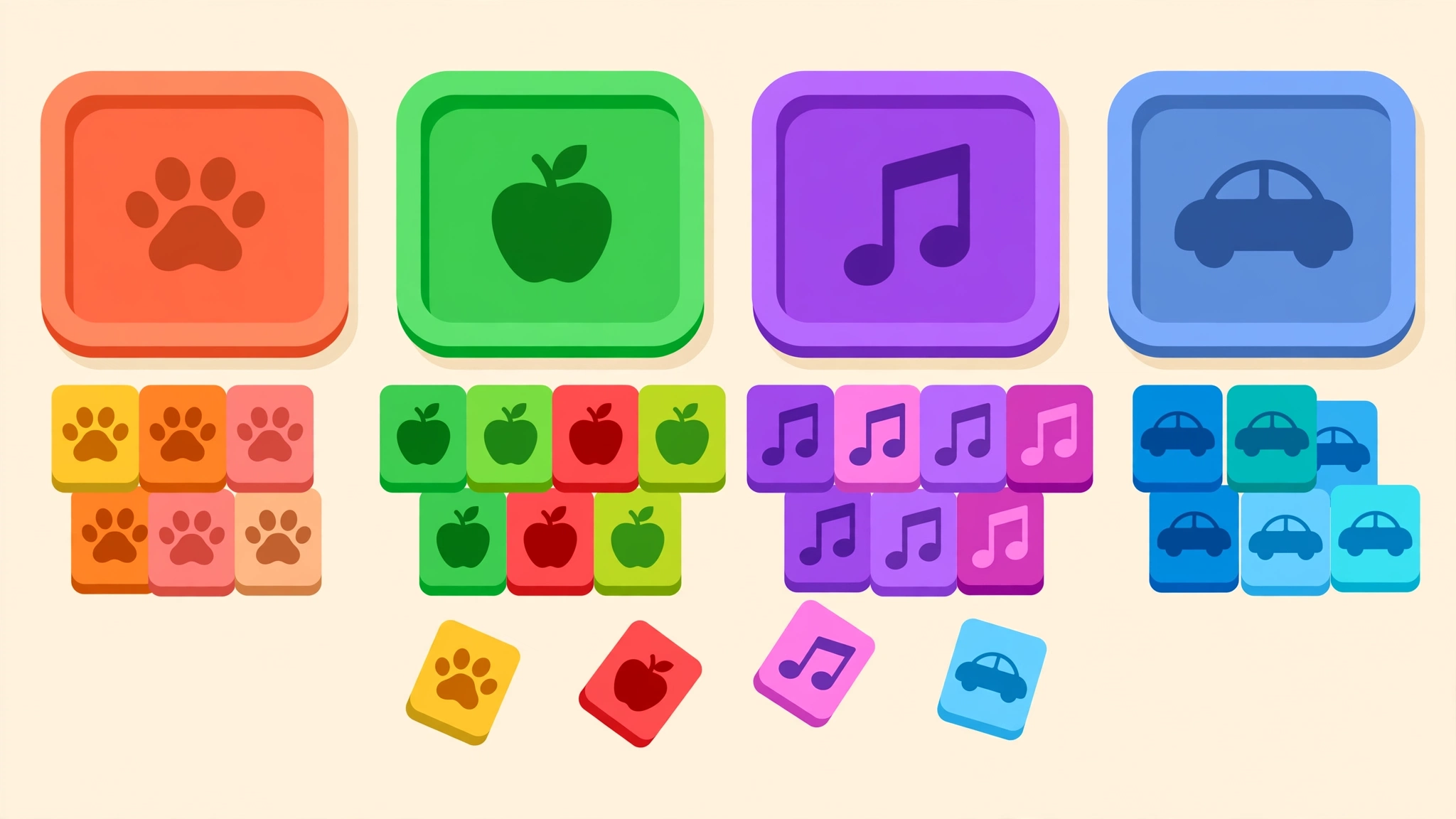
Blockword puzzles are word-sorting puzzle games in which words and pictures on colourful blocks must be dragged into the correct category tiles — for example, sorting "Cat", "Glass" and "Ferrari" into Animals, Objects and Transportation. The name covers two real games: the modern mobile app "BlockWord: Word Associations" (free, no timers, hundreds of levels) and the 1976 Waddingtons board game "Blockword", a classic spelling game now in the V&A museum collection.
They look nothing alike, but both are built on the same idea: words are physical blocks you move around. This guide covers the app most people are searching for, the board-game history, and how to play both well.
BlockWord: Word Associations (the Mobile Game)
The game behind most "blockword puzzles" searches is BlockWord: Word Associations, a free mobile puzzle game released in June 2026. It is developed by Pleasure City (listed on Google Play) with the iPhone edition from Orange One Limited, and it has earned a 4.89-out-of-5 rating from players with tens of thousands of downloads.
It is not a spelling game at all — it is a word-association game, closer to a calm game of Connections than to Scrabble.
How It Works
At the top of the screen sit the category tiles — Mahjong-style trays, each representing a concept or theme such as Animals, Food, Music, Furniture, Transportation, Habits, Sports or Objects. Below them lies a pile of randomly mixed word blocks. Each block carries either a word (like Cat, Glass or Ferrari) or a picture icon (a food item, an animal, an activity).
Your job:
- Drag each block into the category tile it belongs to.
- Collect three correct blocks in one category — the group clears.
- Clear every category to complete the level.
There are no timers and no penalties. You play entirely at your own pace, which makes it a genuinely relaxing puzzle rather than a reflex test.
Why It Is Trickier Than It Looks
The levels are handcrafted, and the difficulty comes from ambiguity. One word can plausibly fit two categories — is a tomato Food or a plant? Is a piano Music or Furniture? The game rewards flexible thinking: you have to hold a word's multiple meanings in your head and decide which grouping the level designer intended. Later levels introduce overlapping categories deliberately, so the "obvious" answer is sometimes a trap.
Key Features
- Hundreds of handcrafted levels with gradually introduced categories and naturally rising difficulty.
- Word + image blocks, which train vocabulary and visual association together.
- No timers, no pressure — short, calm sessions built around discovery rather than speed.
- Free to download, with offline-friendly play.
Where to Play It
BlockWord: Word Associations is available free on Google Play and on iPhone via the App Store. Search for the exact title — the store also hosts lookalike "block" games (block-blast puzzlers, mahjong solitaire) that have nothing to do with words.
Blockword (1976): The Classic Board Game
Long before the app, there was Blockword, a spelling board game produced by Waddingtons in England and dated to the early twentieth century in some catalogues, with the surviving 1976 edition held in the V&A's Young collection in London.
What Is in the Box
- A moulded plastic playing tray with locating octagons.
- 25 yellow plastic cube blocks, each printed with four letters around the sides; the blocks stack into one another.
- A score pad and printed instructions.
How the Board Game Plays
Two to four players take turns placing letter blocks onto the tray's octagons. The letter facing each player is the starting point, and every block placed must form valid words with the blocks adjacent to it. It is part spelling game, part territory game: you build your own words while trying to block your opponent's.
That combination of vocabulary and strategy is why it survived as a family favourite for decades — it rewards both a big word list and a tactical eye.
The Two Blockwords Compared
| Feature | BlockWord: Word Associations (app) | Blockword (1976 board game) |
|---|---|---|
| Type | Mobile word-association puzzle | Board spelling game |
| Players | Single player | 2–4 players |
| Core skill | Semantic relationships, lateral thinking | Spelling, vocabulary, strategy |
| Timers | None — fully relaxed | Turn-based, social pace |
| Levels | Hundreds of handcrafted levels | Endless replay with the same blocks |
| Cost | Free | Out of print (second-hand / collectors) |
| Availability | Google Play, iPhone | V&A museum collection; vintage markets |
Tips for Winning at Blockword Puzzles
For the Mobile App
- Read every category first. Before dragging anything, scan all the tiles. Knowing the full set of options prevents premature "obvious" placements.
- Place the certain blocks first. Lock in the unambiguous words, then use the remaining categories to disambiguate the tricky ones.
- Think in multiple meanings. If a word fits two categories, hold both in mind — the level usually resolves the ambiguity through the blocks that are left.
- Use the pictures. Image blocks often disambiguate faster than words; a picture of a piano screams Music where the word "piano" might tempt Furniture.
- Slow down at overlap levels. When categories start sharing members, every placement deserves a second look.
For the 1976 Board Game
- Play the ends of words. Prefixes and suffixes let one block serve two words at once.
- Block deliberately. Placing a block that ruins an opponent's planned word is often worth more than a modest word of your own.
- Keep short words ready. Two- and three-letter words are the glue that holds a crowded tray together.
Games Like Blockword Puzzles
If you enjoy the association-sorting loop, try the NYT's Connections (group 16 words into 4 categories — the same mental muscle), or explore our Plusword vs Wordle guide for more daily word games. Fans of calm, untimed puzzling will also like learning how to play Plusword, our own daily word puzzle with no download required.
The Bottom Line
Whether you mean the calm, modern sorting app or the vintage Waddingtons board game, blockword puzzles turn words into objects you can pick up and put in their place. Start with the free app for a relaxed daily brain teaser, and if you ever spot the 1976 box at a car-boot sale, grab it — it is a genuine piece of word-game history. For a fresh daily challenge in your browser, today's Plusword puzzle is waiting.
What are blockword puzzles?
Blockword puzzles are word-sorting games where you drag word and picture blocks into the correct category tiles. The name also refers to a 1976 Waddingtons board spelling game.
Is BlockWord: Word Associations free?
Yes. The mobile game is free to download on Google Play and iPhone, with no timers and no mandatory purchases to play the levels.
How do you play BlockWord: Word Associations?
Drag each word or picture block into its matching category tile at the top of the screen. Three correct blocks clear a category; clear all categories to finish the level.
Who made BlockWord: Word Associations?
The Android edition is developed by Pleasure City and the iPhone edition is published by Orange One Limited. It was released in June 2026.
What is the 1976 Blockword board game?
Blockword is a Waddingtons spelling board game from 1976 (with earlier roots) for 2–4 players: place letter cube blocks on a tray to form words and score points. An edition is preserved in London’s V&A museum.
Is Blockword the same as Block Blast?
No. Block Blast and similar “block puzzle” games are tile-fitting puzzlers with no words. Blockword puzzles are specifically about sorting words into categories.
Can you play blockword puzzles online?
The mobile app is the main way to play today. There is no official browser edition of BlockWord: Word Associations; avoid clone sites asking for payment.
Are blockword puzzles good for vocabulary?
Yes. Sorting words by meaning and association trains semantic knowledge — understanding what words mean and how they relate — which is exactly what vocabulary tests measure.