
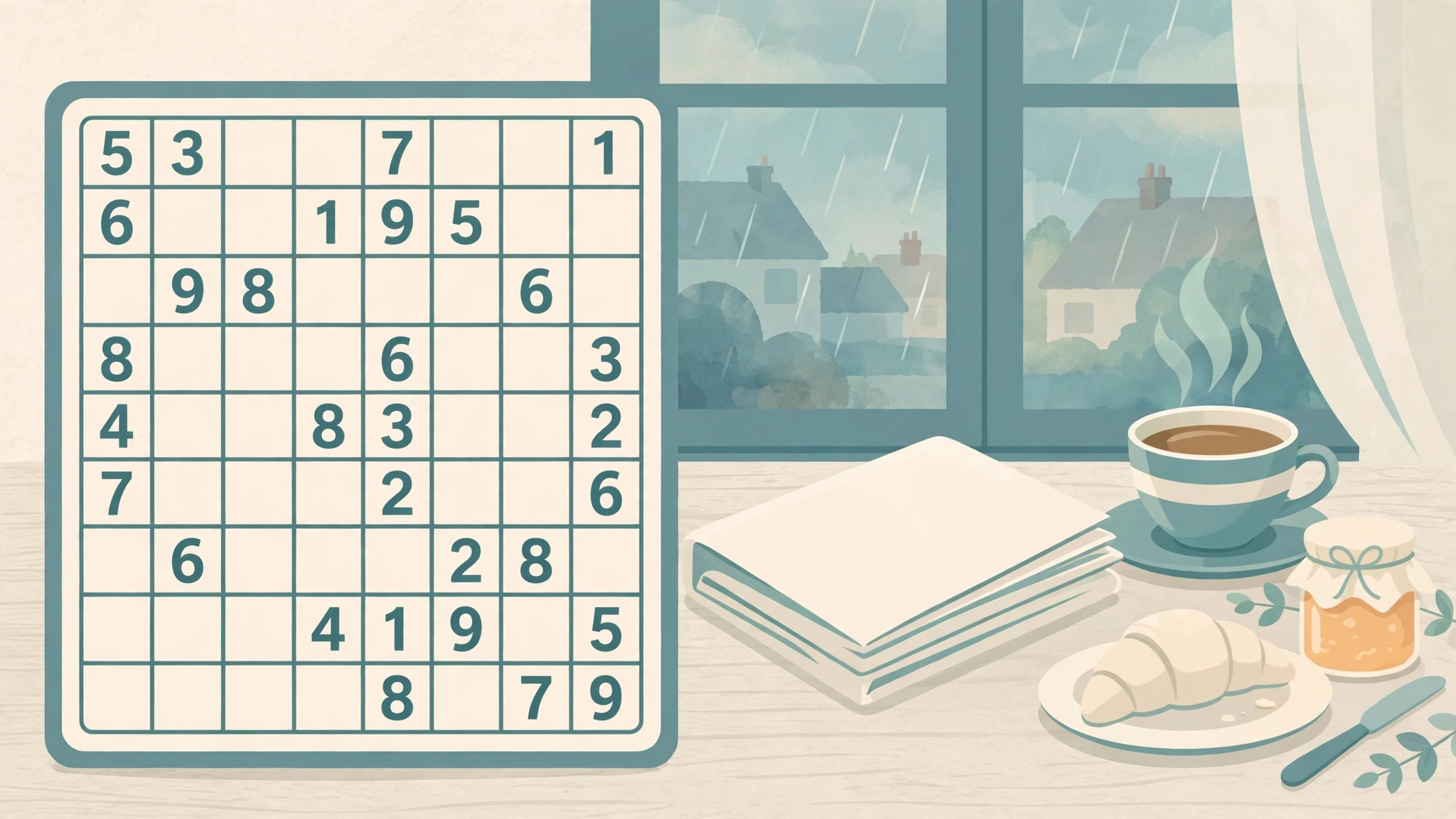
The Daily Telegraph Sudoku is the paper's daily 9×9 number puzzle, published every day on the Telegraph's Puzzles website at telegraph.co.uk/puzzles with Regular and Tough grids plus a searchable archive of thousands of past puzzles, though full access requires a puzzles subscription. You can play free in the browser or through the Telegraph Puzzles app — here is where to find it, how the difficulty levels work, and how to get better at it.
Where to Play the Daily Telegraph Sudoku
The Telegraph relaunched its puzzles offering as a dedicated interactive Puzzles website in September 2022, describing it as the start of a wider digital transformation of its puzzle portfolio (InPublishing). The new site offers a bespoke, fully interactive experience with puzzles across difficulty levels for solvers of all abilities — and sudoku sits right at the heart of it.
Your options for playing:
- Online at telegraph.co.uk/puzzles — the daily Sudoku Regular and Sudoku Tough grids, playable in the browser with modern solver-friendly features.
- The Telegraph Puzzles app — available on Google Play (uk.com.telegraph.puzzle.app), bundling sudoku with the paper's crosswords, PlusWord, Panagram, Kakuro and Codewords, plus streaks, achievements and a puzzles archive.
- In print — the classic daily sudoku still appears in the newspaper itself.
- Telegraph sudoku books — including The Telegraph Big Book of Sudoku 4 (2024), with over 400 puzzles graded from gentle to extreme (IberLibro).
Note that full access to the puzzles site and app is tied to the Telegraph's puzzles subscription — the app listing mentions promotional pricing such as a year of Telegraph Puzzles for £1, so check the current offer before subscribing.
A Quick History: The Telegraph and Puzzles
The Telegraph has one of the deepest puzzle heritages in British newspapers: it was the first quality newspaper in the UK to publish a daily cryptic crossword, back in 1925 (InPublishing). Sudoku joined the lineup during the 2000s puzzle boom, and the paper's puzzles are compiled by setters including Michael Mepham, whose name appears across the Telegraph's sudoku collections (Pan Macmillan; Foyles).
The paper has published a long shelf of sudoku books — the Daily Telegraph Sudoku collections and the Big Book of Sudoku series — with puzzles graded from gentle through moderate and tough to diabolical, each with an introductory tutorial and full solutions at the back.
Difficulty Levels Explained
The Telegraph's daily online offering comes in two core grades (InPublishing; Google Play listing):
| Level | What to expect | Best for |
|---|---|---|
| Sudoku Regular | "Relax with the classic number game" — standard logical solving | Daily solvers, warm-ups, beginners |
| Sudoku Tough | "Can you crack our trickiest number game?" — advanced techniques | Experienced solvers |
The print books use a finer grading scale — gentle, moderate, tough and diabolical — so if the Tough daily still feels easy, the book collections go further.
How to Solve the Telegraph Sudoku: Tips
The Telegraph's sudokus are classic 9×9 logic puzzles — no maths required, just reasoning. These techniques will carry you from Regular to Tough. Once the standard grids feel easy, killer sudoku adds cage-sum arithmetic for a sterner test.
What makes the Telegraph's grids satisfying is the same thing that defines the best newspaper sudokus: clean, fair logic. The given numbers (the "givens") are placed so that each deduction follows from the last — no guessing required if your candidate tracking is disciplined. Regular grids typically yield to single-candidate scanning, while the Tough demands full candidate notation and pattern-based techniques. Treat the two daily grids as a training pair: the Regular warms up your scanning, the Tough tests your advanced logic.
- Scan for singles first. In every row, column and 3×3 box, look for digits that can only go in one cell. Regular grids often collapse quickly this way.
- Pencil in candidates. Mark possible digits in empty cells; the Telegraph's online player supports candidate mode, which makes this painless.
- Use the process of elimination. If a digit appears twice in a band of boxes, its third occurrence is forced into the remaining box.
- Learn one advanced technique at a time. Tough grids typically need pairs, triples, X-wings or swordfish — learn "naked pairs" first, then build up.
- Play the Regular before the Tough. The daily Regular is an ideal warm-up that sharpens the pattern recognition the Tough grid demands.
- Use the archive. With thousands of past puzzles available, you can drill specific difficulty levels instead of waiting for tomorrow.
Meet the Setter: Michael Mepham
One name appears across the Telegraph's sudoku collections more than any other: Michael Mepham. A long-standing compiler of crosswords and sudoku for the paper, Mepham is one of Britain's best-known puzzle setters, and his graded collections are the backbone of the Telegraph's sudoku bookshelf. His puzzles are known for clean, logical construction — the kind where every deduction feels earned rather than guessed — which is exactly why the Telegraph's books, from gentle starters to diabolical finishers, carry his name so prominently.
Telegraph Puzzles App vs Website
| Feature | Website (telegraph.co.uk/puzzles) | Puzzles app |
|---|---|---|
| Daily sudoku | Regular + Tough | Regular + Tough |
| Archive | Thousands of past puzzles | Thousands of extra games |
| Streaks & achievements | Varies | Built in, with notifications |
| Other puzzles | Crosswords, PlusWord, Kakuro, Codewords | Same full lineup |
| Offline play | No | Yes, via the app |
If you solve on the move, the app's streaks and notifications are genuinely useful for building a daily habit. If you prefer a big screen, the website's solver-friendly interface is the better choice.
Can I play the Telegraph Sudoku offline?
Yes — the Telegraph Puzzles app supports offline play, unlike the website which needs a connection. Download the day’s grids (and archive puzzles) while on Wi-Fi, then solve on the train or plane without using data.
What is the Telegraph Big Book of Sudoku?
It is the paper’s flagship print collection — Big Book of Sudoku 4 (2024) packs over 400 puzzles graded from gentle to extreme across 480 pages (ISBN 9781788405447), compiled by setters including Michael Mepham. Earlier editions in the series are widely available second-hand if you want years of extra puzzles.
Where can I play the Daily Telegraph Sudoku?
Play it every day at telegraph.co.uk/puzzles (Sudoku Regular and Sudoku Tough), in the Telegraph Puzzles app on Google Play and the App Store, or in the print newspaper.
Is the Telegraph Sudoku free?
The puzzles are tied to the Telegraph’s puzzles subscription, though promotional pricing is regularly offered — the app listing has advertised a year of Telegraph Puzzles for £1. Check the current offer on the Telegraph’s site.
What difficulty levels does the Telegraph Sudoku have?
Online, there are two daily grades: Sudoku Regular and Sudoku Tough. The Telegraph’s sudoku books use a finer scale: gentle, moderate, tough and diabolical.
Who creates the Telegraph’s sudoku puzzles?
The Telegraph’s sudoku collections are compiled by setters including Michael Mepham, a long-standing compiler of crosswords and sudoku for the paper (Pan Macmillan).
Does the Telegraph have a sudoku app?
Yes — the Telegraph Puzzles app (Google Play listing: uk.com.telegraph.puzzle.app) includes Sudoku Regular and Tough plus crosswords, PlusWord, Panagram, Kakuro and Codewords, with streaks, achievements and an archive of thousands of puzzles.
Are there Telegraph sudoku books?
Yes. The Telegraph Big Book of Sudoku series is the flagship — Big Book of Sudoku 4 (2024) contains over 400 puzzles graded from gentle to extreme across 480 pages (ISBN 9781788405447). Earlier Daily Telegraph Sudoku collections are also widely available second-hand.
What is the difference between Sudoku Regular and Sudoku Tough?
Sudoku Regular is the classic daily grid solvable with basic logic — ideal for a relaxed solve. Sudoku Tough demands advanced techniques like pairs, triples and X-wings, and is aimed at experienced solvers.