
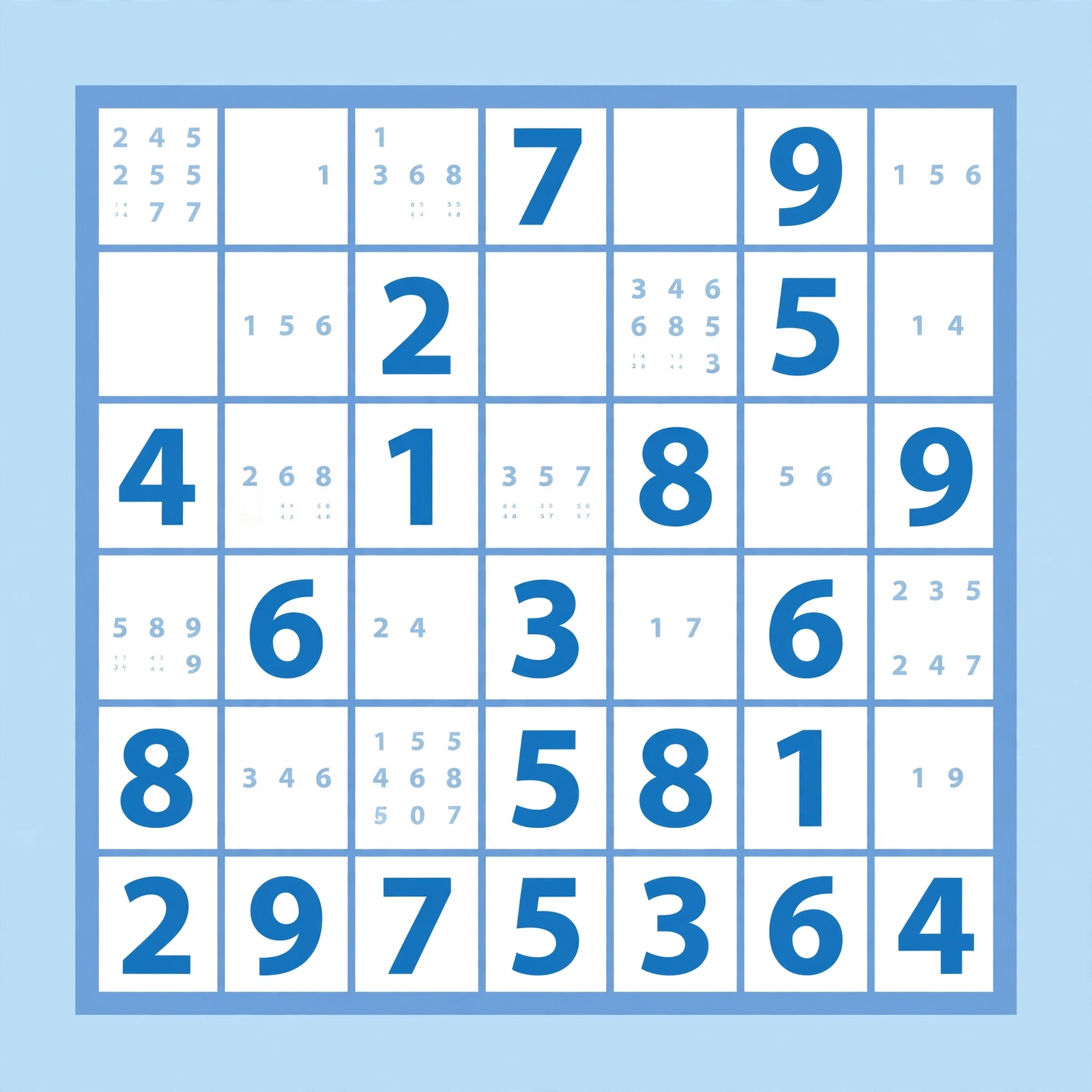
Sudoku is solved by filling a 9×9 grid so that every row, column and 3×3 box contains the digits 1 to 9 exactly once, using logic and deduction alone — never guessing. Start by scanning for obvious placements and filling in "singles", then add pencil-mark candidates when you get stuck. Apply elimination patterns like pairs and X-Wings for harder puzzles.
The Rules in 30 Seconds
This logic puzzle follows just three rules. Every standard Sudoku obeys them:
- Each of the 9 rows must contain the digits 1–9 exactly once.
- Each of the 9 columns must contain the digits 1–9 exactly once.
- Each of the nine 3×3 boxes must contain the digits 1–9 exactly once.
That's it. Every solving technique is just a clever way of applying those three constraints. If you're completely new to the puzzle itself, our guide to what Sudoku is covers the history and format first.
The Solving Loop: Your Step-by-Step Method
Experienced solvers all follow roughly the same loop. Run through these steps in order, and repeat until the grid is full:
- Scan rows, columns and boxes for easy placements.
- Fill singles — cells where only one digit can go.
- Add pencil marks — write small candidate numbers in empty cells when scanning stalls.
- Apply patterns — pairs, triples and line-based eliminations.
- Rescan — every new placement unlocks fresh moves, so loop back to step 1.
Step 1: Scanning (Cross-Hatching)
Scanning is the first technique to master. Pick a 3×3 box and look at the rows and columns crossing through it. If the digit 7 already appears in two of the three rows crossing a box, then within that box the 7 can only sit in the third row — often in exactly one cell.
Work systematically: scan each row for missing digits, then each column, then each box. Puzzles at easy difficulty can often be solved with scanning alone.
Step 2: Naked Singles
A "naked single" is a cell where pencil-mark logic leaves only one possible candidate. If a cell's row contains 1, 2, 4, 5, 6, 7, 8, 9, its column adds nothing new and its box is missing only the 3 — the cell must be 3. Fill it in immediately; each placement tends to reveal more singles.
Step 3: Hidden Singles
A "hidden single" is sneakier: a digit that appears as a candidate in several cells of a unit, but only one of those cells is actually legal. For example, the digit 5 might be a candidate in three cells of a row — but in two of them, the column or box rules it out. The remaining cell is a hidden single. Look for these whenever scanning dries up.
Step 4: Pencil Marks (Candidate Notation)
When no more singles are visible, write the possible candidates as small numbers in each empty cell (most apps have a "notes" or "candidate" mode that does this automatically). This turns the puzzle from a memory test into a visual one: patterns like pairs and triples jump out of the marks. The golden rule is to keep marks updated — erase candidates the moment a placement rules them out.
Intermediate Techniques
Once the basics are automatic, these patterns crack medium puzzles:
| Technique | What it is | When to use it |
|---|---|---|
| Naked pair | Two cells in a unit share the same two candidates | Eliminate those two digits from all other cells in the unit |
| Hidden pair | Two digits appear only in the same two cells of a unit | Remove all other candidates from those two cells |
| Pointing pair/triple | Candidates for a digit line up in one row/column within a box | Eliminate that digit from the rest of the row/column outside the box |
| Box/line reduction | A digit's candidates in a row/column are confined to one box | Eliminate that digit from the rest of the box |
Naked Pairs in Practice
If two cells in the same row both contain only the candidates {3, 7}, then 3 and 7 must occupy those two cells in some order — so you can delete 3 and 7 from every other cell in that row. This "matching pairs" logic (also called twins) is the workhorse of intermediate solving.
Pointing Pairs
Suppose the digit 4 can only appear in the top row of the middle box. Wherever the 4 goes inside that box, it sits in the top row — so 4 can be eliminated from the top row's cells in the other two boxes. This box-to-line interaction solves many puzzles that resist simple scanning.
Advanced Patterns for Hard Puzzles
Hard and evil puzzles demand bigger patterns. You don't need these on day one, but knowing they exist stops you from guessing:
- X-Wing: a digit forms the corners of a rectangle across two rows and two columns — eliminate it from the rest of those columns.
- Swordfish: the 3-row/3-column version of the X-Wing.
- XY-Wing: three cells with a pivot/bivalue structure that eliminates a candidate seen by both "pincers".
- Forcing chains: follow the logical consequences of "if this cell were X…" until a contradiction or confirmation appears.
Our hard Sudoku strategies guide walks through these advanced techniques in detail with examples.
Common Beginner Mistakes
- Guessing instead of reasoning. Every published Sudoku has a unique solution reachable by pure logic. If you're guessing, you've missed a pattern — back up and rescan.
- Over-noting too early. Filling every cell with full candidate lists creates clutter. Add pencil marks only where you're stuck, then expand as needed.
- Forgetting to update candidates. Stale pencil marks hide singles. Erase ruled-out candidates after every placement.
- Solving one area to death. If a corner won't crack, move on — a placement elsewhere often unlocks it.
- Ignoring one digit at a time. Focusing on a single number across the whole grid (cross-hatching every 7, then every 3) is often more productive than staring at empty cells.
How to Practise Effectively
This deduction puzzle rewards deliberate practice more than marathon sessions:
- Start on easy puzzles and only move up when you finish them comfortably without guessing.
- Use apps with hint and candidate modes while learning, then switch hints off.
- Time yourself occasionally — not to rush, but to notice which techniques slow you down.
- Try variant formats like Killer Sudoku once classic solving feels natural; the cage arithmetic sharpens candidate logic.
- Review your mistakes: when you get stuck, check which deduction you missed rather than guessing — that feedback loop is what turns the 9×9 logic puzzle from trial-and-error into genuine skill.
What is the easiest way to solve Sudoku for beginners?
Scan rows, columns and boxes for cells where only one digit fits (singles), fill those in, and repeat. Most easy puzzles fall to scanning plus naked and hidden singles alone.
Do you ever need to guess in Sudoku?
No. Every properly constructed Sudoku has one unique solution reachable by logic. Guessing means a pattern was missed — erase the guess and look again.
What are pencil marks in Sudoku?
Pencil marks are small candidate numbers written in empty cells showing which digits could legally go there. They make patterns like pairs and triples visible and are essential beyond easy difficulty.
What is the hardest Sudoku technique?
Forcing chains and pattern-based eliminations like Death Blossom and ALS chains sit at the top end; most hard puzzles yield to X-Wings, Swordfish and XY-Wings first.
How long should a Sudoku take to solve?
Easy puzzles take 5–15 minutes for beginners, medium 15–30, and hard or evil grids can take over an hour. Speed comes naturally with pattern recognition.
Can Sudoku improve your brain?
Sudoku exercises logical reasoning, working memory and concentration. Like any puzzle, it’s a good mental workout — though specific “brain training” claims should be taken with a pinch of salt.
Why can’t I solve hard Sudoku puzzles?
Hard puzzles require intermediate patterns (pairs, pointing pairs, box/line reduction) applied systematically with clean pencil marks. Learn one new technique at a time rather than trying to absorb them all at once.