
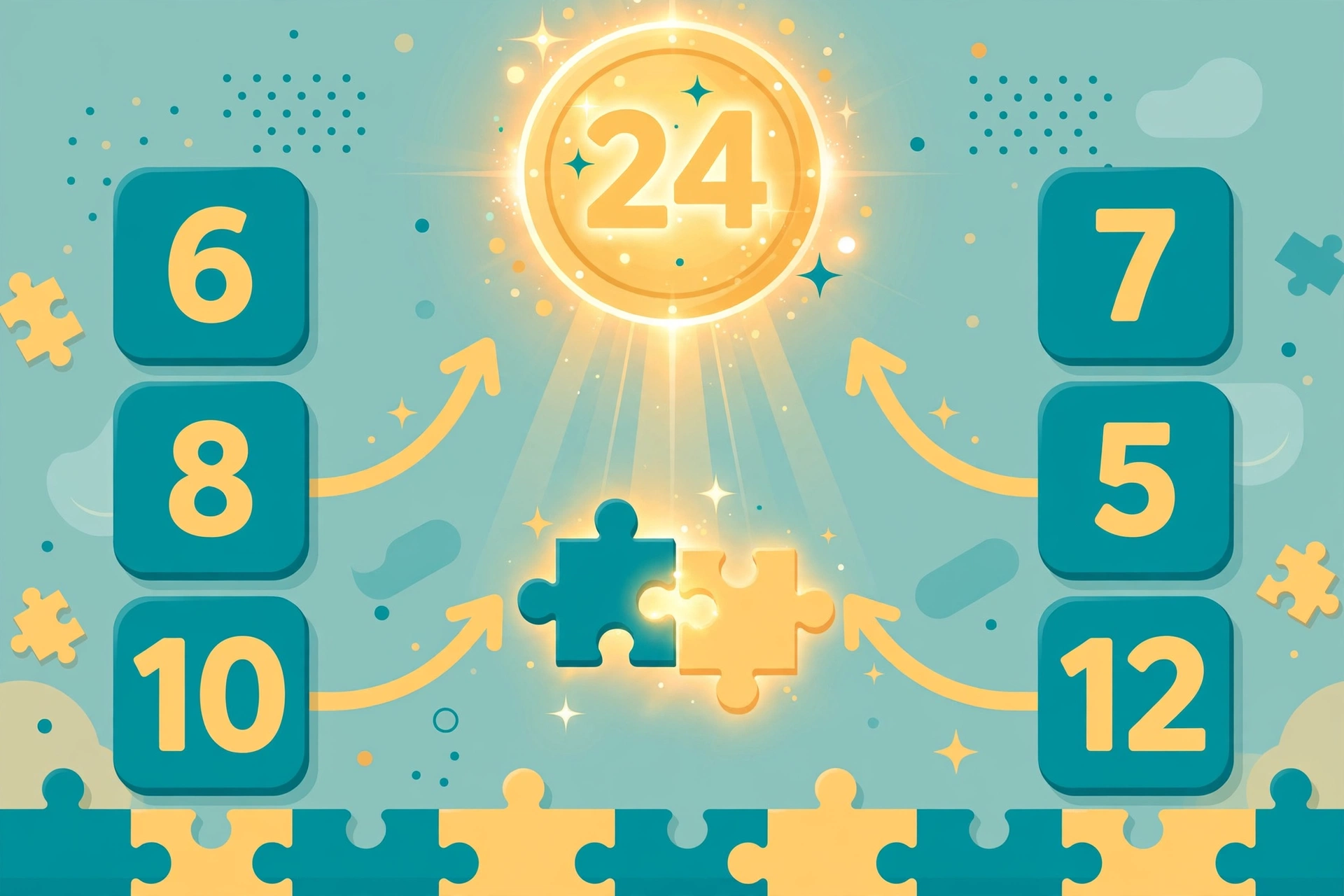
Summle is a free daily math game with a simple brief: reach the target number by chaining small sums together, in five steps or fewer. It plays like the numbers round of the TV show Countdown squeezed into a Wordle-style daily format — quick to learn, surprisingly deep, and over in a few minutes.
What Is Summle?
Summle (summle.net) is a numbers puzzle in the daily-games family. Each day you are given a target number at the top of the screen and a row of number tiles at the bottom. Your job is to combine the tiles with arithmetic to build sums that eventually reach the target — and you must do it in five steps or fewer.
It is listed among the well-known daily number games alongside Nerdle — the maths-based Wordle created by data scientist Richard Mann and released in January 2022 — Mathler and Sumplete (github.com/guilyx/awesome-daily-minigames), and it is regularly described as "Countdown-style" because the core mechanic — chaining operations to hit a target — is exactly what the numbers round of the long-running Countdown) TV show asks contestants to do.
The game is free, browser-based, requires no account, and releases one new puzzle every day at midnight local time.
How to Play Summle: The Rules
The rules are short enough to learn in under a minute:
- Reach the target. A target number sits at the top of the screen. Combine the number tiles at the bottom to build sums that reach it.
- Five steps or fewer. You have a maximum of five steps (sums) to arrive at the target. Fewer steps is better.
- Each number tile can be used once. Click tiles to add them to a sum; click again to remove them. You do not have to use every tile.
- Chain your subtotals. Sums you have already made appear as yellow subtotal tiles, and you can reuse those subtotals in a new sum — this chaining is how you build toward big targets efficiently.
- There is always at least one solution. Every daily puzzle is guaranteed solvable, and a fresh puzzle arrives daily.
In practice, a turn looks like this: pick two or three tiles, combine them into a subtotal, then combine that subtotal with another tile or subtotal, repeating until the running total equals the target.
Summle Tips and Strategies
Plan backwards from the target. Before touching a tile, look at the target and ask what "nice" numbers divide into it or sit near it. If the target is 347, getting to 350 first and adjusting is often easier than building 347 directly.
Save big tiles for big moves. Large number tiles are your most powerful tools — do not spend them on small opening sums. Build modest subtotals first, then deploy the big tiles for the final push.
Chain aggressively. The yellow subtotal tiles exist to be reused. A common beginner mistake is treating each sum as final; strong players chain three or four subtotals together across their five steps.
Do the easy arithmetic first. Knock out obvious pairings (tiles that sum to round numbers like 10, 25, 50, 100) early. Round subtotals are flexible building blocks for the later steps.
Count your steps. With only five steps allowed, a solution that needs six operations is a failure. If your plan needs more than five chained sums, simplify — combine more tiles per step rather than adding steps.
Try the difficulty modes. Summle includes junior and hard modes alongside the standard daily, so you can warm up or push yourself depending on the day.
Summle vs Other Daily Math Games
| Feature | Summle | Nerdle | Calcle |
|---|---|---|---|
| Core mechanic | Chain sums to reach a target | Guess a hidden equation | Guess numbers in a shown equation |
| Steps / guesses | 5 steps | 6 guesses | 5 guesses |
| Colour feedback | Subtotal tiles (yellow) | Green / purple / black tiles | Green / purple / gray tiles |
| Closest TV equivalent | Countdown numbers round | — | — |
| Difficulty modes | Junior + hard modes | Standard only | Standard only |
| Daily puzzle | Yes | Yes | Yes |
Summle stands apart because there is no hidden answer to deduce — the target is public and the challenge is purely constructive: find an efficient path to it. Number-game fans should also try our Nerdle game guide for the equation-guessing side of the genre.
Where to Play Summle
The official game is at summle.net — free, no sign-up, playable on desktop and mobile browsers. It is also hosted on Wordle-portal sites including dordle.io and wordhurdle.co if you prefer those interfaces. Every version follows the same daily puzzle. For more quick daily challenges, browse our list of daily puzzle games.
Common Summle Mistakes to Avoid
- Treating each sum as final. The yellow subtotal tiles exist to be reused. A common beginner mistake is stopping after one sum; strong players chain three or four subtotals together across their five steps.
- Spending big tiles early. Large number tiles are your most powerful tools — do not waste them on small opening sums. Build modest subtotals first, then deploy the big tiles for the final push.
- Not counting your steps. With only five steps allowed, a solution that needs six operations is a failure. If your plan needs more than five chained sums, simplify — combine more tiles per step.
- Ignoring round numbers. Tiles that sum to round numbers like 10, 25, 50 or 100 make flexible building blocks for later steps. Knock out obvious pairings early.
Working Backwards: The Countdown Mindset
The article's top tip — plan backwards from the target — deserves a full method, because it is the difference between flailing at tiles and solving like a Countdown champion. Here is the backwards-solving system.
Find the "anchor" operation first. Look at the target and ask which single operation gets you closest: is the target near a multiple of one of your large tiles? If the target is 347 and you hold 50 and 7, then 50 × 7 = 350 is your anchor — one adjustment away. Anchors turn a five-step puzzle into a two-step puzzle with a correction.
Think in corrections, not constructions. Beginners build upward from small tiles, hoping to land on the target. Experts build near the target, then correct: overshoot and subtract, undershoot and add. Corrections are easier to spot than constructions because the gap is small — and Summle's subtotal tiles make chaining a correction trivially easy.
Spend large tiles decisively. Large number tiles are your most powerful moves, and hoarding them is the classic beginner error. A large tile used in step one or two shapes the entire solution; a large tile unused at step five is wasted potential. If a big tile does not fit your plan, change the plan — do not sideline the tile.
Count your steps like a budget. Five steps is generous until it is not. Before committing to a line of play, sketch the step count: anchor (1), correction (2), done — with three steps in reserve for when the anchor needs an intermediate. Puzzles that "should" work but do not usually fail on step arithmetic, not number arithmetic.
What is Summle?
Summle is a free daily number puzzle game at summle.net. You combine number tiles into sums to reach a target number in five steps or fewer, chaining subtotals Countdown-style.
How do you play Summle?
Click number tiles to build sums, chain the resulting yellow subtotal tiles into further sums, and reach the target number at the top within five steps. Each tile can be used once, and there is always at least one solution.
Is Summle free?
Yes. Summle is completely free to play in your browser with no account or download required.
What are the yellow tiles in Summle?
Yellow tiles are subtotals from sums you have already made. You can reuse them as inputs in new sums, which is the key to reaching large targets efficiently.
Does Summle have different difficulty levels?
Yes. Alongside the standard daily puzzle, Summle offers a junior mode for easier puzzles and a hard mode for a stiffer challenge.
How is Summle different from Wordle?
Wordle is about deducing a hidden word from feedback; Summle shows you the target openly and challenges you to construct a path to it. It tests arithmetic planning rather than vocabulary.
When does the new Summle puzzle come out?
A new puzzle is released every day at midnight local time, so everyone gets a fresh target and tile set daily.
What happens if your solution needs more than five steps?
It counts as a failure — five steps is the hard limit. If your plan needs more chained sums, combine more tiles per step instead.
What happens if your Summle solution needs more than five steps?
It does not count — the puzzle requires reaching the target in five steps or fewer, and fewer is better. If your line needs six steps, look for an anchor operation that jumps closer to the target in one move rather than building up gradually.
Is every Summle puzzle guaranteed solvable?
Yes — every daily puzzle is guaranteed to have at least one solution within the five-step limit. If you are stuck, the puzzle is not broken; try working backwards from the target instead of forwards from the tiles.