
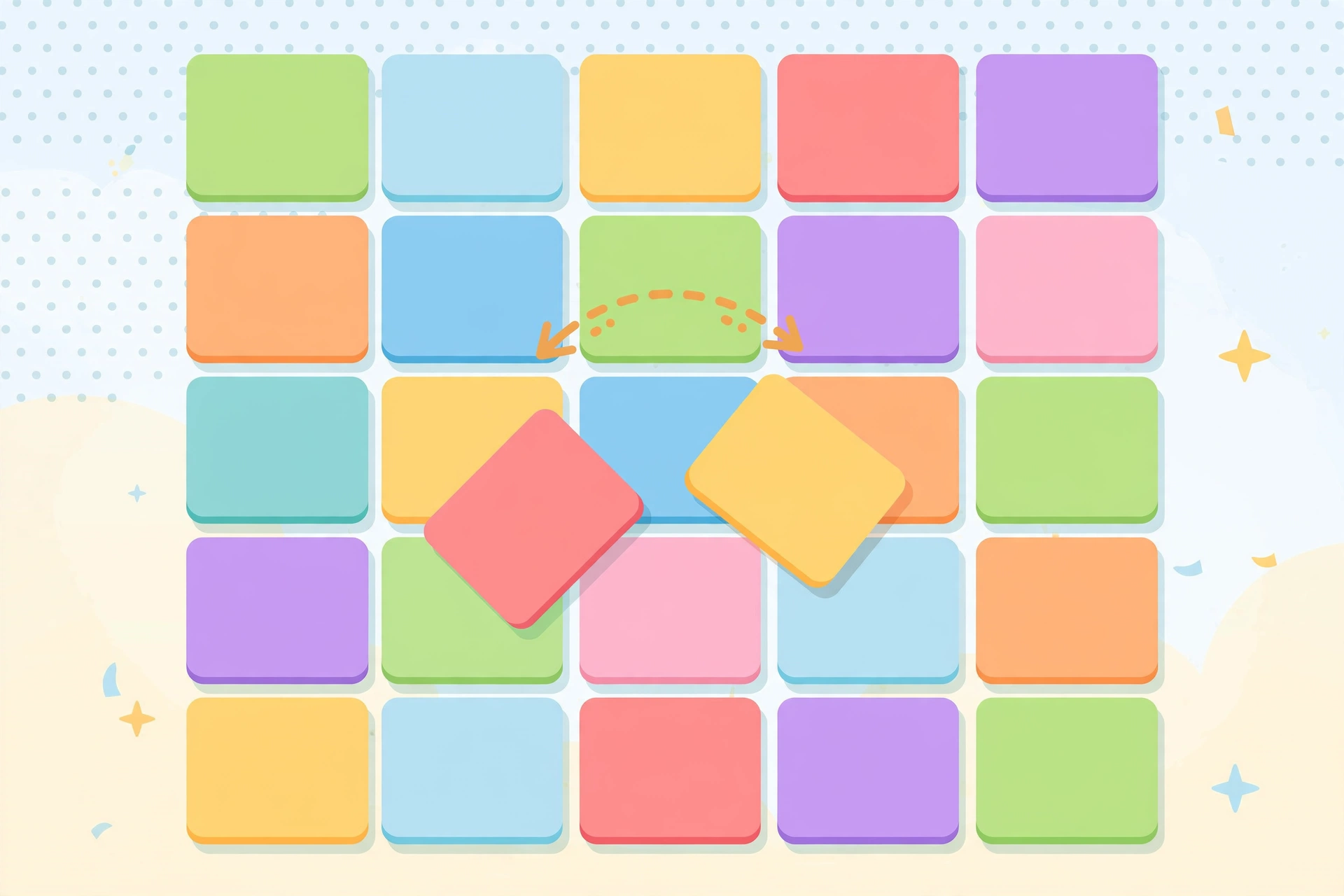
GramJam is a daily word puzzle game that blends match-three swapping mechanics with Scrabble-style word making. Instead of guessing a hidden word like in Wordle, you swap adjacent letter tiles on a grid to form words along rows and columns, clearing the board before you run out of swaps. It is free to play in the browser at gramjam.app.
What Is GramJam?
GramJam (stylised Gram Jam) is a browser-based word puzzle game built with SvelteKit. It has been featured in the Svelte community showcase, where it is described as a word puzzle game inspired by match-three games and Scrabble, and it appears in community-curated lists of Wordle-like games as a "5×5 swap Wordle". Its developer introduced it on Hacker News as "a daily word puzzle with a twist," noting two years of development aimed at making a more challenging word game while learning interactive web design — there are now two modes: Classic, an endless arcade-style high-score mode, and Daily, where a fixed number of swaps must clear 36 tiles.
The core idea sets it apart from the Wordle clones that flooded the internet in 2022. There is no hidden word to guess and no green-and-yellow letter feedback. Instead, you are given a grid of letter tiles and a limited number of swaps. Your job is to rearrange the tiles by swapping adjacent pairs so that the rows and columns spell valid words. Every word you complete clears those tiles, and the goal is to clear the board within your swap budget.
Because a fresh puzzle is published every day, GramJam works as a daily ritual in the same way Wordle does, and an archive of past puzzles lets you catch up on any days you missed.
The Three Game Modes
GramJam offers three distinct modes, each with its own board size and swap limit:
- Mini. The gentlest introduction. Make words along rows and columns and clear the board in 18 swaps. Ideal for learning the swapping mechanic or for a quick daily session.
- Daily. The main event. A larger 6×6 board that must be cleared in 20 swaps. This is the puzzle everyone plays each day, and the one your streak is built on.
- Classic. The score-chaser's mode. Make words of 4 or more letters to score points, but be careful not to run out of swaps. Here the goal is maximising your score rather than simply clearing the board.
The site also includes a leaderboard, so competitive players can compare their Classic scores and Daily performances against others, plus an archive where you can replay previous days' puzzles. GramJam belongs to the growing family of daily puzzle games that reward a few focused minutes each morning.
How to Play GramJam
The rules are straightforward once you understand the swap mechanic:
- Look at the letter grid. You start with a board full of letter tiles (5×5 in Mini, 6×6 in Daily).
- Swap adjacent tiles. Click or tap two neighbouring tiles to swap their positions. Each swap costs one from your swap budget.
- Form words along rows and columns. When a complete row or column spells a valid English word, those tiles clear from the board.
- Clear the board before swaps run out. In Mini you have 18 swaps and in Daily you have 20. If the board is not clear when the budget is spent, the puzzle is failed.
- Score in Classic. In Classic mode, every word of 4+ letters scores points, so longer words and clever tile reuse push your total higher.
The key skill is planning: unlike match-three games where matches happen by accident, every swap in GramJam should be working toward a specific word.
GramJam vs Wordle: Key Differences
| Feature | GramJam | Wordle |
|---|---|---|
| Core mechanic | Swap tiles to form words | Guess a hidden 5-letter word |
| Feedback | Words clear when completed | Green/yellow/grey letter hints |
| Win condition | Clear the board within swap limit | Guess the word in 6 tries |
| Modes | Mini, Daily, Classic + archive | One daily puzzle (+ variants) |
| Skills tested | Anagramming, spatial planning | Vocabulary, deduction |
| Time per puzzle | A few minutes | A few minutes |
Players who enjoy the tactile rearrangement of Scrabble tiles or the planning of match-three puzzlers tend to take to GramJam quickly, while pure Wordle fans may need a puzzle or two to adjust to the absence of letter feedback.
Strategies and Tips
- Scan for near-words first. Before swapping anything, look at each row and column and spot which ones are one swap away from a real word. Those are your cheapest clears.
- Prioritise long words in Classic. Since Classic scores words of 4+ letters, a single 6-letter word is worth far more than two 3-letter words. Plan swaps around the longest word you can see.
- Save swaps by chaining. Clearing a row can drop new letters into a column and complete a second word for free. Look for these cascade opportunities before spending swaps.
- Don't spend swaps on dead rows. If a row's letters can't plausibly form a word, leave it alone and focus your budget where words are achievable.
- Use the archive to practise. Replaying old Daily puzzles is the fastest way to build pattern recognition for common tile arrangements.
- Think in anagrams. The core skill in GramJam is anagramming under constraint. Practising with anagram puzzles off-board genuinely transfers to better scores — our word puzzle strategies guide has drills for exactly this.
Advanced GramJam Techniques
Once the basics click, these techniques separate efficient clearers from casual swappers.
- Plan swap chains, not single swaps. Look two or three swaps ahead: moving one tile often sets up the next. Random swapping wastes moves; chained swapping clears boards in far fewer.
- Clear corners and edges first. Tiles at the board's edges have fewer neighbours, so they are harder to fix later. Free them early while the centre is still flexible.
- Save long words for tight spots. In Classic mode, a well-placed long word can clear a congested area in one move. Resist spending your best words on easy sections.
- Use the archive as a training ground. Replaying past Daily puzzles lets you experiment with risky strategies you would not try on today's leaderboard run. Study which swap sequences worked and reuse the patterns.
What is GramJam?
GramJam is a free daily word puzzle game at gramjam.app where you swap adjacent letter tiles to form words along rows and columns, aiming to clear the board within a limited number of swaps.
How is GramJam different from Wordle?
Wordle asks you to guess one hidden word with letter-colour feedback. GramJam has no hidden word: you rearrange a full grid of tiles by swapping them, clearing words Scrabble-style until the board is empty.
What are the game modes in GramJam?
Three modes: Mini (clear the board in 18 swaps), Daily (a 6×6 board to clear in 20 swaps), and Classic (score points with 4+ letter words without running out of swaps). There is also a leaderboard and an archive of past puzzles.
Is GramJam free?
Yes, GramJam is completely free to play in your browser at [gramjam.app](https://gramjam.app), with no download or account required.
Who made GramJam?
GramJam is an independent browser game built with SvelteKit. It has been featured in the official Svelte community showcase as an example of what can be built with the framework.
Can I play old GramJam puzzles?
Yes. The site includes an archive where you can replay previous days’ Daily puzzles, which is also a great way to practise.
What does “5×5 swap Wordle” mean?
It is a community nickname for GramJam’s format: a 5×5 grid (in Mini mode) where progress comes from swapping tiles rather than guessing, placing it in the broader family of Wordle-inspired daily puzzle games.
Can I play GramJam on my phone?
Yes. GramJam is a browser game that works on mobile browsers, so you can swap tiles on your phone just as easily as on a desktop.
How do I climb the GramJam leaderboard?
Consistency beats brilliance: play the Daily every day, practise past puzzles in the archive, and focus on clearing boards in fewer swaps. Small efficiency gains compound over weeks.