
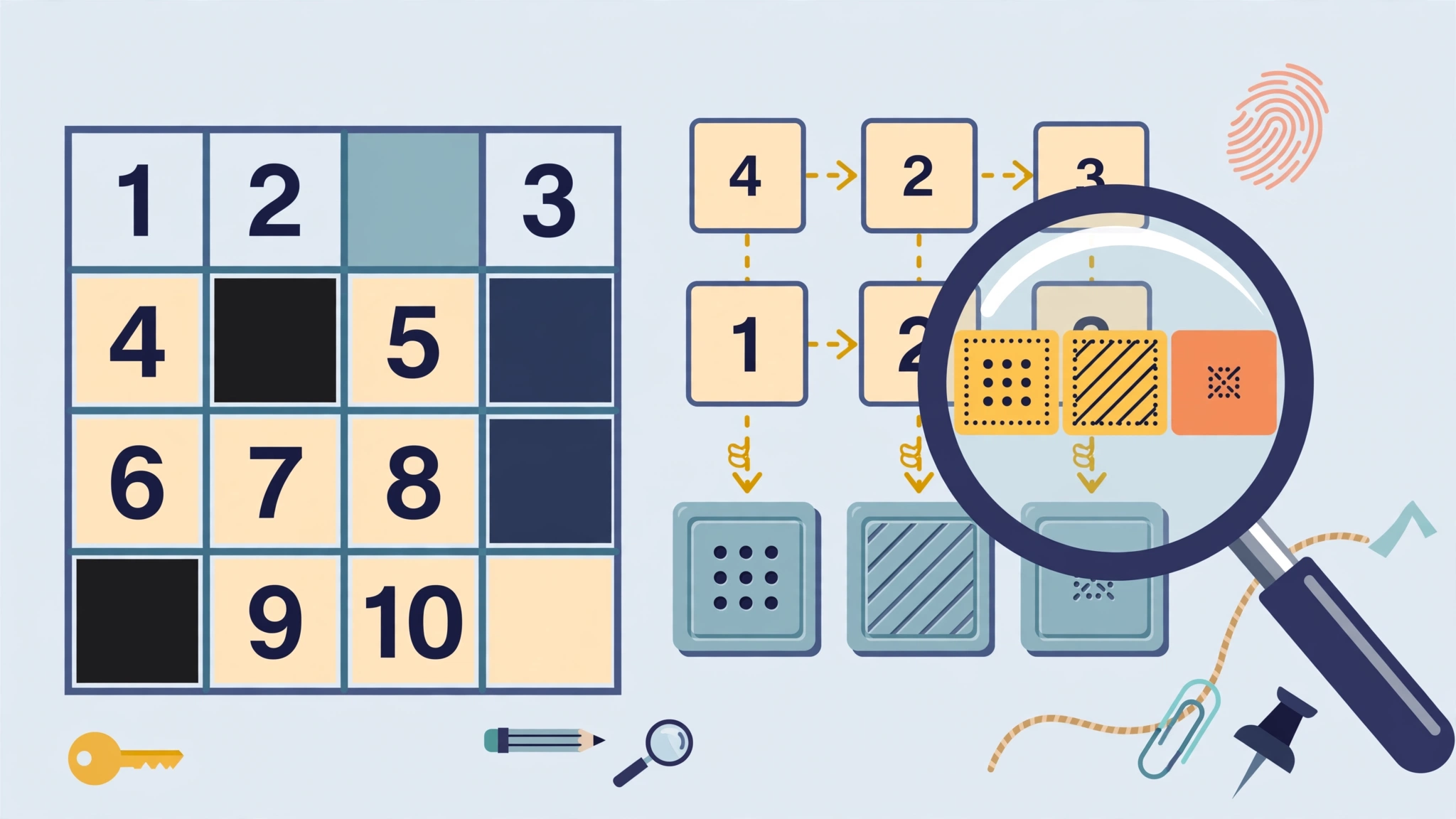
The code word game — usually called a codeword — is a cryptogram-style letter-substitution puzzle: a crossword-style word grid with a twist — there are no clues. Instead, every cell in the grid contains a number from 1 to 26, and each number stands for one letter of the alphabet. The same number always represents the same letter throughout the puzzle, and your job is to crack the code and fill the grid with real words.
Codeword Rules in 60 Seconds
A codeword (also known as a coded crossword or code cracker) is a grid-based word puzzle similar to a crossword, but instead of clues, each cell is marked with a number. Each number corresponds to exactly one letter of the alphabet, consistently throughout the puzzle — if 12 is 'A' in one cell, every 12 in the grid is 'A'. All 26 letters of the alphabet are used (source: https://amuselabs.com/docs/puzzles/codeword/overview/).
Here is how a typical game plays out, following the format of Arkadium's popular Codeword:
- Start with the given letters. The game pre-fills a few squares with letters to get you going. Each revealed letter also fills every other square sharing its number.
- Pick a square, enter a letter. Click any empty cell and type the letter you believe belongs there. That letter then appears in all cells with the same number.
- Work the patterns. Use word shapes, common letter combinations, and the crossing words to deduce which number is which letter.
- Complete the grid. When every square is filled with the correct letters, you win — and can share your daily score (source: http://wordfinder.yourdictionary.com/blog/play-codeword-a-puzzle-game-built-like-a-word-search/).
The fewer letters revealed at the start, the harder the puzzle. A daily puzzle with generous starter letters is a gentle warm-up; a bare grid is a serious logic workout (source: https://amuselabs.com/docs/puzzles/codeword/overview/).
Codeword vs Crossword: What's Different?
| Feature | Crossword | Codeword |
|---|---|---|
| Clues | Written clues for every entry | None — numbers only |
| Grid cells | Blank squares | Numbered squares (1–26) |
| Core skill | Vocabulary + general knowledge | Logic + pattern recognition |
| Letters | Placed per word | Placed per number (fills all matching cells) |
| Difficulty control | Cryptic vs quick clues | Number of starter letters given |
Codeword fans often describe it as the "logic puzzler's crossword" — you need vocabulary to recognize word shapes, but deduction does the heavy lifting.
How to Solve a Codeword: Strategy Guide
Start with the given letters
The pre-filled letters are your anchor points. Note every number they occupy — those numbers are solved across the entire grid at once.
Attack the short words
Two- and three-letter words have limited possibilities. A 2-cell word ending in a known letter is often "of," "to," "in," "on," or "at" — each guess that lands solves its numbers everywhere.
Look for common patterns
Double letters in the middle of a word are usually E, L, S, or O. A three-letter word ending in the same number twice (…EE) is likely "see," "bee," "fee," or "lee." Word endings like -ING, -TION, and -NESS have distinctive number patterns once you spot part of them.
Use the crossing words
Like a crossword, every letter you place is confirmed (or contradicted) by the word crossing it. Fill a confident letter and check what it does to the crossing entries — contradictions mean backtracking.
Keep a code key
Penny Dell Puzzles' classic advice still holds: write each cracked letter into a code key chart (1=A, 2=B, …) and cross letters off the alphabet as you assign them, so you always know which letters remain (source: https://www.pennydellpuzzles.com/wp-content/uploads/2019/01/cdw-sample-page.pdf).
Use hints sparingly
Digital versions like Arkadium's Codeword offer a hint (eye icon) that reveals a letter in the selected cell. Save it for genuine dead ends — cracking a stubborn number yourself is far more satisfying (source: https://kagadu.com/game/arkadium-codeword).
- Daily habit: Arkadium's Codeword releases a new puzzle every day, with a calendar to revisit past puzzles and monthly score totals (source: https://kagadu.com/game/arkadium-codeword).
- Print versions: Penny Press and similar publishers include codewords in puzzle magazines — the same solving logic applies on paper.
- Mistakes are cheap: Most digital versions have an undo button, so aggressive guessing is a valid strategy.
Where to Play Codeword Online
Codeword is an Arkadium game, and the company licenses it widely. Quality places to play the official version include Arkadium.com itself, BestForPuzzles.com, and the Washington Post's games section (source: http://wordfinder.yourdictionary.com/blog/play-codeword-a-puzzle-game-built-like-a-word-search/). Free variants also appear on puzzle aggregator sites, and printable codeword PDFs are popular for classrooms and puzzle clubs (source: https://assets.printablesworld.com/premade/codeword-puzzle-generator/codeword-puzzle-generator-sample-2.pdf).
Why Puzzle Fans Love the Code Word Game
Codeword scratches a different itch from standard word games. There's no trivia knowledge required and no time pressure — just pure deductive reasoning. Every cracked number delivers a small dopamine hit as letters cascade across the grid, and the "aha" moment when a stubborn section finally resolves is genuinely thrilling. It's also quietly educational: regular solvers get noticeably better at recognizing English letter patterns and word structures. If you enjoy logic-heavy word puzzles, you might also enjoy our guides to hard Sudoku strategies and the Wordle vs Plusword comparison.
Codeword in British Newspapers: A Quiet Tradition
Codeword has been a fixture of British puzzle pages for decades, and understanding the tradition explains the game's design.
- A daily staple. UK papers have run codewords alongside crosswords for generations. The format suits newsprint perfectly: no special symbols needed, just numbers 1 to 26.
- The gentle difficulty curve. Newspaper codewords are designed to be finished with a cup of tea — a few starter letters, familiar vocabulary, and no obscure words. That is why the format feels friendlier than it looks.
- Why it never went away. Unlike crosswords, codewords need no cultural knowledge — only pattern recognition. That universality kept them in print while other puzzles faded.
- From paper to screen. The online versions preserve the newspaper feel deliberately: the same numbered grid, the same code key, the same satisfaction of cracking the last few numbers.
What is the code word game?
The code word game (codeword) is a crossword-style puzzle with no written clues. Each grid cell contains a number from 1 to 26, and each number represents one letter of the alphabet. You deduce the letter for each number to reveal all the hidden words.
How do you play codeword?
Start from the pre-filled starter letters, then assign letters to numbers so that every row and column forms valid words. Each number always equals the same letter throughout the puzzle.
Is codeword the same as a coded crossword?
Yes. Codeword, coded crossword, and code cracker are different names for the same puzzle format: a clue-less crossword where numbers stand for letters.
What do the numbers mean in a codeword puzzle?
Each number from 1 to 26 stands for one letter of the alphabet. All 26 letters are used, and the mapping is consistent — every cell with the same number holds the same letter.
How many letters are given at the start of a codeword?
It varies. Easier puzzles reveal several starter letters; harder ones give very few. The fewer the given letters, the more challenging the deduction.
Is there a daily codeword puzzle?
Yes. Arkadium’s Codeword releases a new puzzle every day, with a calendar feature letting you go back and solve past puzzles.
Where can I play codeword for free?
Arkadium.com hosts the original, and licensed versions appear on sites like BestForPuzzles.com and the Washington Post games section. Free printable codeword PDFs are also widely available.
What is the best strategy for solving codewords?
Start with the given letters, attack short words first, watch for common patterns like double letters and -ING endings, use crossing words to verify guesses, and keep a written code key of cracked numbers.
Can I play codeword on my phone?
Yes. Arkadium’s daily codeword and most licensed versions run in mobile browsers, and the numbered grid works well on touchscreens.
Is codeword good for beginners?
Very. The given starter letters and the consistent number-to-letter mapping mean you always have a foothold, unlike crosswords where a blank grid can feel impenetrable.