
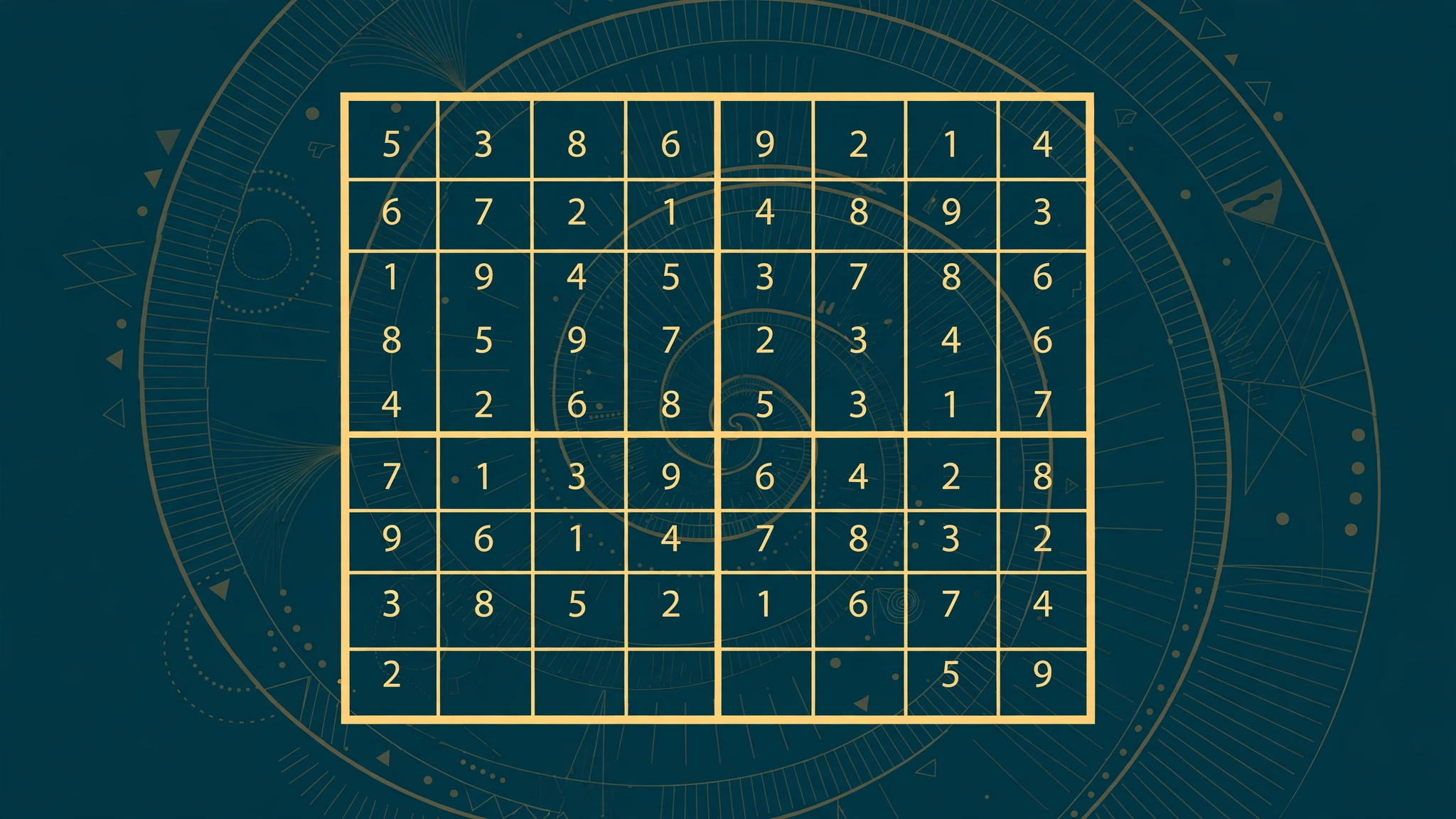
The most famous candidate for the hardest sudoku ever created is AI Escargot, designed in 2006 by Finnish applied mathematician Arto Inkala. With just 23 given clues arranged in a pattern that reminded its creator of a snail, it was built to defeat every simple solving technique and force solvers into long chains of advanced logic. It has exactly one solution, requires no guessing — and has humbled expert solvers worldwide.
AI Escargot: The Everest of Sudoku
In late November 2006, the 37-year-old Inkala announced that he had created "the most difficult sudoku puzzle known so far." The name is a small joke with a pedigree: "AI" are his own initials, and "Escargot" — French for snail — describes both the puzzle's spiral-like clue pattern and the pace at which anyone solves it. "Solving it is like an intellectual culinary pleasure," Inkala said (SudokuWiki.org).
The creation story is part of the legend. According to contemporary reports, Inkala spent three months developing the puzzle, testing it against more than a billion number combinations to guarantee two things: that it had exactly one solution, and that it resisted every straightforward solving method (markswist.com; sudoku4adults.com).
Why AI Escargot Is So Hard
Difficulty in sudoku is not about the number of clues — hard puzzles can have more givens than easy ones. What makes a puzzle hard is the depth of logic required. Inkala himself said Escargot "demands those tackling it to consider eight casual relationships simultaneously, while the most complicated variants attempted by the public require people to think of only one or two combinations at any one time."
Concretely, cracking Escargot requires chain-based advanced techniques:
- Forcing chains — following long if-then sequences across the grid
- Nishio — testing a candidate and tracing the contradiction
- Colouring — tracking conjugate pairs through the grid
- XY-Wings — three-cell pincers that eliminate candidates
- Unique rectangles — exploiting the single-solution guarantee
The puzzle can be solved with pure logic — no guessing is ever required — but the chains of deduction are extraordinarily long. When The Guardian printed the puzzle, one reader reportedly solved it in two hours while baking bread; most solvers need far longer, and many give up (sudoku4adults.com).
Inkala's Even Harder Puzzles
AI Escargot was only the beginning. Inkala later published puzzles he rated as harder still, including a 2010/2012 puzzle often called the "World's Hardest Sudoku." Each new creation pushed the required logic deeper, though none captured the public imagination quite like Escargot, which remains the benchmark every "hardest puzzle" claim is measured against (sudokly.com).
The Hardest Sudoku Puzzles Ever Published
| Puzzle | Creator | Year | Clues | Claim to fame |
|---|---|---|---|---|
| AI Escargot | Arto Inkala | 2006 | 23 | Most famous hardest sudoku; billion-combination design process |
| "World's Hardest Sudoku" | Arto Inkala | 2010/2012 | 21–22 | Inkala's own harder successor |
| Platinum Blonde | Arto Inkala | 2007 | 21 | Another Inkala extreme, rated among the toughest |
| Golden Nugget | — | — | — | Community-rated extreme frequently cited in solver forums |
Note: "hardest" is partly subjective — different rating systems (such as the forum rating system on sudoku.com cited in early coverage) rank puzzles differently. But AI Escargot is the one puzzle that appears on virtually every list.
The culture around the hardest sudoku puzzles mirrors the culture of the hardest chess problems or the hardest crosswords: a small community of specialists, a shared vocabulary of rating systems and solving techniques, and an ongoing arms race between puzzle designers and the solvers who crack their creations. For most players, AI Escargot is a legend to admire rather than a puzzle to solve — but knowing what the ceiling looks like puts every hard-rated daily puzzle in perspective. If a 23-clue extreme can take an expert hours, the "Hard" in your morning paper is exactly where your training belongs.
What Makes Any Sudoku Hard?
Understanding difficulty helps you appreciate what the extreme puzzles do:
- Clue count is not difficulty. A 23-clue puzzle can be easy and a 30-clue puzzle brutally hard. Placement matters more than quantity.
- Technique depth. Easy puzzles fall to naked singles and hidden singles. Hard ones demand X-Wings, Swordfish, colouring, and forcing chains.
- Chain length. The hardest puzzles require following logical consequences five, ten, or more steps deep before a single digit can be placed.
- Branching. Extreme puzzles present positions where several candidates look equally plausible and only deep analysis separates them.
Should You Attempt the Hardest Sudoku?
Honestly? Build up to it. Solvers who jump straight to Escargot typically stare at the grid for an hour without placing a digit. A better path:
- Master singles, pairs, and box-line reduction on hard-rated puzzles.
- Learn X-Wing, Swordfish, and XY-Wing on "extreme" puzzles from sudoku apps.
- Study forcing chains and colouring with worked examples.
- Then — and only then — print out AI Escargot and clear your weekend.
The reward is real: solving one of the hardest sudokus ever created is a genuine badge of honour in the puzzle community.
Want a daily puzzle that is tough but fair? Read what Plusword is and learn how to play Plusword.
Sources
- SudokuWiki.org — "Escargot": Inkala's 2006 announcement and quotes (https://www.sudokuwiki.org/Escargot)
- sudokly.com — "The World's Hardest Sudoku": FAQ on Escargot's difficulty and solvability (https://sudokly.com/hardest-sudoku/)
- sudoku4adults.com — "AI Escargot": creation story, Guardian coverage (https://www.sudoku4adults.com/worlds-hardest-sudoku-puzzle-ai-escargot/)
How to Train for Extreme Sudoku
Nobody jumps from newspaper easies to AI Escargot. Here is the training path that actually works.
- Master the hard level first. If standard hard puzzles still take you over an hour, you are not ready. Extreme puzzles assume every basic and intermediate technique is automatic.
- Learn one advanced technique at a time. Pick X-Wing, practise it on dedicated puzzles until it feels natural, then add Swordfish, then colouring. Stacking techniques before any is solid leads to confusion.
- Study solved examples. Published walkthroughs of extreme puzzles show how experts chain techniques together. Reading them teaches the decision-making, not just the mechanics.
- Accept slow progress. An extreme puzzle can take many hours across multiple sittings. Treat it as a project, not a race — the satisfaction is in the depth, not the speed.
What is the hardest sudoku ever made?
AI Escargot, created by Finnish mathematician Arto Inkala in 2006, is the most famous hardest sudoku. It has 23 clues, one solution, and requires extremely long chains of advanced logic. Inkala later made puzzles he rated harder, but Escargot remains the benchmark.
Who created the hardest sudoku?
Arto Inkala, a Finnish applied mathematician. He spent three months and tested over a billion combinations to produce AI Escargot, declaring it “the most difficult sudoku puzzle known so far.”
Can AI Escargot be solved without guessing?
Yes. It has exactly one solution reachable by pure logic — but the logic required includes forcing chains, colouring, XY-wings, and other advanced techniques followed over very long deductions.
How many clues does the hardest sudoku have?
AI Escargot has 23 given clues. But clue count does not determine difficulty — what matters is the depth of logic the clue placement forces.
Why is it called Escargot?
“AI” are Arto Inkala’s initials, and “Escargot” (French for snail) refers to the puzzle’s snail-like clue pattern — and, jokingly, to the speed at which it gets solved.
Has anyone solved the world’s hardest sudoku?
Yes, many expert solvers have. When The Guardian published it, one reader reported solving it in about two hours — though most solvers take far longer, and computers solve it in milliseconds.
What techniques do you need for the hardest sudoku?
Forcing chains, Nishio, colouring, XY-wings, Swordfish, and unique-rectangle logic — far beyond the singles and pairs that solve ordinary hard puzzles.
Is there a harder sudoku than AI Escargot?
Arto Inkala himself published harder puzzles after 2006, including ones from 2010–2012. Whether they are “harder” depends on the rating system, but Escargot remains the most famous.
Can a computer solve AI Escargot?
Yes — in milliseconds. Computers brute-force the search space trivially; the puzzle is only hard for humans because our brains cannot hold that many candidate chains at once.
Where can I find AI Escargot to try?
The puzzle is widely published online — The Guardian printed it in 2006, and the grid is easy to find with a web search. Attempt it only when standard hard puzzles feel comfortable.