
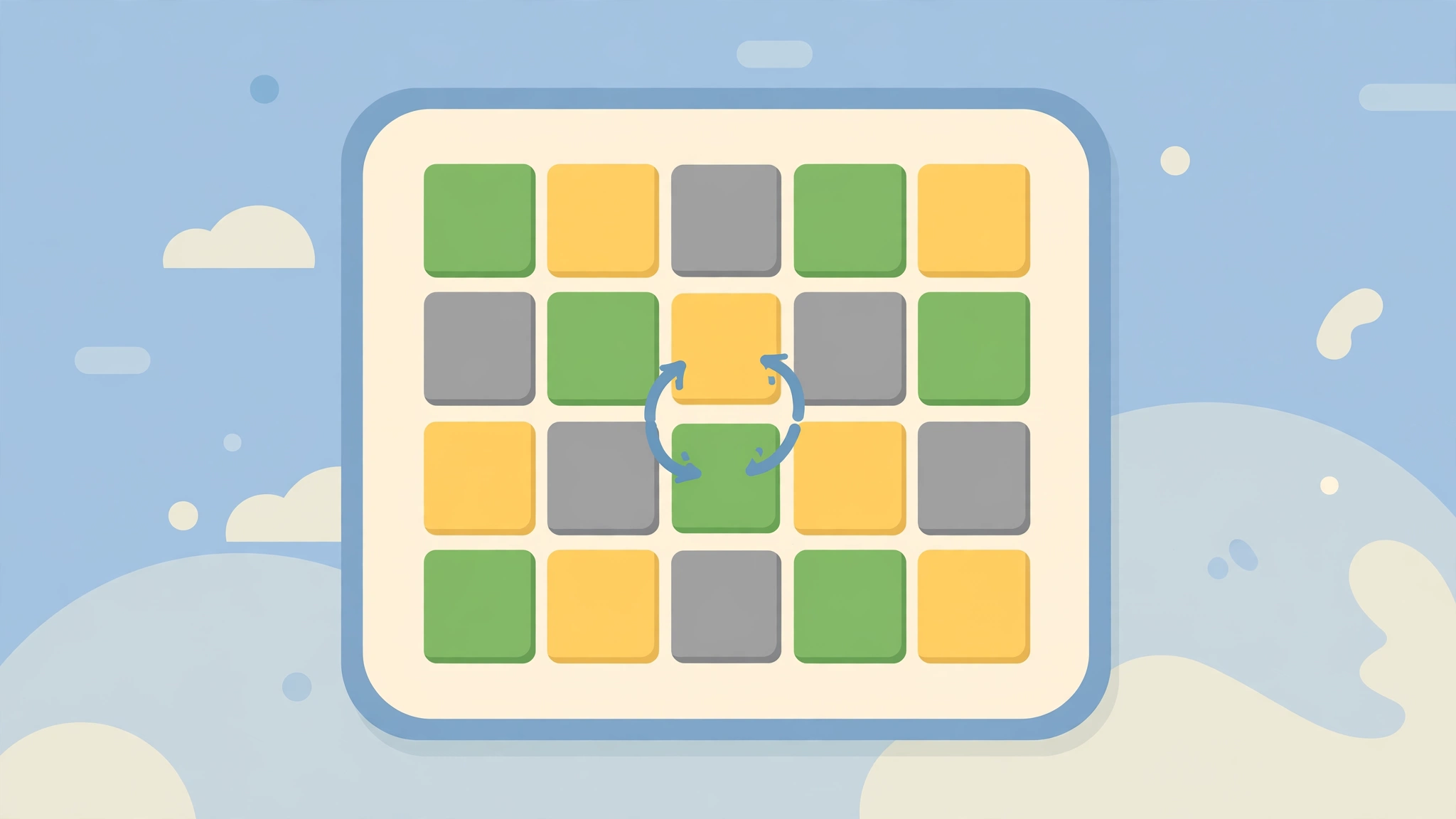
Word Box is a mobile tile-swapping word puzzle by developer tiny bird: swap letter tiles to complete rows of words and clear the board, across more than 4,000 levels and 28,000+ words of calm, self-paced puzzling, with changeable themes and ambient piano music. If you are hunting for a calm, vocabulary-stretching puzzle game to play in short bursts, it is worth a look. The game describes itself as "a gentle journey towards your vocabulary limits": swap the letter tiles, complete the rows of words, and clear the board. With more than 28,000 words and over 4,000 levels, it is a deep, relaxing alternative to the daily-puzzle crowd — no timers, no streaks to break, just you and the tiles.
What Is the Word Box Game?
Word Box is a mobile word puzzle built around a simple mechanic: a box of letter tiles arranged in rows, each row forming part of a word. You swap tiles to complete every row of words and clear the level. As the levels progress, the grids grow trickier — more rows, longer words, and fewer obvious placements — pushing you to really think about vocabulary and word structure rather than just spotting familiar patterns.
Key features listed by the developer include:
- 28,000+ words in the dictionary — a genuinely large word list that keeps the game fresh for a long time.
- 4,000+ levels — enough content for months of casual play.
- Changeable themes — customize the look of the game to your taste.
- Background music — ambient piano that supports the game's peaceful tone.
- Non-intrusive advertising — ads are present (it is a free game) but designed not to interrupt play.
Unlike Wordle-style games, Word Box is not a daily puzzle: it is a level-based game you can play through at your own pace, which makes it ideal for unwinding on a commute or before bed. (Source: uptoplay.net/word-box listing, developer tiny bird)
How to Play Word Box
The Core Mechanic
Each level presents a box filled with letter tiles. Your job: swap any two tiles to rearrange the letters so that every row forms a valid English word. When all rows are complete words, the level clears and you move on.
Step-by-Step
- Look at the whole grid first. Before swapping, scan every row. Some rows will be one swap away from a real word — these are your easy wins.
- Fix the obvious rows first. If a row reads "CATP", swapping one tile gives "PACT" or "CAPT"… actually, look for the arrangement that works — completing easy rows first reveals which letters the hard rows must keep.
- Think about word endings. English words love endings like -ING, -ED, -ER, -LY, -TION. Spotting a Jumbled "GIN" at the end of a row is a strong hint.
- Watch for consonant clusters. TH, CH, SH, ST, PR, and CR are among the most common starting pairs. If a row begins with T and H is nearby, that row probably starts with "TH".
- Use process of elimination. If a letter doesn't fit anywhere else, its row becomes easier to solve — every swap narrows the possibilities.
- Replay levels to improve. Later levels reuse vocabulary, so the words you learn early become tools for the harder grids ahead.
Word Box vs Other Word Games
| Feature | Word Box | Wordle | Letter Boxed |
|---|---|---|---|
| Play style | Level-based tile swapping | Daily 5-letter guessing | Daily letter-connection |
| Pace | Self-paced, 4,000+ levels | One puzzle per day | One puzzle per day |
| Timers | None | None | None |
| Vocabulary focus | High (28,000+ words) | Medium (5-letter words) | High (3+ letter words) |
| Best for | Relaxing long sessions | Quick daily habit | Brain-teasing challenge |
Word Box's closest cousins are games like Wordscapes and Word Cookies — level-based word games with a calm atmosphere. Where it differs is the swap-tiles mechanic: instead of building words from a letter wheel, you are rearranging a fixed set of jumbled letters, which rewards anagram thinking, word-finding skills and pattern recognition rather than fast reflexes. It is a vocabulary puzzle first and a dexterity game never — closer to solving anagrams on paper than to the twitchy time-trial word games crowding app stores.
7 Tips to Get Better at Word Box
- Start with short words. Two and three-letter rows solve fastest and lock tiles in place, shrinking the puzzle.
- Group vowels and consonants. Most rows alternate them. If a row is all consonants, it almost certainly needs a swap.
- Memorize common prefixes and suffixes. RE-, UN-, PRE-, DIS- at the start; -ING, -ED, -ES, -ER at the end. These solve rows by themselves.
- Say the letters aloud. Hearing letter combinations activates a different part of your brain — a jumble like "L-E-F-A-L" suddenly becomes "LEAF-L"… or rather, reveals itself as two words.
- Don't fixate on one row. Swap attention between rows; solving one row often hands you the answer to another.
- Learn from repeats. The game's word list repeats vocabulary across levels, so every solved level teaches words you'll use again.
- Change the theme when you're stuck. It sounds odd, but a visual refresh genuinely breaks mental ruts — the developer included theme options for a reason.
Where to Play Word Box
Word Box is a mobile game by tiny bird, available on Android. It can also be played online through game platforms that host the Android app, such as UptoPlay, which streams mobile apps in a browser. The game is free with non-intrusive ads. (Source: uptoplay.net listing)
A word of caution for any mobile game download: always get Word Box from a reputable store or platform and check the developer name (tiny bird) before installing, since popular puzzle games attract copycat listings.
Is Word Box Free?
Yes — Word Box is free to play, supported by advertising that the developer describes as non-intrusive. There is no indication of a forced subscription or pay-to-win structure; the core loop (swap tiles, complete rows, clear levels) is fully available in the free, ad-supported version.
This makes it a true freemium casual word game: you can work through all 4,000+ levels without paying, with the developer monetising through gentle advertising rather than locked content or energy timers. For comparison, many level-based word games gate progress behind boosters or lives — Word Box's model is closer to the relaxed, self-paced puzzling it promises. If you download from Google Play, double-check the developer name (tiny bird) first, since successful casual puzzle games routinely attract copycat listings with identical names.
Why Word Box Appeals to Word Puzzle Fans
Word Box sits in a sweet spot that many puzzle games miss: it is genuinely relaxing without being trivial. The swap mechanic creates a satisfying tactile rhythm — nudge tiles, watch words snap into place — and the huge level count means the game can become a long-term companion rather than a two-week novelty. If you enjoy the word-finding side of Plusword's puzzle ethos but want something level-based to play between daily puzzles, Word Box fits the bill.
What is the Word Box game?
Word Box (full name: Word Box – Seven Words Puzzle) is a mobile word puzzle by tiny bird. You swap letter tiles to complete rows of words and clear levels, with 4,000+ levels and 28,000+ words.
Who developed Word Box?
Word Box was developed by tiny bird, and is listed as a word game with features including themes, background music, and non-intrusive advertising. (Source: uptoplay.net listing)
Is Word Box free to play?
Yes. Word Box is free, supported by non-intrusive advertising.
How many levels does Word Box have?
The developer lists over 4,000 levels and more than 28,000 words, making it one of the deeper casual word games available.
How do you play Word Box?
Swap letter tiles so that every row in the box forms a valid word. When all rows are complete words, the level clears.
Where can I play Word Box online?
Word Box is an Android game that can also be played online via platforms like UptoPlay (uptoplay.net) that host mobile games in the browser.
Is Word Box related to Wordle?
No. Word Box is an independent tile-swapping puzzle game by tiny bird and has no connection to Wordle or the New York Times.
What are good Word Box strategies?
Solve short rows first, watch for common prefixes and suffixes (-ING, -ED, RE-, UN-), group vowels and consonants, and use process of elimination as rows lock into place. **Sources:** uptoplay.net Word Box listing (developer tiny bird; 28,000+ words; 4,000+ levels; swap tiles and complete the rows of words; non-intrusive advertising).