
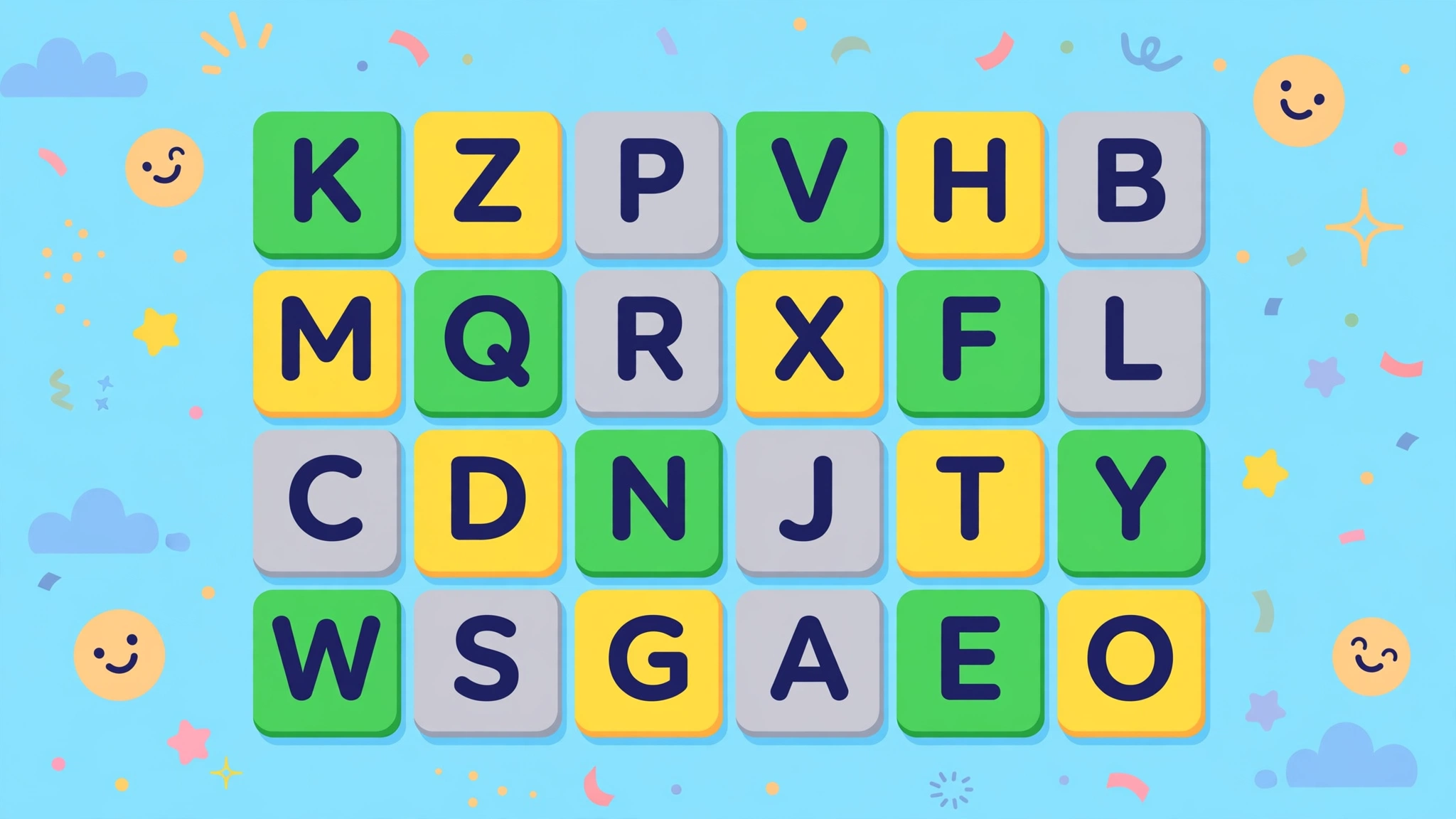
Spellie is a free daily word puzzle game designed specifically for young spellers, working like Wordle but with three difficulty levels built around Grade 2 to Grade 5 vocabulary. Created by a parent for his own children, it gives kids six guesses per word, kid-friendly colors and fonts, hints on easier modes, and collectible emoji rewards — making it one of the most popular educational Wordle variants for classrooms and families [1][2].
The Story Behind Spellie
Spellie was created by Christopher Porter and his friend David Hirtle, who wanted a version of Wordle their own children could actually enjoy and learn from [1]. The original Wordle's adult vocabulary frustrated young players, so the pair built a game around age-appropriate word lists — and it worked. Spellie was named to the ALSC Notable Children's Digital Media list for 2023, a recognition from the Association for Library Service to Children [2].
Unlike most Wordle clones that simply reskin the same adult game, Spellie was rebuilt from the ground up for learners. The keyboard can be alphabetical instead of QWERTY, the font is the highly readable Andika typeface designed for beginning readers, and letters can even be entered in any order — a forgiving touch that keeps young players from getting stuck [1].
How Spellie Works: The Three Difficulty Levels
Every day, Spellie serves up three puzzles — one at each difficulty level — so kids can progress as their skills grow [3].
| Level | Vocabulary | Best For |
|---|---|---|
| Easy | Grade 2 words, short | Ages 5-7, beginning readers |
| Medium | Grades 3-4 words | Ages 8-9, building spellers |
| Hard | Grade 5 words | Ages 10-11, confident readers |
Each puzzle gives players six attempts to guess the day's word, with the classic green/yellow/grey tile feedback after every guess [4]. A new set of puzzles appears at midnight local time each day, keeping the daily-habit loop that made Wordle famous [5].
What Makes Spellie Kid-Friendly
Several design choices set Spellie apart from standard Wordle:
- Hints on easy mode: Younger players can get help when stuck, rather than hitting a wall [1].
- Brighter, cheerful colors: The palette is warmer and more playful than Wordle's stark design [1].
- Alphabetical keyboard option: Kids who haven't learned QWERTY can still play comfortably [2].
- No dictionary restrictions: Guesses don't have to be "valid" words, so experimentation is encouraged [1].
- Emoji rewards: Players unlock collectible emojis — over 400 of them — as rewards for solving words, turning practice into a collection game [1].
Spellie vs Wordle: Key Differences
| Feature | Spellie | Classic Wordle |
|---|---|---|
| Target audience | Kids (grades 2-5) | Adults |
| Daily puzzles | 3 (one per level) | 1 |
| Vocabulary | Grade-leveled | Adult dictionary |
| Hints | Yes (easy mode) | No |
| Keyboard | QWERTY or alphabetical | QWERTY only |
| Font | Andika (reader-friendly) | Standard |
| Rewards | 400+ collectible emojis | None |
| Guess rules | Any letters, any order | Valid words only |
Spellie vs Other Kids' Wordle Games
Spellie isn't the only Wordle made for children, but it has a distinct identity. Where some kids' variants simply swap in easier words, Spellie's three-tier grade system and its official recognition (the ALSC notable list) give it an educational credibility few clones match [2]. If you're comparing options for a classroom or a young learner at home, Spellie's progressive difficulty — easy, medium, hard in one daily session — makes it easy to find the right challenge level without switching games.
For a broader look at how Wordle-style games compare to the original, see our Plusword vs Wordle breakdown, and if you're new to these puzzles entirely, our how to play Plusword guide covers the basics.
Tips for Playing Spellie With Kids
- Start on Easy regardless of age. The Grade 2 words build confidence fast, and confidence is the whole point.
- Use the hints. They're there to teach, not to cheat — especially for new readers.
- Try the alphabetical keyboard. It removes one barrier for kids who don't type on QWERTY.
- Talk through the colors. Ask "what do we know now?" after each guess to build deduction skills.
- Celebrate the emojis. The collection mechanic is a genuine motivator — let kids show off their unlocks.
- Move up a level when Easy feels trivial. The jump to Medium is the sweet spot for growth.
- Play together. Spellie works brilliantly as a shared daily ritual — parent and child guessing side by side.
Where to Play Spellie
The official game lives at spelliegame.com [2], and it's completely free with no sign-up required. Because it's a daily-mode-only game (three puzzles per day, no unlimited mode), it fits neatly into a morning routine — much like Wordle itself did for adults [3].
The Bottom Line
Spellie takes everything great about Wordle — the daily ritual, the satisfying tile feedback, the shareable wins — and rebuilds it for young spellers with grade-appropriate words, hints, and rewards. Created by parents, recognized by children's librarians, and genuinely fun, it's the rare educational game that kids ask to play. Whether you're a teacher looking for a classroom warm-up or a parent hunting for screen time that actually teaches, Spellie deserves a spot in the daily rotation.
Spellie Mistakes That Frustrate Young Spellers
Spellie is built for young spellers, which means the mistakes are different — and so are the fixes:
- Jumping to the hardest level. Spellie offers three difficulty levels for a reason. Kids who start on the toughest setting get discouraged fast; beginning on the easiest builds the confidence and letter-pattern sense that harder levels require.
- Ignoring the hints. Easier modes include hint features, and some parents treat them as cheating. They are not — they are scaffolding. Let kids use hints freely at first, then taper them as spelling confidence grows.
- Skipping the letter sounds. Young spellers solve faster when they sound words out loud. Encourage kids to say each guess's letters phonetically — it connects the tile feedback to actual spelling knowledge instead of pure guessing.
- Forgetting it is a spelling game, not a guessing game. The Grade 2 to Grade 5 vocabulary is deliberately learnable. When a child misses, turn it into a mini spelling lesson: write the word, use it in a sentence, and it sticks.
- Playing without a grown-up nearby. Spellie's sweet spot is co-play: a parent or teacher talking through the colour feedback turns each puzzle into a guided phonics exercise rather than a frustrating solo grind.
- Rushing past the emoji rewards. The collectible emoji rewards are motivation design, not decoration. Celebrate them — for young players, the reward loop is what brings them back tomorrow, and daily return is what builds spelling skill.
What is Spellie?
Spellie is a free daily spelling game for kids, modeled on Wordle but with three difficulty levels using Grade 2 to Grade 5 vocabulary [1].
Who created Spellie?
Christopher Porter created Spellie with his friend David Hirtle, inspired by wanting a Wordle their children could enjoy [1].
Is Spellie free to play?
Yes, Spellie is completely free to play at spelliegame.com with no account or sign-up required [2].
What ages is Spellie for?
Spellie targets roughly ages 5-11, with Easy mode for Grade 2 readers and Hard mode for Grade 5 students [3].
How many puzzles does Spellie have per day?
Three — one Easy, one Medium, and one Hard puzzle, refreshed at midnight local time [3][5].
Does Spellie give hints?
Yes, the easy mode offers hints to help younger players who get stuck [1].
What are the emoji rewards in Spellie?
Players unlock collectible emojis — over 400 available — as rewards for solving words and showing imagination [1].
Is Spellie good for classrooms?
Yes. Its grade-leveled vocabulary, hints, and kid-friendly design make it a popular classroom warm-up, and it earned a spot on the ALSC Notable Children’s Digital Media 2023 list [2]. **Sources:** [1] https://puzzlesbay.com/spellie-answer-today/ [2] https://alsc-awards-shelf.org/book/5295/spellie [3] https://wordlewebsite.com/spellie [4] https://strandspuzzle.com/spellie [5] https://food-le.com/spellie
What ages is Spellie for?
Spellie is designed around Grade 2 to Grade 5 vocabulary, roughly ages 7 to 11, with three difficulty levels so younger or older kids can find their comfort zone.
Who created Spellie?
Spellie was created by a parent for his own children — a origin story that shows in its kid-friendly colours, fonts, hints and emoji reward design.