
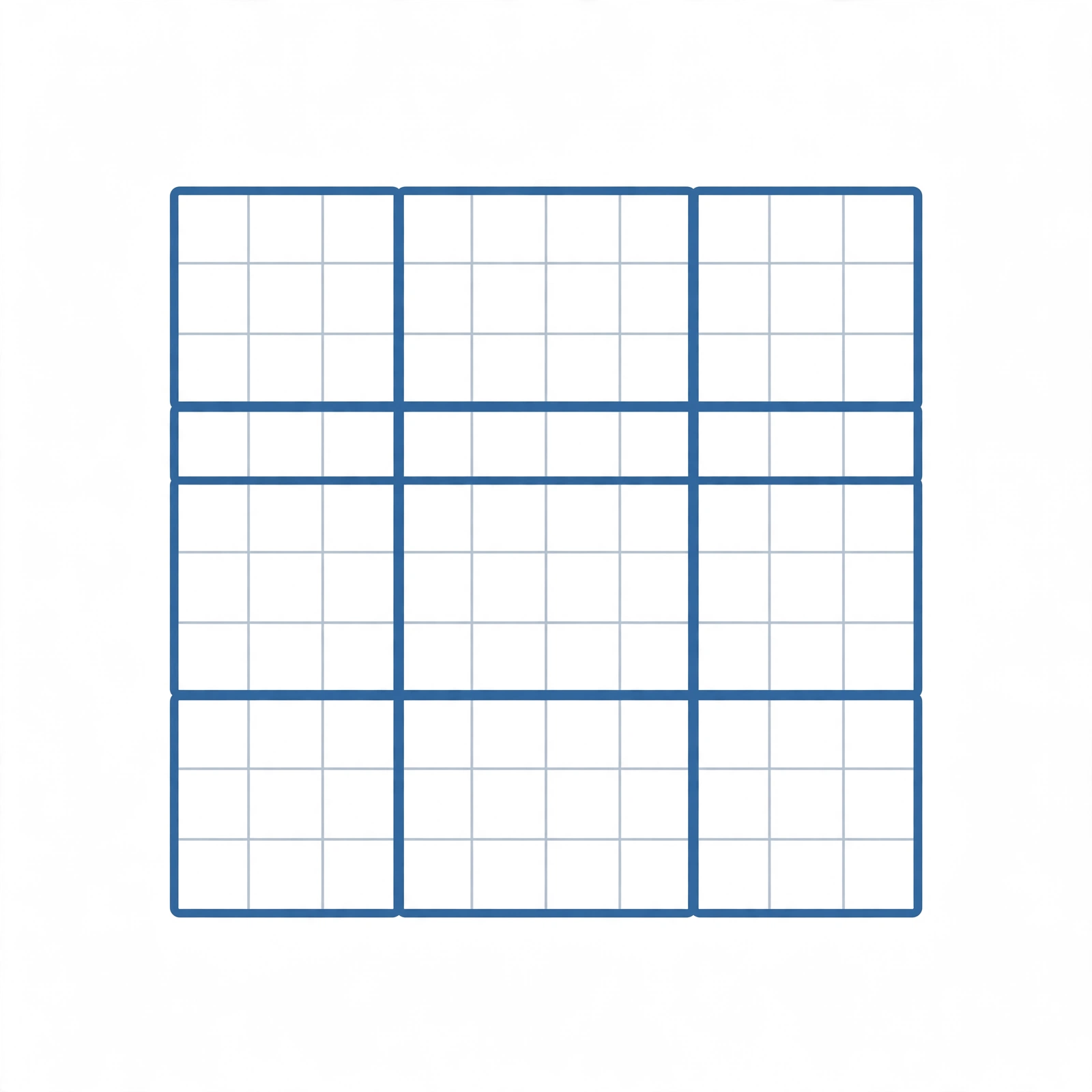
A blank sudoku grid is an empty 9×9 template with 81 unfilled cells — a printable puzzle canvas for the classic number puzzle, ready to be printed or filled in by hand. People use it to copy puzzles from newspapers and books, create their own sudoku puzzles, restart a puzzle that went wrong, or practise solving techniques on paper.** This guide explains what a blank grid is, how to use one properly, and where to get free printable templates.
What Is a Blank Sudoku Grid?
A blank sudoku grid is the standard sudoku layout with nothing filled in: nine rows, nine columns and nine outlined 3×3 boxes, making 81 empty cells in total. It follows the exact geometry of a normal puzzle — the heavier lines separating the nine boxes are what make a grid a sudoku grid rather than just a table.
Unlike a playable puzzle, a blank grid has no givens (the pre-filled numbers a puzzle starts with). It is a template: a clean working surface you customise. Blank grids are most commonly distributed as printable PDFs, often with one large grid per page or four smaller grids on a single sheet, and they are free for personal use from several puzzle sites.
Why Use a Blank Sudoku Grid?
There are several practical reasons solvers and teachers reach for an empty grid instead of a pre-filled puzzle.
- Copying puzzles from elsewhere. Newspapers, magazines and puzzle books cannot be written on twice, so solvers copy the givens into a blank grid to protect the original — a use case puzzle publishers themselves point to. Clarity Media, a puzzle supplier, publishes free blank grids specifically so solvers "always have a blank grid in place to copy your puzzles into".
- Creating your own puzzles. Teachers, bloggers and puzzle clubs design puzzles by hand: fill a grid with a complete valid solution, erase cells strategically, and a new puzzle is born.
- Start over after a mistake. When a puzzle goes wrong and you cannot trace the error, transferring the givens to a fresh blank grid gives you a clean restart.
- Teaching. Maths teachers use blank grids in classrooms — students can restart a puzzle midway without fuss, and one printed page serves the whole class.
Blank Grid vs Pre-Filled Puzzle: What's the Difference?
| Feature | Blank Sudoku Grid | Pre-Filled Puzzle |
|---|---|---|
| Cells filled | None — all 81 empty | 17 or more givens (a valid puzzle needs at least 17 clues) |
| Ready to solve | No, you fill it in first | Yes, solve immediately |
| Main use | Copying, creating, restarting, teaching | Solving for fun or practice |
| Solvable as-is | No (no unique solution) | Yes (designed to have one unique solution) |
| Difficulty | N/A — depends what you put in it | Graded: easy, medium, hard, evil |
A blank grid only becomes a puzzle once numbers are added — and for a puzzle to be valid, it must have exactly one solution. That minimum of 17 givens for a unique solution is a well-established result in sudoku mathematics, proven in 2012 by Gary McGuire's team at University College Dublin (Mathematics of Sudoku).
How to Use a Blank Sudoku Grid
Copying a Puzzle from a Newspaper or Book
This is the most common use. Number the rows 1–9 top to bottom and the columns 1–9 left to right (lightly, in the margin) so you can track positions.
- Read the newspaper puzzle row by row and write each given digit into the matching cell of your blank grid.
- Double-check by reading back each row: compare the newspaper's givens against your copy.
- Solve on the copy, keeping the original pristine — useful for puzzle magazines you want to share or revisit.
Creating Your Own Sudoku Puzzle
Designing a fair puzzle is more involved than it looks. A blank grid is the natural starting point:
- Fill a complete valid solution. Place digits so every row, column and 3×3 box contains 1–9 exactly once.
- Remove numbers gradually. Take out digits a few at a time, keeping symmetry if you want the classic look (many published puzzles use rotationally symmetric givens).
- Check for uniqueness. The puzzle is only valid if it has exactly one solution. If removing a digit creates multiple solutions, put it back.
Solving Techniques with Pencil Marks
Blank grids are ideal for practising the paper logic-puzzle techniques experienced solvers rely on.
- Candidate notation (pencil marks). Write small possible digits in the corners of empty cells, then erase candidates as digits get placed.
- Cross-hatching. Scan rows and columns for a digit that can only fit in one cell of a box.
- Naked pairs and triples. When two cells in a row, column or box can only hold the same two digits, those digits are eliminated from the rest of the unit.
Working these by hand on a printed grid is how many beginners build intuition faster than they do in apps, where candidate entry can feel fiddly.
Where to Get Free Printable Blank Sudoku Grids
Several reputable puzzle sites offer free blank-grid PDFs with no sign-up:
- Math = Love (mathequalslove.net). Run by a US high-school maths teacher, this blog offers two free blank 9×9 PDF versions — one large grid per page, or four smaller grids on a single page — intended for creating puzzles or copying newspaper and book puzzles.
- Clarity Media (clarity-media.co.uk). The UK puzzle supplier behind many newspaper puzzles provides free blank grids for both standard sudoku and samurai sudoku, sized for copying puzzles in to solve.
- Escape Sudoku (escape-sudoku.com). Offers blank grids beyond the classic 9×9, including 12×12 and 16×16 templates you can print or download as PDF, free for personal use.
When printing, choose "Actual size" in your printer settings so cells stay square, and pick the layout that suits your purpose: one large grid per page for comfortable handwriting, or four-per-page when you want to copy several puzzles at once.
Grid Sizes: Beyond the Standard 9×9
The classic blank grid is 9×9, but sudoku variants use larger templates:
| Grid | Cells | Structure | Notes |
|---|---|---|---|
| 9×9 (standard) | 81 | Nine 3×3 boxes | The classic; what most blank templates provide |
| 12×12 | 144 | Twelve 3×4 boxes | Uses digits 1–12; printable blanks available |
| 16×16 | 256 | Sixteen 4×4 boxes | Often uses 1–9 plus A–G; only 1–2 fit per A4 page |
Stick with the 9×9 template unless you are specifically working with a variant puzzle — the larger grids need correspondingly larger givens and are a different solving challenge.
Strategies and Tips for Blank-Grid Solving
- Always verify your copy. A single misplaced given makes the puzzle unsolvable or changes its solution entirely. Read back every row before you start solving.
- Work in pencil, lightly. Candidate marks need erasing, and a hard pen makes a mess of a grid you may restart.
- Use one grid per attempt. If a puzzle stalls, copy the givens onto a fresh blank grid rather than erasing a page of candidates — it is faster and clearer.
- Keep a solution record. When you design your own puzzle, save the completed grid before removing numbers; you will need it to verify uniqueness.
- Print a small stack. Blank grids are free and cheap to print — having spares means never hesitating to restart.
- Want ready-to-solve puzzles instead? Try medium sudoku online for a graded daily challenge, or browse our daily puzzle games roundup for more.
What is a blank sudoku grid?
An empty 9×9 sudoku template with all 81 cells unfilled. It is used for copying puzzles from newspapers or books, creating your own puzzles, restarting failed attempts, and classroom or club use.
How many cells does a blank sudoku grid have?
81 cells: nine rows by nine columns, grouped into nine outlined 3×3 boxes. Larger variants exist — 12×12 grids have 144 cells and 16×16 grids have 256 — but 9×9 is the standard.
Can I print blank sudoku grids for free?
Yes. Several puzzle sites offer free blank-grid PDFs for personal use, including Math = Love (one large or four small grids per page), Clarity Media in the UK, and Escape Sudoku, which also provides 12×12 and 16×16 templates.
How do I copy a newspaper sudoku onto a blank grid?
Write each given digit from the newspaper into the matching cell of your blank grid, working row by row. Then read back each row against the original to catch transcription errors before you start solving — one wrong digit breaks the puzzle.
Can I make my own sudoku puzzle with a blank grid?
Yes. Fill the grid with a complete valid solution, then remove digits gradually while checking the puzzle still has exactly one solution. A valid puzzle needs at least 17 givens and no ambiguity.
What is the difference between a blank grid and a printable sudoku puzzle?
A blank grid is completely empty and is a template for copying or creating puzzles. A printable sudoku puzzle comes pre-filled with givens at a set difficulty and is ready to solve straight away.
Do blank grids work for sudoku variants?
The standard 9×9 blank template suits classic sudoku. For variants you need matching templates: samurai sudoku needs five overlapping 9×9 grids, while 12×12 and 16×16 puzzles need their own larger blank grids, all available as free printables.