
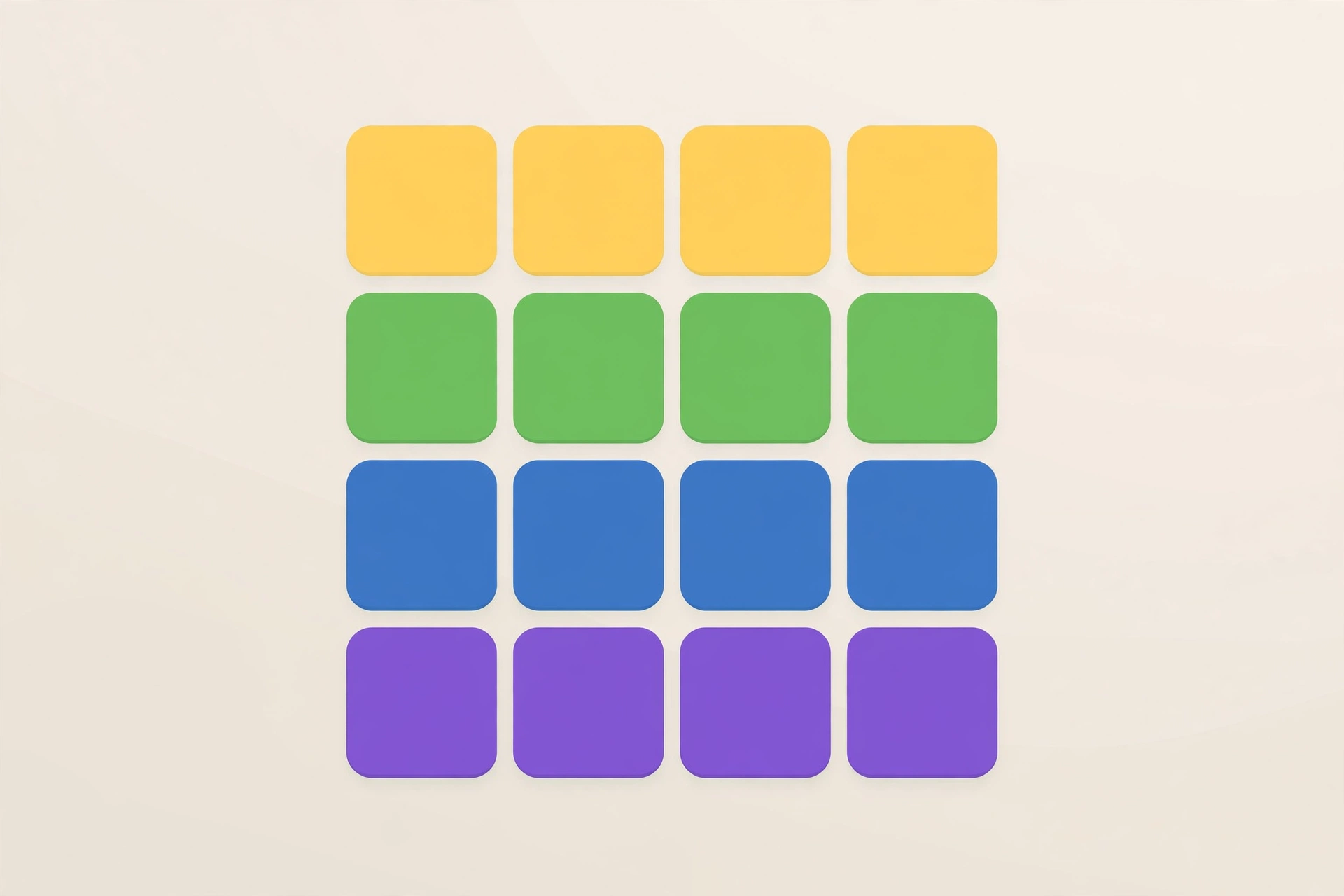
The Connections Unlimited game is a free, fan-made version of the New York Times' popular Connections puzzle that lets you play as many rounds as you want. Instead of one puzzle per day, you get an unlimited supply of 16-word sorting challenges to solve back to back.
The Connections Unlimited Game Explained
The New York Times' Connections, launched in 2023, is one of the most played daily word puzzles in the world. Each day, players sort 16 words into four groups of four, with each group connected by a shared theme. But once you've solved the daily puzzle, you're done until tomorrow.
That's the gap the Connections Unlimited game fills. Hosted at connections-unlimited.org, it is a third-party, fan-made website that offers unlimited Connections-style puzzles — meaning you can play round after round without waiting for the next day's edition. The gameplay mirrors the original: a 16-word grid, groups of four, and color-coded difficulty levels.
It's important to be clear about one thing: Connections Unlimited is not affiliated with or endorsed by The New York Times. It is an unofficial fan version that recreates the same puzzle format so players can keep practicing beyond the single daily NYT puzzle.
How to Play: Rules of the Connections Unlimited Game
If you've played the NYT version, you'll feel right at home. The rules follow the same structure described in the site's own how-to guide (connections-unlimited.org/blog/how-to-play-connections-game-word-puzzle-game/).
The Basic Rules
- The puzzle presents a grid of 16 words.
- Your job is to sort them into four groups of four, with each group sharing a common theme or trait.
- Select four words you believe belong together, then click the submit button.
- If the group is correct, those four words clear from the grid.
- If the group is wrong, you lose one of your four allowed mistakes.
- The game ends when you solve all four groups — or when you use up your four mistakes.
As TechRadar's guide to the game explains, you select four words, hit submit, and lose one of your four chances on a wrong guess. The same guide notes that you don't need a subscription to play, which also applies to the free unlimited version.
The Color-Coded Difficulty Levels
Each solved group is assigned a color that reveals how tricky it was. The color system, described in explainers of the game such as Jagran Josh's, works like this:
- Yellow — the easiest group, usually a straightforward category anyone can spot.
- Green — slightly harder, but still based on clear, direct connections.
- Blue — genuinely challenging, often requiring a second look.
- Purple — the hardest and trickiest group, frequently built on wordplay rather than obvious themes.
Knowing the color order helps you pace yourself: knock out the yellow and green groups first, then focus your brainpower on blue and especially purple.
Strategies and Tips for Solving Connections Puzzles
Unlimited puzzles mean unlimited practice, and practice is where good solving habits are built. Here are the strategies experienced players rely on:
- Start with the obvious. Scan the grid for the most straightforward group first. Solving it removes four words and narrows the field, making the remaining groups easier to see.
- Shuffle the board. Words are placed to mislead you — decoys often sit next to the words they want to distract you from. Shuffling breaks those false visual pairings.
- Say the group name out loud. Before submitting, try to name the connection clearly. If you can't describe what links the four words, it's probably not a real group.
- Watch for red herrings. Puzzle designers love including words that could plausibly fit two different groups. If a word seems to belong in two places, pause and figure out which one is the trap.
- Save purple for last. Since the purple group is usually wordplay-based, solving the other three groups first leaves you with just four words — the answer by elimination.
- Use your mistakes wisely. You have four chances, so don't burn them on guesses. If you're unsure about a group, look for more evidence or try solving a different group first.
- Look for multiple meanings. Many tricky groups hinge on a word's secondary meaning — a word you know as a noun might be the key as a verb.
The Purple Group: Why the Hardest Category Is Full of Wordplay Traps
The purple group is where most games are won or lost. While yellow, green, and blue groups usually connect words through meaning — things that belong to the same category — the purple group connects words through how they look or sound.
Common purple-group tricks include:
- Words hidden inside other words — four words that each contain the same shorter word.
- Homophones — words that sound alike but are spelled differently.
- Shared beginnings or endings — words that all start or end with the same letters or syllable.
- Anagrams and letter play — connections based on rearranging or manipulating letters.
- Compound-word parts — words that each pair with the same hidden partner to form common phrases.
The key insight is to stop asking "what do these words mean?" and start asking "what do these words look like?" When a grid has stumped you on the final group, switch from meaning-mode to pattern-mode: read the remaining words slowly, listen to how they sound, and look at their first and last letters.
NYT Connections vs Connections Unlimited vs Similar Puzzle Games
How does the unlimited version compare to the original and other word puzzles? Here's a side-by-side look:
| Feature | NYT Connections | Connections Unlimited | Other Daily Word Puzzles |
|---|---|---|---|
| Puzzles per day | One daily puzzle | Unlimited rounds | Usually one daily puzzle |
| Cost | Free on the NYT Games site/app | Free to play | Often free with optional extras |
| Account needed | Optional (NYT account for stats) | None — play in your browser | Varies by site |
| Core mechanic | 16 words, 4 groups of 4 | 16 words, 4 groups of 4 | Varies by game |
| Difficulty colors | Yellow, green, blue, purple | Yellow, green, blue, purple | Varies or none |
| Mistakes allowed | 4 | 4 | Varies by game |
| Official status | The original by The New York Times | Unofficial fan-made version | Independent games |
| Best for | The daily ritual | Practice and binge-playing | Trying new formats |
The two versions complement each other well: play the official NYT Connections for your daily challenge, then head to the unlimited version when you want to sharpen your skills or just keep the fun going. For more word puzzles, see our list of the best games like Plusword.
Final Thoughts
The Connections Unlimited game is the perfect training ground for anyone who loves the NYT Connections format but finds one puzzle a day isn't enough. The rules are identical, the color-coded difficulty keeps every round interesting, and the unlimited supply means your pattern-recognition skills improve with every session. Just remember it's a fan-made tribute rather than an official NYT product — and then get solving. For more one-a-day challenges, browse our daily puzzle games round-up.
What is the Connections Unlimited game?
The Connections Unlimited game is a free, fan-made website (connections-unlimited.org) offering unlimited Connections-style word puzzles. Each puzzle gives you 16 words to sort into four groups of four, just like the NYT version, but you can play as many rounds as you like.
Is the Connections Unlimited game free to play?
Yes. The site is free to play in your browser with no subscription required, and there is no limit on how many puzzles you can attempt.
Is Connections Unlimited affiliated with The New York Times?
No. It is a third-party, fan-made version and is not affiliated with or endorsed by The New York Times. The original Connections is the NYT’s own daily game, playable free on its Games website and app.
How many puzzles can you play per day on Connections Unlimited?
As many as you want. Unlike the NYT version, which publishes a single puzzle per day, the unlimited version generates new rounds continuously, so there is no daily cap.
Do you need an account to play Connections Unlimited?
No account or sign-up is needed. You simply open the site and start solving — pick four words that share a trait, click submit, and correct groups clear from the grid.
What are the best tips for solving the purple groups?
Solve the other three groups first so the purple words are isolated by elimination, then switch from meaning to pattern-spotting: check for hidden words, homophones, shared beginnings or endings, and anagram-style letter play.