
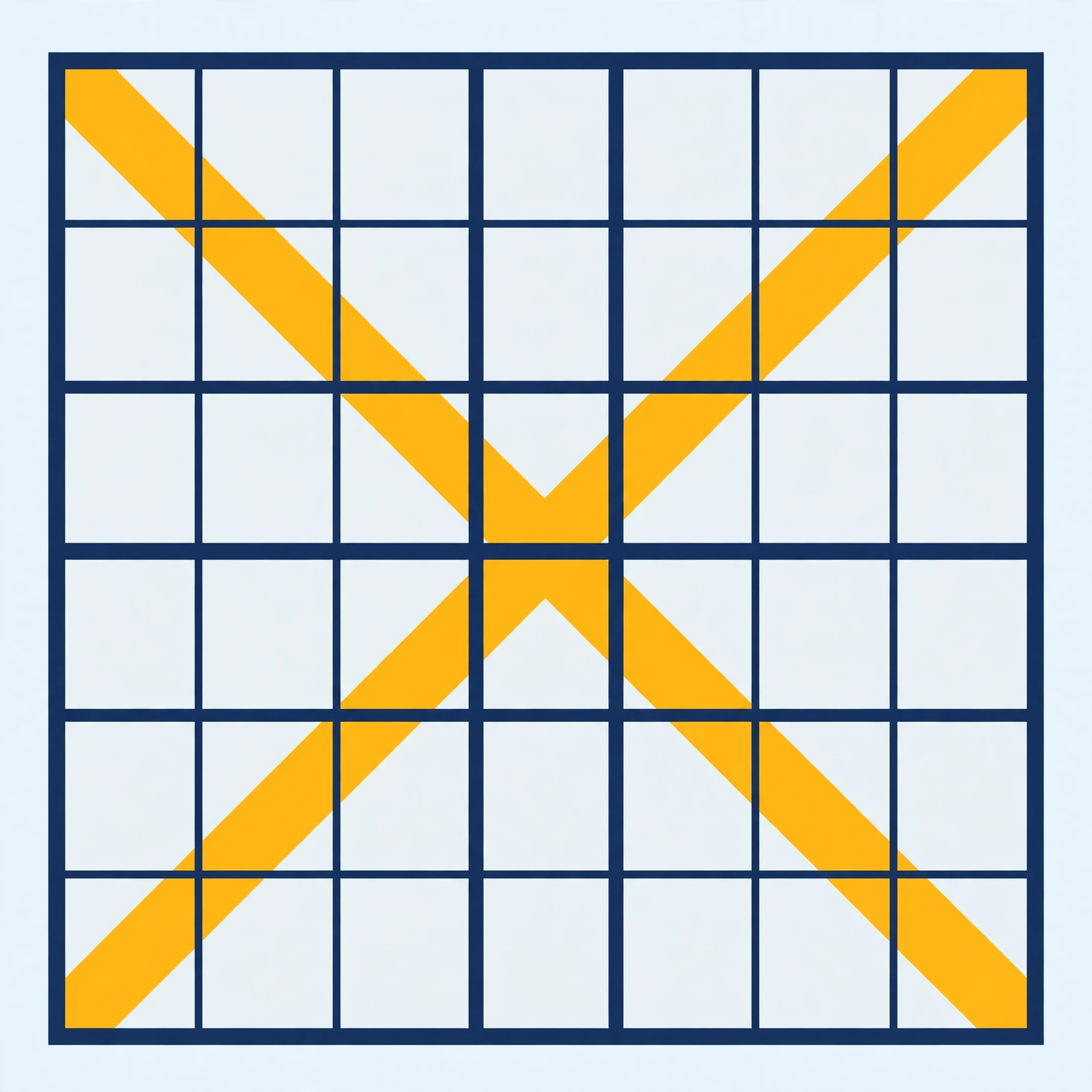
Diagonal Sudoku — also known as Sudoku X — is a Sudoku variant where the two main diagonals of the grid must each contain the digits 1 through 9 exactly once, on top of the standard row, column, and 3×3 region rules. Here is how the game works, the strategies that crack it, and where to play free online.
What Is Diagonal Sudoku?
Diagonal Sudoku is a variant of classic Sudoku played on the same 9×9 grid. It keeps every standard constraint — each row, each column, and each 3×3 region must contain the digits 1 through 9 exactly once — and adds one more: the two main diagonals forming an 'X' across the grid must also each contain the digits 1 through 9 without repetition (gridpuzzle.com).
That single extra rule changes the feel of the puzzle dramatically. The diagonals act like two invisible regions cutting across the whole board, and every number you place has to satisfy them too.
Why Is It Called Sudoku X?
The name comes from the shape the two diagonals make: they cross the grid from corner to corner, forming a giant 'X'. In Diagonal Sudoku, a diagonal cell becomes a four-way intersection — it belongs to its row, its column, its 3×3 box, and a diagonal — making these cells powerful anchors that filter possibilities across multiple dimensions at once (gridpuzzle.com).
The Rules of Diagonal Sudoku
The complete rules, as laid out by puzzle sites:
- Standard placement: Every horizontal row and vertical column must contain the numbers 1-9 uniquely.
- Regional integrity: Each of the nine 3×3 subgrids must contain the numbers 1-9 exactly once.
- The X-constraint: The two main diagonals (connecting the opposite corners of the grid) must each contain a complete set of digits from 1 to 9 (gridpuzzle.com).
Note that a valid classic Sudoku solution is not necessarily a valid Diagonal Sudoku solution — most standard solutions violate the diagonal rule, so Diagonal Sudoku puzzles are generated specifically with the X-constraint in mind.
How to Solve Diagonal Sudoku: Proven Strategies
Diagonal Scanning
Treat the two main diagonals as additional regions. Early in the puzzle, scan each diagonal for missing numbers — a diagonal that already has seven or eight givens can hand you quick placements that rows and columns might miss. Make the diagonals part of your regular scanning routine, not an afterthought (gridpuzzle.com).
The Center Point Strategy
The center cell of the grid is unique: it belongs to a row, a column, a 3×3 box, and both diagonals. That makes it the most constrained cell on the board. When you are stuck, examine the center cell's candidates — it is often solvable earlier than you'd expect, and cracking it opens up both diagonals at once (gridpuzzle.com).
Intersection Points
Look for where a diagonal crosses a row or column that is nearly complete. These intersection cells are highly restricted — they must satisfy the row, column, box, and diagonal simultaneously — and they are often the key to breaking open difficult puzzles. A cell on a diagonal in a box that already holds most of its digits can frequently be pinned down by elimination alone (gridpuzzle.com).
Standard Sudoku Techniques Still Apply
Everything you know from classic Sudoku — naked and hidden singles, pairs, locked candidates — works here too. The difference is that you get extra leverage: every elimination can now be cross-checked against the diagonals. If you are new to Sudoku strategy in general, the Plusword sudoku puzzle book guide covers how puzzle collections build difficulty from easy techniques to advanced ones.
Diagonal Sudoku vs Classic Sudoku
| Feature | Classic Sudoku | Diagonal Sudoku (Sudoku X) |
|---|---|---|
| Grid | 9×9 | 9×9 |
| Row/column rule | Digits 1-9, no repeats | Digits 1-9, no repeats |
| 3×3 box rule | Digits 1-9, no repeats | Digits 1-9, no repeats |
| Diagonal rule | None | Both main diagonals 1-9, no repeats |
| Most constrained cell | Any cell in a busy area | Center cell (row + column + box + both diagonals) |
| Difficulty | Easier | Harder — extra constraint, fewer valid solutions |
Because the extra constraint eliminates most classic solutions, Diagonal Sudoku puzzles tend to need fewer givens to have a unique solution, and the solving path feels tighter and more interconnected.
Where to Play Diagonal Sudoku Free Online
- GridPuzzle — Diagonal Sudoku (gridpuzzle.com). Free online Diagonal Sudoku with difficulty levels from Easy to Evil, live player replays so you can watch logical deductions in action, and leaderboards for competitive solvers (gridpuzzle.com).
If you enjoy number puzzles with a twist, Plusword's daily puzzle offers a fresh challenge every day, and the site's crossword books guide is a good next step for puzzle-book lovers.
Don't Confuse It With the X-Wing Technique
The name "Sudoku X" causes one persistent mix-up worth clearing up: it has nothing to do with the X-Wing technique. X-Wing is a classic solving method for ordinary sudoku — a pattern where a candidate number appears in exactly two cells in two rows, aligned in the same two columns, letting you eliminate it elsewhere. It is a technique, not a puzzle type, and it works on standard grids. Diagonal Sudoku (Sudoku X), by contrast, is a variant whose two main diagonals must each contain the digits 1–9 exactly once — an extra rule baked into the puzzle itself. The shared "X" is pure coincidence: one X describes the shape of a solving pattern, the other the shape of the constraint diagonals. Why does it matter? Because beginners searching for "Sudoku X strategy" land on X-Wing tutorials that teach them nothing about diagonal constraints, and vice versa. When you want diagonal-specific help, search for "Diagonal Sudoku" or "Sudoku X variant" explicitly — and when you want the technique, search "X-Wing sudoku technique". Two different X's, two different rabbit holes.
What is Diagonal Sudoku?
Diagonal Sudoku, also known as Sudoku X, is a variant of classic Sudoku where the two main diagonals of the grid must also contain the digits 1 through 9 exactly once, in addition to the standard row, column, and 3×3 region constraints (gridpuzzle.com).
How do you play Diagonal Sudoku?
Fill the 9×9 grid so every row, column, and 3×3 region contains the digits 1-9 exactly once, and additionally make sure both corner-to-corner diagonals contain the digits 1-9 without repetition (gridpuzzle.com).
Is Diagonal Sudoku harder than regular Sudoku?
Yes, generally. The extra diagonal constraint restricts the solution space, so placements interact more and the puzzle demands more cross-checking — though the diagonals also give you extra solving footholds.
What is the center cell trick in Diagonal Sudoku?
The center cell belongs to a row, a column, a 3×3 box, and both diagonals, making it the most constrained cell on the board. Examining it early often yields a quick placement that unlocks both diagonals (gridpuzzle.com).
Can a normal Sudoku solution work for Diagonal Sudoku?
Usually not. Most classic Sudoku solutions repeat digits along the diagonals, so Diagonal Sudoku puzzles are specially constructed to satisfy the X-constraint.
Where can I play Diagonal Sudoku for free?
GridPuzzle offers free online Diagonal Sudoku puzzles from Easy to Evil difficulty, with live replays and leaderboards (gridpuzzle.com).
Does Diagonal Sudoku use the same strategies as classic Sudoku?
Yes — singles, pairs, and scanning all still work. The diagonals simply add two more “regions” to scan, plus the powerful center-cell and intersection-point techniques (gridpuzzle.com).
Is Diagonal Sudoku good for beginners?
Learn classic sudoku first. The diagonal constraint adds a real difficulty jump, so players who are comfortable with singles, pairs and scanning in standard grids will get far more out of the X-variant than absolute beginners.
Can a regular sudoku puzzle become a Diagonal Sudoku?
Usually not. Most classic solutions repeat digits along the diagonals, so Diagonal Sudoku puzzles are specially constructed to satisfy the X-constraint — you cannot simply impose the diagonal rule on an ordinary puzzle.