
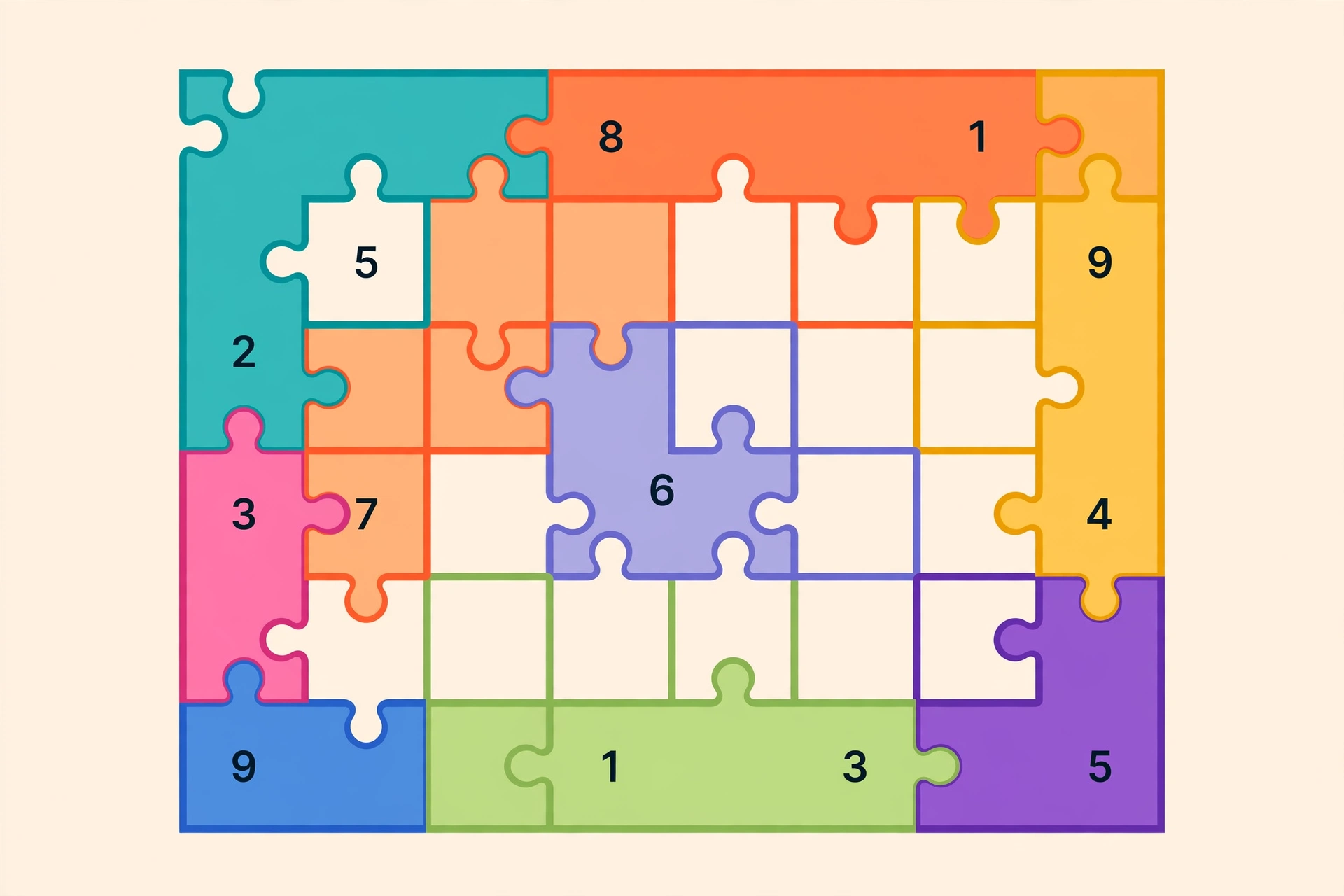
Jigsaw Sudoku — also called irregular sudoku — is a logic-puzzle variant in which the usual nine 3×3 boxes are replaced by nine irregular, jigsaw-shaped regions. The rules are otherwise identical to classic sudoku: fill the 9×9 grid with the digits 1–9 so that every row, every column and every outlined region contains each digit exactly once. It's also called Irregular Sudoku or Squiggly Sudoku — all three names describe the same puzzle. (Sources: SudokuPro, Sudoku a Day, GridPuzzle)
Jigsaw Sudoku vs Classic Sudoku
| Classic Sudoku | Jigsaw Sudoku | |
|---|---|---|
| Grid | 9×9 | 9×9 (also 4×4, 6×6) |
| Regions | Nine identical 3×3 boxes | Nine irregular jigsaw shapes, unique per puzzle |
| Row/column rules | Digits 1–9, no repeats | Identical |
| What changes | Predictable box geometry | Region boundaries snake across rows and columns |
| Difficulty feel | Familiar scanning patterns | Forces fresh visual analysis every puzzle |
The only rule change is the region shape — but that single change rewires how you solve this logic puzzle. In classic sudoku, experienced players barely look at boxes; the 3×3 geometry is memorised. In jigsaw sudoku, every puzzle has a unique region layout, so you must actively trace which cells belong to which region before placing a single digit.
The Rules in Full
- Fill every empty cell with a digit from 1 to 9.
- Every horizontal row must contain the digits 1–9 exactly once.
- Every vertical column must contain the digits 1–9 exactly once.
- Every bold-outlined jigsaw region — however strangely shaped — must contain the digits 1–9 exactly once.
- No digit may repeat within any row, column or region.
Smaller versions exist too: 6×6 jigsaw (digits 1–6, six irregular regions) and 4×4 jigsaw (digits 1–4) are excellent training grounds before tackling the full 9×9.
Why Irregular Regions Change Everything
In classic sudoku, a box sits neatly inside three rows and three columns. In jigsaw sudoku, a region might snake along a single row for five cells, then dive into the row below. This has a powerful consequence: satisfying one irregular region automatically eliminates digits from several rows and columns at once — region boundaries often give stronger constraints than standard boxes.
The flip side is error risk. The most common beginner mistake is misassigning a cell to the wrong region — placing a digit that's "fine" for the row but duplicates within the true region. That error cascades. Which leads to strategy number one.
5 Key Jigsaw Sudoku Strategies
1. Map the regions before you solve
Spend 30 seconds tracing each of the nine regions visually before placing anything. Some solvers lightly shade or number the regions. This feels slow, but it prevents the single most damaging error in jigsaw solving.
2. Start with standard row/column logic
Rows and columns work exactly as in classic sudoku. Naked singles, hidden singles and basic elimination are unchanged — begin here and bank the easy placements. If you're new to these techniques, our sudoku puzzle book guide covers difficulty progression.
3. Hunt the "inner corners"
Jigsaw regions have nooks — cells where a region bends inward. These cells are often influenced by three regions at once, making them prime spots for hidden singles. GridPuzzle's solving guides specifically flag inner corners as the highest-value cells to examine first (Source: GridPuzzle).
4. Use region protrusions
Watch where a region protrudes into a row or column. If a region occupies 5 of its cells within just two rows, the digits in those cells are locked out of the rest of those rows. This "law of leftovers" — comparing what a row contains against the regions crossing it — is the signature jigsaw technique with no classic-sudoku equivalent.
5. Finish almost-complete regions
Any region with eight digits placed has its ninth forced. In jigsaw puzzles these forced placements often span multiple rows and columns, unlocking cascades of singles elsewhere. Always scan for nearly-complete regions before attempting harder logic.
Common Beginner Mistakes
- Ignoring region shapes. Treating the grid like classic sudoku and forgetting the bold outlines exist. The regions are the puzzle — respect them.
- Rushing the first placements. Early misplacements in jigsaw sudoku are harder to spot because the geometry is unfamiliar. Double-check region membership for your first five placements.
- Overlooking long regions. A region stretched across four rows constrains all four. Beginners underuse these "long" regions; experts mine them first.
- Skipping the 6×6. Jumping straight to 9×9 jigsaw is like learning chess on a tournament clock. The 6×6 version teaches region-thinking with half the cognitive load.
Where to Play Jigsaw Sudoku Free
Several well-regarded puzzle sites offer free jigsaw sudoku with daily puzzles and difficulty levels from Easy to Expert: SudokuPro (four difficulty levels, hints, progress saving) and GridPuzzle (daily puzzles, 6×6 and 4×4 variants, solve replays). Both run in the browser with no sign-up required.
For solvers who want the full classic-sudoku foundation first, the Plusword homepage features a daily word puzzle, and our sudoku puzzle book guide helps you pick the right difficulty level in print.
How to Design Your Own Jigsaw Sudoku
Making your own jigsaw puzzles deepens your solving skills — and it is easier than it looks.
- Draw the regions first. Sketch nine irregular regions on a blank 9×9 grid. Aim for regions of nine cells each with interesting protrusions and inner corners — the shapes that make jigsaw solving fun.
- Fill a complete solution. Complete the grid respecting rows, columns and your regions. Any valid completion works; symmetry is a bonus, not a requirement.
- Remove clues gradually. Take out digits a few at a time, checking after each round that the puzzle still has a unique solution. Stop when removing more would create ambiguity.
- Test on a friend. Fresh eyes find flaws you will miss. If a tester gets stuck in a way that feels unfair rather than challenging, add back a clue or two.
What is jigsaw sudoku?
Jigsaw Sudoku is a sudoku variant where the standard 3×3 boxes are replaced by nine irregular, jigsaw-shaped regions. Rows, columns and regions must each contain the digits 1–9 exactly once. It’s also called Irregular Sudoku or Squiggly Sudoku.
What are the rules of jigsaw sudoku?
Fill the 9×9 grid so every row, every column and every bold-outlined irregular region contains the digits 1–9 exactly once, with no repeats. Row and column logic is identical to classic sudoku; only the region shapes differ.
Is jigsaw sudoku harder than regular sudoku?
For most solvers, yes at first. The unfamiliar region shapes break memorised scanning patterns, forcing active visual analysis. Once you learn region-based techniques like protrusion logic, the difficulty feels comparable.
What is the best strategy for jigsaw sudoku?
Map all nine regions visually before placing digits, then use standard row/column elimination, hunt “inner corner” cells for hidden singles, exploit region protrusions with the law of leftovers, and always finish almost-complete regions first.
Where can I play jigsaw sudoku online free?
SudokuPro (sudokupro.app) and GridPuzzle (gridpuzzle.com) both offer free browser-based jigsaw sudoku with daily puzzles, multiple difficulty levels and 6×6/4×4 variants — no sign-up required.
What is the difference between jigsaw sudoku and irregular sudoku?
Nothing — they’re two names for the same variant. “Squiggly Sudoku” and “Oddball Sudoku” also refer to identical puzzles: standard row/column rules with irregular regions instead of 3×3 boxes.
Can beginners play jigsaw sudoku?
Yes — start with 4×4 or 6×6 jigsaw grids, which teach region-thinking with far fewer cells. Move to full 9×9 once mapping irregular regions feels natural, usually after a dozen or so smaller puzzles.
Do jigsaw sudoku puzzles have unique solutions?
Properly constructed ones do, just like classic sudoku. Reputable puzzle sites generate jigsaw puzzles with a single valid solution, so pure logic always suffices — guessing is never required.
Can I print jigsaw sudoku puzzles for free?
Yes. The same specialist printable-puzzle sites that offer classic sudoku usually carry jigsaw variants, with free PDFs at multiple difficulty levels.
How long does a 9×9 jigsaw sudoku take to solve?
Typically 15 to 45 minutes depending on difficulty — a little longer than a classic sudoku of the same level, because mapping the irregular regions adds an extra thinking step.