
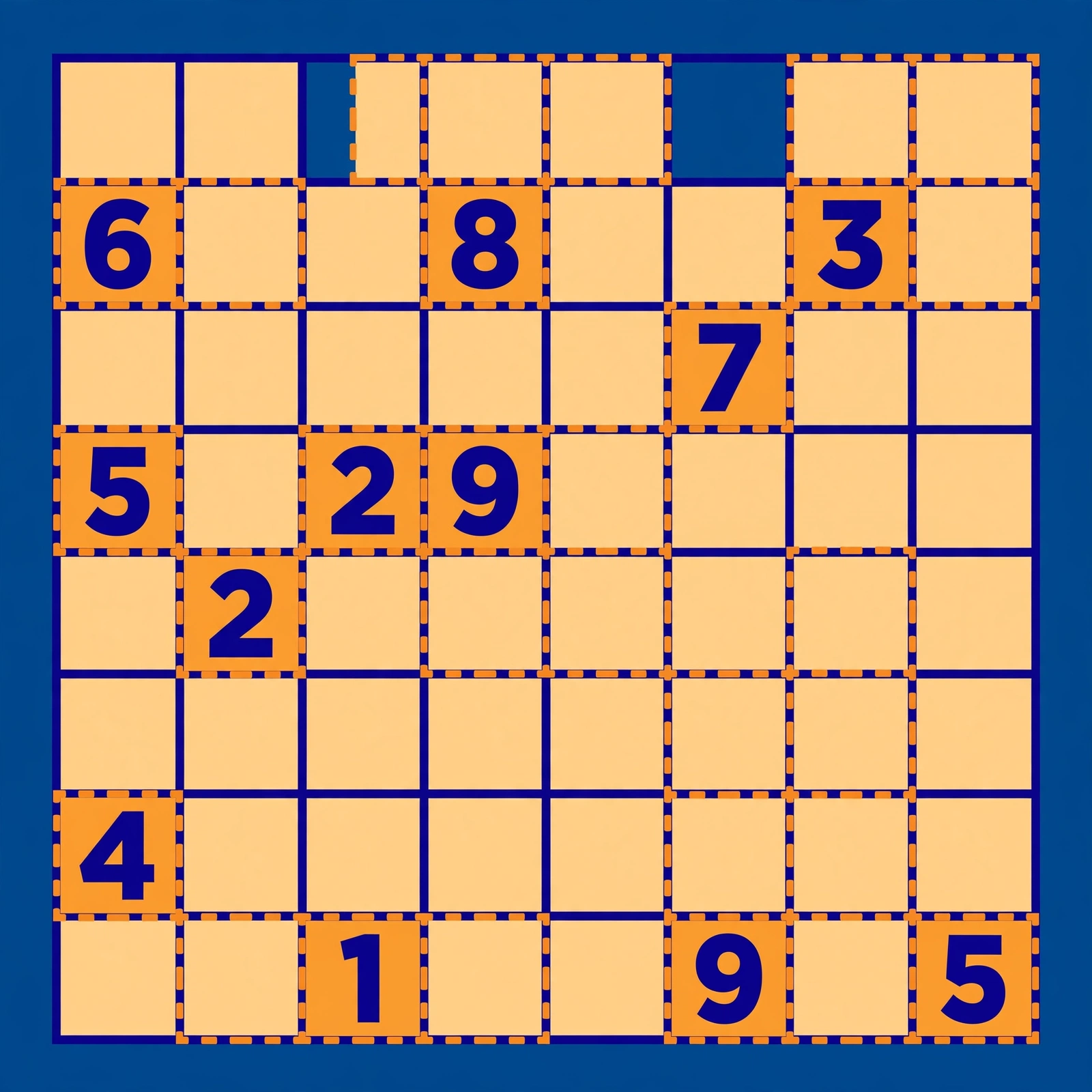
Killer sudoku combinations are the sets of unique digits (1–9, never repeating inside a cage) that add up to a cage's printed sum. Learn them and every puzzle gets faster: some cage sums have only one possible combination, which hands you free information before you place a single digit. This guide covers exactly those cages, plus the full 2-cell table and the 45 rule.
What Killer Sudoku Combinations Are
Killer sudoku looks like a normal 9×9 sudoku grid, but there are no given numbers. Instead, the grid is divided into irregular outlined groups called cages, each marked with a small sum clue in its top-left corner. The rules are strict (sudoku.by; sudokuleader.com):
- Every row, column, and 3×3 box must contain the digits 1–9 exactly once — the standard sudoku rule.
- The digits inside each cage must add up to the cage's printed sum.
- No digit may repeat inside a single cage. This is what makes the combination list finite: a 2-cell cage summing to 4 can only be 1+3, never 2+2.
A "combination" is therefore a set of different digits that produce a given sum for a given cage size. Some sums have only one possible combination — memorise those and you get instant answers every game.
Why combinations matter
In classic sudoku, your starting clues are fixed digits. In killer sudoku, your starting clues are cage sums — and a cage sum is only useful once you know which digits can make it. Combinations are the vocabulary of killer sudoku: learn them and everything else gets faster.
Cage Combinations With Only One Solution
The single most valuable table in killer sudoku. Each of these cage sizes and sums has exactly one possible set of digits (verified via sudokusolver.pro). The moment you spot one, you know precisely which digits live in the cage — you just don't know their order yet.
| Cells | Sum | Only possible digits |
|---|---|---|
| 2 | 3 | 1, 2 |
| 2 | 4 | 1, 3 |
| 2 | 16 | 7, 9 |
| 2 | 17 | 8, 9 |
| 3 | 6 | 1, 2, 3 |
| 3 | 7 | 1, 2, 4 |
| 3 | 23 | 6, 8, 9 |
| 3 | 24 | 7, 8, 9 |
| 4 | 10 | 1, 2, 3, 4 |
| 4 | 11 | 1, 2, 3, 5 |
| 4 | 29 | 5, 7, 8, 9 |
| 4 | 30 | 6, 7, 8, 9 |
| 5 | 15 | 1, 2, 3, 4, 5 |
| 5 | 35 | 5, 6, 7, 8, 9 |
Why these exist
Notice the pattern: unique combinations only appear at the extremes — the very smallest or very largest sums for a given cage size. A 2-cell cage summing to 3 can only be 1+2 because any other pair adds to more. Middle sums always have several options, which is why the edges are where the free information lives.
Common 2-Cell Cage Combinations
Two-cell cages are the most common small cage in killer sudoku puzzles, and their combinations are the most worth learning. Here is the complete list for every possible 2-cell sum, from 3 to 17 (sudokuleader.com):
| Sum | Possible combinations |
|---|---|
| 3 | 1+2 |
| 4 | 1+3 |
| 5 | 1+4, 2+3 |
| 6 | 1+5, 2+4 |
| 7 | 1+6, 2+5, 3+4 |
| 8 | 1+7, 2+6, 3+5 |
| 9 | 1+8, 2+7, 3+6, 4+5 |
| 10 | 1+9, 2+8, 3+7, 4+6 |
| 11 | 2+9, 3+8, 4+7, 5+6 |
| 12 | 3+9, 4+8, 5+7 |
| 13 | 4+9, 5+8, 6+7 |
| 14 | 5+9, 6+8 |
| 15 | 6+9, 7+8 |
| 16 | 7+9 |
| 17 | 8+9 |
How to read this table
- Sums 3, 4, 16, and 17 have one combination each — these are the memorise-first cages from the previous table.
- Sums near the middle (9–11) have the most options, so they give you less to work with on their own.
Minimum and maximum sums
A useful rule from sudokusolver.pro: an n-cell cage cannot be smaller than 1+2+…+n, nor larger than 9+8+…+(10−n). So a 4-cell cage summing to 12 is very tightly constrained: its minimum is 10, so only small digits are possible.
The 45 Rule: Your Secret Weapon
Every row, column, and 3×3 box in sudoku contains the digits 1–9 exactly once, and those digits add up to 45 (1+2+…+9 = 45). This gives you one of the most powerful killer sudoku techniques of all (sudokusolver.pro):
- If the cages inside one box total 38, but one cell of that box belongs to a cage sticking out elsewhere, that cell must be 45 − 38 = 7.
- It works in reverse too: if cages inside a box total 52 with one cell sticking outside, that outside cell holds 52 − 45 = 7.
- Extend it. The rule works on any group of complete units: three rows sum to 135, a band of three boxes sums to 135, and the whole grid sums to 405 (sudokusolver.pro).
That's how experienced solvers work: the 45 rule produces a digit, and the combination table tells you what must accompany it. Neither technique is as strong alone as the two are together.
How to Use Combinations While Solving
1. Scan for single-combination cages first
Before doing anything else, walk the whole grid and mark every cage from the first table. A 2-cell cage on 3, a 3-cell cage on 24, a 5-cell cage on 15 — each one gives you a complete set of digits for free. Pencil them in lightly.
2. Use row, column, and box conflicts to split the pairs
Knowing a 2-cell cage holds {7, 9} is only half the battle. Apply standard sudoku logic: if one cell's row already contains a 7 elsewhere, the 7 goes in the other cell. Cage combinations and classic elimination feed each other constantly.
3. Eliminate combinations using what's already placed
When a row already contains a 1, a 2-cell cage summing to 10 in that row cannot be 1+9. Every digit you place narrows the combination lists of every cage sharing its row, column, or box — update them as you go.
4. Look for "locked" digits inside multi-combination cages
Some cages have several combinations but share a common digit. A 3-cell cage summing to 8 can be 1+2+5 or 1+3+4 — both contain 1, so one cell of that cage is 1 even though you don't know which one.
5. Add the 45 rule to any stuck region
When a row, column, or box is mostly covered by cages and won't yield, total the cages inside it and compare with 45 (or 90 for two units, 135 for three). The difference is a digit you can place for free.
Advanced Tips for Cage Math
- Two cages in the same unit interact. If a 2-cell cage summing to 16 {7, 9} and another 2-cell cage summing to 13 {4+9, 5+8, 6+7} share a row, standard logic tells you exactly which digits are fighting over which slots.
- Five-cell cages are often easier than they look. A 5-cell cage summing to 15 is {1, 2, 3, 4, 5} — five digits at once. Big cages with extreme sums are gifts, not threats.
- Watch the cage size on ambiguous sums. Sum 12 in a 2-cell cage is {3+9, 4+8, 5+7}, but sum 12 in a 4-cell cage is much tighter because the minimum is 10. Always read the cage size and the sum together.
- Practice on the real thing. If you're new to the variant, our guide to playing sudoku online free and the BBC sudoku guide cover the classic rules that killer sudoku builds on, while our sudoku puzzle book guide can point you toward killer sudoku collections in print.
What is a killer sudoku combination?
A combination is a set of unique digits (1–9, with no repeats) that adds up to a cage’s printed sum. For example, a 2-cell cage summing to 4 has only one combination — the digits 1 and 3 — because 2+2 is illegal (digits can’t repeat inside a cage).
Which killer sudoku cage combinations should I memorise first?
The cages with exactly one possible combination: 2-cell sums of 3, 4, 16, and 17; 3-cell sums of 6, 7, 23, and 24; 4-cell sums of 10, 11, 29, and 30; and 5-cell sums of 15 and 35 (sudokusolver.pro).
What is the 45 rule in killer sudoku?
Every row, column, and 3×3 box contains the digits 1–9, which sum to 45. If the cages fully inside a unit total less than 45, the difference is the digit of the cell sticking out — and vice versa (sudokusolver.pro; sudokuleader.com).
What is the smallest possible sum for a 2-cell cage?
The smallest is 3 (1+2) and the largest is 17 (8+9). Digits cannot repeat inside a cage, so sums like 2 (1+1) or 18 (9+9) are impossible.
Is killer sudoku harder than regular sudoku?
It can be, but the cage sums are also extra clues that regular sudoku doesn’t give you. Puzzles with many small, extreme-sum cages often solve faster than a hard classic sudoku, because single-combination cages hand you digits immediately (techsngames.com).