
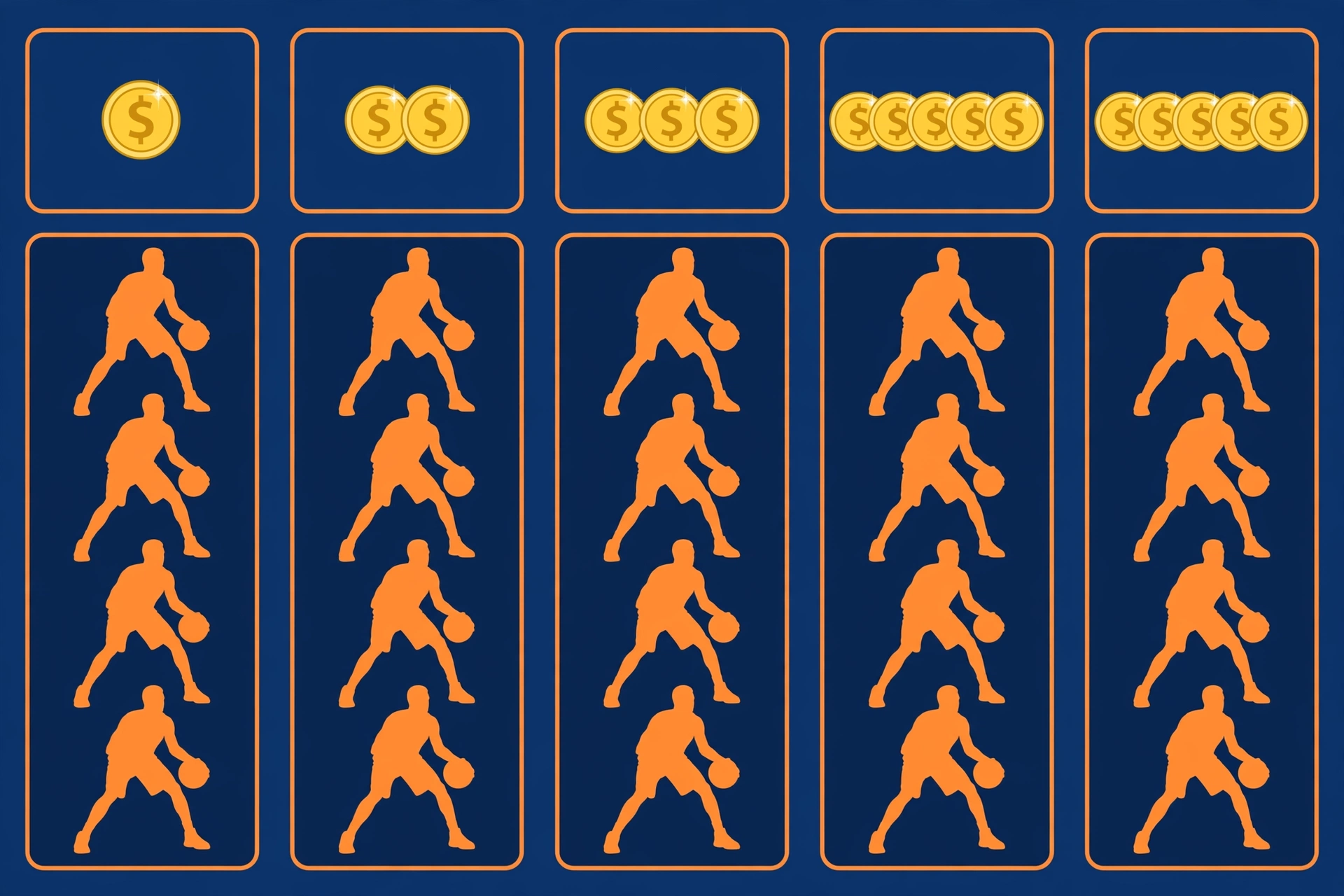
NBA Grids are budget-based basketball trivia games — a salary-cap puzzle in which you draft a starting five — one player at each position — without spending more than $15. Every player carries a price tag between $1 and $5, so the real challenge is balancing superstars with bargain picks. Below is a complete guide to the rules, a real example grid, and the strategies that win the debate.
What Are NBA Grids?
NBA Grids are a social-media-born basketball game format built around one delicious constraint: a salary cap. You get a grid of players sorted by position — point guard, shooting guard, small forward, power forward and centre — each with a price, usually $1 to $5. Draft the best starting five you can without breaking the budget. The classic budget is $15, hence the nickname: the "$15 grid".
The grid's own instructions state the premise plainly: "This is a price based grid. The goal is select what you feel are the best options available while also staying within the budget of $15." (fanspo.com) And every grid ends with the format's signature question: "Who yall taking for 15 bucks?"
Unlike daily trivia games, NBA Grids have no timer, no single correct answer and no official score. They are debate games: you build your five, share it, and argue your case against other fans — and once you have settled the basketball debate, unwind with the Plusword daily word puzzle. The budget cap is what makes the format work — without it, everyone would just pick the five best players alive and the conversation would end. With it, every choice has an opportunity cost, and your team reveals what you actually value: peak talent, two-way balance, shooting, defence or chemistry. The best-known hub for the format today is the nba_grids community on Fanspo, where fans post themed grids and vote on each other's teams with likes, "flames" for spicy takes, and quotes that spin off into full discussions.
How to Play NBA Grids: The Rules
This fantasy-style draft game has simple rules — the strategy is in the budget:
- Read the grid. Players are grouped by position (PG, SG, SF, PF, C), and each one carries a price — most commonly $1 to $5.
- Draft one player per position. Your team needs exactly five players: one point guard, one shooting guard, one small forward, one power forward and one centre.
- Stay on budget. Your five picks must cost $15 or less in total. A few special grids raise the cap — the all-time "$50 grid", for example, includes a $20 tier of legends — but $15 is the standard.
- Share your team. Post your five and make your case. The debate is the entire point of the game.
- Vote on other teams. On community grids you can react with likes for teams you agree with, flames for controversial picks, and quotes to start a thread (fanspo.com).
Example: A Real $15 NBA Grid
Here is a genuine $15 grid from the nba_grids community (fanspo.com), with five price tiers and one player per position in each tier:
| Price | PG | SG | SF | PF | C |
|---|---|---|---|---|---|
| $5 | Stephen Curry | Anthony Edwards | Kevin Durant | LeBron James | Anthony Davis |
| $4 | De'Aaron Fox | Kyrie Irving | Brandon Ingram | Kristaps Porziņģis | Victor Wembanyama |
| $3 | D'Angelo Russell | Jalen Green | Lauri Markkanen | Domantas Sabonis | Chet Holmgren |
| $2 | Chris Paul | Josh Giddey | Buddy Hield | Julius Randle | Jonas Valančiūnas |
| $1 | Cameron Payne | Dante Exum | Deni Avdija | Harrison Barnes | Al Horford |
One winning $15 team
Here is a sample build from that grid — every dollar spent, every position filled:
| Position | Pick | Price |
|---|---|---|
| PG | Stephen Curry | $5 |
| SG | Jalen Green | $3 |
| SF | Deni Avdija | $1 |
| PF | Julius Randle | $2 |
| C | Kristaps Porziņģis | $4 |
| Total | $15 |
Why this team works: Curry is the $5 anchor — elite shooting and playmaking that warps defences — while Porziņģis at $4 adds rim protection plus floor spacing. Three value picks do the rest: Randle's rebounding at $2, Green's shot creation at $3, and Avdija's two-way wing play at $1.
Strategies for Winning the $15 Game
1. Anchor with one superstar, not two
Two $5 players consume $10 of your $15, leaving just $5 for three positions — three $1–$2 role players and a glaring talent gap somewhere. One $5 anchor plus smart mid-tier picks almost always produces the better-balanced five.
2. Hunt for value in the middle tiers
The $2–$3 range is where $15 grids are won. Players like Domantas Sabonis ($3) or Julius Randle ($2) deliver near-star production at half the top-tier price. Before locking in a $5 pick, always ask: is there a $3 player who gives me 80% of this production? If yes, take the savings and upgrade two other positions.
3. Don't neglect fit
Five scorers and no defender loses most debates. Spend at least one pick on defence, rebounding or pure playmaking — a $1 defensive specialist like Deni Avdija or a $2 veteran like Chris Paul gives your team an identity beyond "five guys who can score". Judges (and rival fans) reward rosters that look like real teams.
4. Use the era to your advantage in all-time grids
All-time grids change the maths: judge every player at his peak, and look for the all-time greats the grid-maker underpriced. A $1 legend from the 1970s might have been the best player on earth in his prime — that is where the biggest bargains hide.
5. Read the theme before you draft
Themed grids demand themed logic. An age-restricted grid rewards prime-year analysis; a "last name starts with H" grid is pure chaos where fit matters most; a playoff-only grid should weight postseason pedigree over regular-season stats. Never draft a themed grid with generic logic — and don't be afraid of one bold, defensible contrarian pick, because the grids that generate the best discussions are the ones where someone zigged.
Themed Grid Variations
The format is endlessly remixable. Real themed grids from the nba_grids community (fanspo.com):
- $15 grid of players aged 26–27 — prime-age stars only.
- $15 grid, last names starting with H — Harden, Haliburton, Holmgren and company.
- Playoff grid — built for the postseason.
- $50 all-time price grid — with a $20 legends tier: Magic Johnson, Kobe Bryant, Michael Jordan, LeBron James and Kareem Abdul-Jabbar.
- $15 grid of All-Star Game MVPs, Pacific Division players, players from quarterfinal-eliminated teams, and players aged 34–40.
If you ever get bored of the standard format, invent your own theme. The community rewards creativity: the weirder the constraint, the livelier the debate.
NBA Grids vs Immaculate Grid
Newcomers often confuse NBA Grids with Immaculate Grid, the daily 3×3 basketball trivia game. They share an audience — deep-cut NBA nerds — but almost nothing else:
| NBA Grids ($15 game) | Immaculate Grid | |
|---|---|---|
| Core mechanic | Draft 5 players on a budget | Fill a 3×3 trivia grid |
| What it tests | Player evaluation, roster construction | NBA history and trivia recall |
| Frequency | Play anytime, endless themes | One new grid daily |
| Win condition | Win the debate — no official score | Complete all 9 squares; rarity score |
| Social element | Likes, flames, quote debates | Share cards and streaks |
The two games reward different skills — team-building versus trivia recall — and most hardcore fans play both. And if you like your puzzles in print, our crossword books for adults guide rounds up the best collections.
What is NBA Grids?
NBA Grids are budget-based basketball games where you draft a starting five — one player per position — for $15 or less, with players priced from $1 to $5. The fun is defending your picks against other fans.
How do you play the $15 grid game?
Pick one player at each position (PG, SG, SF, PF, C) so your five cost $15 or less in total, then share your team and debate it. There is no official winner — the best-argued roster wins.
Where can I play NBA Grids?
The nba_grids community on [Fanspo](https://fanspo.com/nba/s/nba_grids/grids/a5-JSZcIFTuxTr/nba-grid) hosts themed $15 grids with community voting — it is the best-known hub for the format.
What do flames and quotes mean on NBA grid posts?
They are community reactions on Fanspo grids: likes signal agreement, flames mark spicy or controversial takes, and quotes start discussion threads around a team.
Is there an official winner in NBA Grids?
No. There is no official scoring and no prize. The “win” is building the most defensible team and winning the argument in the replies.
Are NBA Grids the same as Immaculate Grid?
No. Immaculate Grid is a daily 3×3 trivia game about matching players to teams, awards and stats; NBA Grids are budget draft-and-debate games with no [daily puzzle](https://plusword.co.uk/daily-puzzle/) and no official score.
Can I make my own NBA grid?
Yes — pick a theme, sort players into price tiers by position, set a budget, and share it with the signature question: “Who yall taking for 15 bucks?”