
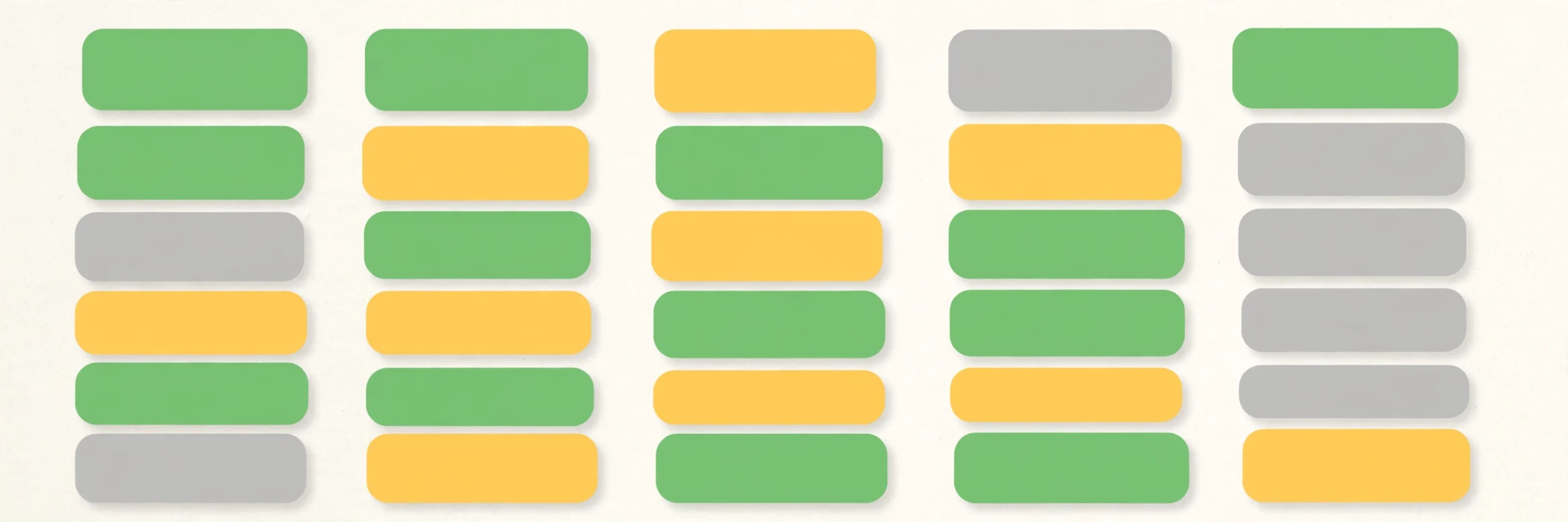
Quintessential Wordle is a free daily word puzzle — a tile-swapping arcade game played on a 5×5 grid of letter tiles. Instead of guessing words, you swap pairs of letters until all five horizontal rows form correct words, aiming to solve the board in as few moves as possible — the best puzzles can be finished in as few as eight swaps. The game is available at quintessential.fun and publishes a new daily puzzle at midnight local time.
What Is Quintessential Wordle?
Quintessential Wordle is a Wordle-inspired browser game, but it plays nothing like the original. Where classic Wordle asks you to guess a hidden five-letter word, Quintessential hands you a 5×5 grid of 25 letters that are already all there — they are just jumbled. Your job is to rearrange them, swapping any two tiles at a time, until each of the five horizontal rows spells a valid five-letter word.
The name "quintessential" refers to the five (quint) rows of five letters, and the game sits squarely in the Wordle-variant genre documented on lists such as the community-curated awesome-wordle GitHub repository, which describes it simply as "Wordle but you can only swap words."
A Daily Puzzle Format
Like the game that inspired it, Quintessential is built around a once-a-day challenge. A new puzzle is released at 12 am local time, so every player around the world works on a fresh grid each morning. According to game-directory listings such as world3dmap.com, the daily mode can be played only once per day — one shot at the day's grid, with a shareable result — while an unlimited or practice mode lets you play extra boards as often as you like. There is no app to download and no account needed; you just open the site and start swapping.
Who Made Quintessential Wordle?
No individual creator or development studio is publicly documented as the author of the game. Unlike the original Wordle, whose creator Josh Wardle is widely known, nobody behind quintessential.fun has published an about page or launch announcement — so any unattributed creator claims you find online should be treated as unverified.
How to Play Quintessential Wordle
The rules are refreshingly simple, which is part of the game's appeal. Here is how a round works:
- Open the game at quintessential.fun and start the day's puzzle.
- You see a 5×5 grid of 25 letter tiles, each tile showing one letter.
- Click or tap two letters to swap their positions. On touchscreens you can also drag one tile onto another.
- After each swap, the tiles change colour to give you feedback about what is right and what is not.
- Keep swapping until all five horizontal rows spell correct five-letter words.
- The game ends when the board is complete. Your score is your number of moves — fewer moves is better.
Understanding the Colour Feedback
The colour code works a lot like the familiar Wordle system, but with a twist that fits the swapping mechanic:
- Green — the letter is in the correct position in the word. Lock it in mentally and work around it.
- Yellow — the letter belongs in that row's word, but it is in the wrong column. Move it somewhere else in the same row.
- Grey or red — the letter does not belong in that row's word at all. Sources describe this state slightly differently (some list it as grey, others as red), but the meaning is the same: that tile's letter belongs in a different row.
Because the colours update after every swap, each move gives you fresh information, and experienced players learn to read the board like a heat map rather than solving one row at a time.
How Quintessential Wordle Differs From Classic Wordle
If you only know the original game, the differences take a moment to click. The table below breaks them down:
| Feature | Classic Wordle | Quintessential Wordle |
|---|---|---|
| Objective | Guess one hidden word | Unscramble five words at once |
| Moves | Type a guess (max 6) | Swap any two tiles (unlimited, but scored) |
| Letters | You supply all guesses | All 25 letters are already on the board |
| Colour feedback | Green, yellow, grey per guess | Green, yellow, grey/red per swap, live |
| Win condition | One correct guess | Five correct rows |
| Scoring | Win or lose | Move count — fewer is better |
| Creator | Josh Wardle, 2021 | Not publicly documented |
The biggest mental shift is this: in Wordle you generate letters and test hypotheses, while in Quintessential you rearrange a fixed set of letters and react to constant feedback. It feels less like a vocabulary test and more like untangling a knot.
Strategies and Tips for Fewer Moves
Winning this tile-swapping puzzle is easy; winning in few moves is the actual game. These strategies will cut your move count:
- Start with the vowels. Every English word needs at least one vowel, so find A, E, I, O and U first and distribute them one per row. This single step usually cracks the rough structure of the board.
- Hunt for common endings and beginnings. Look for S, ED, ING patterns and common prefixes like RE, UN, and ST. When two or three tiles snap into place at once, you have probably found a word fragment.
- Read the colours before each swap. Don't swap blindly. A green tile means the letter is done — never move it. A yellow tile tells you the letter and its row are both correct, so only the column needs fixing.
- **Move letters between rows, not just within them.** A grey or red tile means the letter belongs in a different row entirely. Swap it into a row where it might fit rather than shuffling it around the same word.
- Solve the easiest row first. Completing one full word removes five tiles from the problem and clarifies what remains. Many players finish the most obvious row, then the rest falls into place.
- Plan, then commit. Every swap costs a move, so spend a few seconds scanning the board before acting. A well-chosen swap that places two letters correctly at once is worth twice its value.
Quintessential vs Other Popular Wordle Variants
Quintessential is one of dozens of Wordle offshoots. Here is how it stacks up against the best-known ones:
| Game | Concept | Difficulty | What it tests |
|---|---|---|---|
| Wordle (classic) | Guess one 5-letter word in 6 tries | Moderate | Vocabulary, deduction |
| Quordle | Solve 4 words at once in 9 guesses | Hard | Parallel deduction |
| Octordle | Solve 8 words at once in 13 guesses | Very hard | Stamina, pattern tracking |
| Squareword | Fill a 5×5 grid reading both across and down | Hard | Anagramming, crosswords |
| Quintessential | Swap tiles to unscramble 5 words, fewest moves wins | Moderate | Spatial reasoning, anagrams |
| Nerdle | Guess an equation instead of a word | Moderate | Arithmetic logic |
| Semantle | Guess a word by semantic similarity | Very hard | Vocabulary, semantics |
Quintessential stands out because it removes the "guessing" entirely: you can see every letter you need, and the challenge is purely organisational. If you find Wordle too easy but Quordle too exhausting, Quintessential sits in the sweet spot — a compact, satisfying solve that still rewards clever play. For the full picture of the daily-word landscape, see Plusword vs Wordle, and our daily word puzzle tips cover the fundamentals that apply across every variant.
What is Quintessential Wordle?
Quintessential Wordle is a free daily word game played on a 5×5 grid. You swap letter tiles to form five horizontal five-letter words, and your score is the number of swaps you needed. It is available at quintessential.fun, with a new puzzle daily at midnight local time.
Is Quintessential Wordle free to play?
Yes. The game runs in your browser at quintessential.fun with no download, no account, and no payment. There is a daily puzzle you can play once per day, plus unlimited practice boards.
How is Quintessential Wordle different from regular Wordle?
Instead of guessing a hidden word, you rearrange letters that are already visible. You swap any two tiles until all five rows spell real words, and you are scored on the number of swaps rather than guesses used.
What do the colours mean in Quintessential Wordle?
Green means the letter is in the correct position. Yellow means the letter belongs in that row’s word but in a different column. Grey or red means the letter belongs in a different row.
How many moves does a good Quintessential Wordle score take?
Good puzzles can reportedly be solved in as few as eight swaps. Anything under about fifteen moves is a strong result for most daily boards.
Can I play Quintessential Wordle more than once a day?
Yes. The daily challenge is limited to one attempt per day, but the game also offers an unlimited mode where you can play extra puzzles as often as you want.
Who created Quintessential Wordle?
The creator is not publicly documented. Unlike the original Wordle by Josh Wardle, no developer name, studio, or launch story has been published for quintessential.fun, so any creator claims should be treated as unverified.