
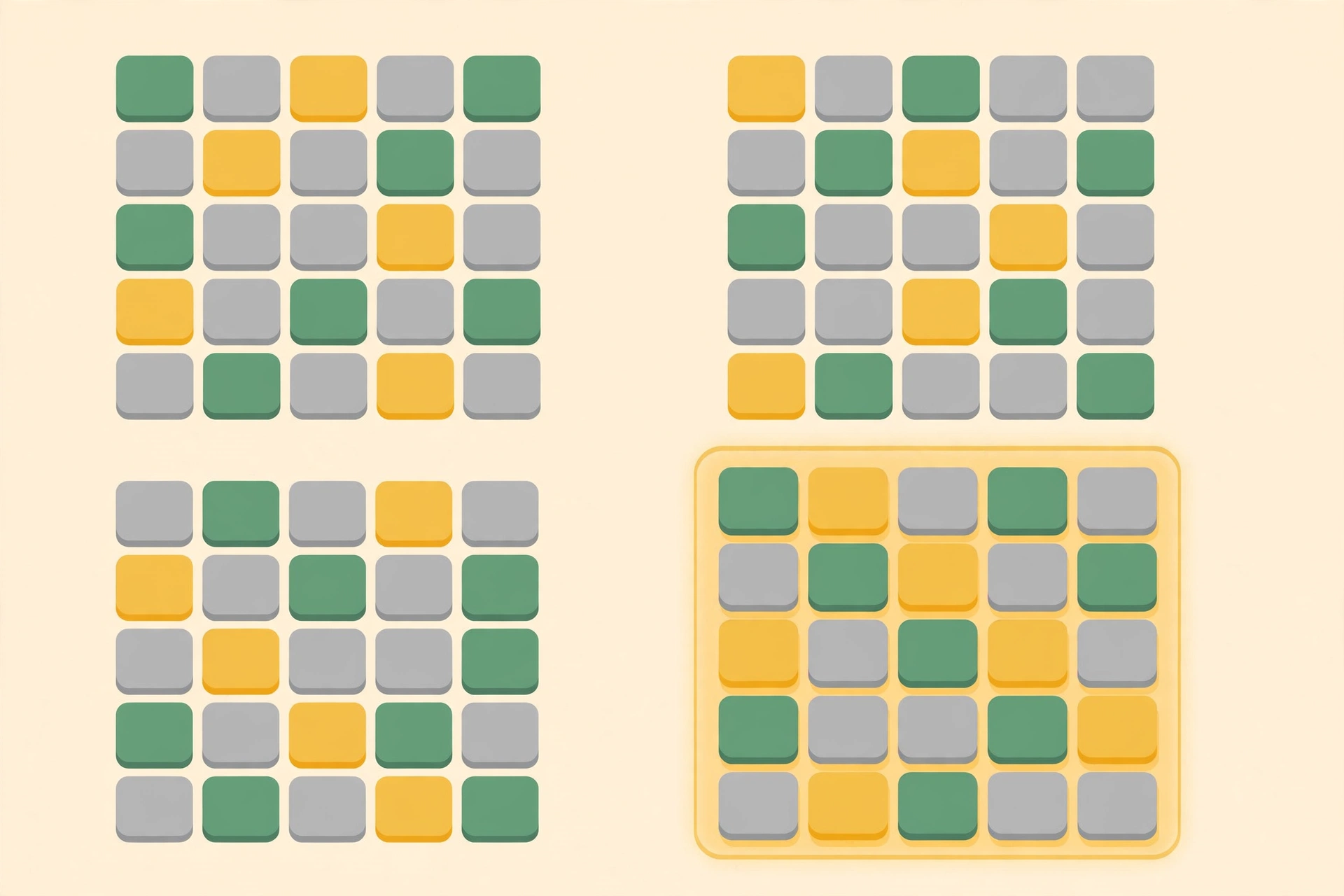
Quordle Daily Sequence is a game mode in Quordle where you solve four five-letter words one at a time, in a fixed order. You get 10 guesses in total, shared across all four words, and the next word only unlocks after you solve the one in front of you. Clues do not carry over between words, so each word is effectively a fresh mini-Wordle.
If classic Quordle is a juggling act, Daily Sequence is a relay race. Every word has to be finished before the next one can start, which makes guess management the entire game. This guide explains how the mode works, how it differs from regular Quordle, and the strategies that will keep your daily streak alive.
What Is Quordle Daily Sequence?
Quordle Daily Sequence is one of the game modes in Quordle, the four-word Wordle spin-off created by developer Freddie Meyer in February 2022 and acquired by Merriam-Webster in January 2023 (Wikipedia). While classic Quordle shows all four grids at once and scores every guess against all four words, Daily Sequence hides them: only one board is visible at a time, and you must solve the words in order.
The mode gets a fresh puzzle every day, and sites such as TechRadar publish dedicated hints and answers for the Daily Sequence alongside the standard Quordle puzzle. If you enjoy solving multiple words in one puzzle, our Waffle word game guide covers another grid-twist Wordle variant.
How the Daily Sequence Mode Works
The rules
- Four hidden five-letter words. Same as classic Quordle — but they are not revealed all at once.
- You see only one board at a time. The current word is displayed on a single Wordle-style grid. The other three stay hidden until you unlock them.
- Solve the word to unlock the next. When you guess the current word correctly, the board clears and the next word's grid appears with a fresh, blank keyboard. You cannot move on until the word in front of you is solved.
- Ten guesses, shared across all four words. Every guess you spend on word one is a guess you no longer have for words two, three and four.
- Colour clues work exactly like Wordle. Green means the right letter in the right position, yellow means the letter is in the word but misplaced, and grey means it is not in the word at all.
- Clues do not carry over. Each word is independent. The on-screen keyboard resets when a new board unlocks, so a letter that was grey in word one can perfectly well appear green in word two. (wordunscrambler.net)
Quordle Daily Sequence vs Classic Quordle
The two modes look similar — four words, five letters each, Wordle colour feedback — but they play like different games:
| Classic Quordle | Daily Sequence | |
|---|---|---|
| Guesses | 9, shared across all four words | 10, shared across all four words |
| Boards visible | All four at once | One at a time |
| Guess scoring | One guess is scored against all four words simultaneously | A guess only ever tells you about the current word |
| Order of solving | Any order — you work on whichever word you like | Fixed order — you must finish word one before word two unlocks |
| Information per guess | High: one opening guess gives clues on four boards | Low: a guess only informs one board |
| Keyboard between words | Carries over all game | Resets to blank for each new word |
Why Sequence Feels Harder Despite More Guesses
On paper, Daily Sequence looks generous: ten guesses for four words versus nine in the classic game. In practice, most players find Sequence harder, and the reason is information rather than arithmetic.
In classic Quordle, a strong opening guess like RAISE is doing four jobs at once. It gathers evidence about all four answers in parallel, and by your third guess you usually have a foothold on each board. That work compounds.
Sequence removes that leverage entirely. A guess only ever tells you about the single board in front of you, so nothing compounds. Solving each word in two or three guesses feels comfortable; needing five on the first word puts real pressure on the remaining three. The mode rewards efficiency, not cleverness.
Tips and Strategies to Win at Daily Sequence
Because you cannot recycle information across boards, Daily Sequence needs a different playbook. These strategies will help you spend your ten guesses wisely. General word-game fundamentals help too — our daily word puzzle tips cover tactics that carry across every Wordle-style game.
1. Open with your best starter every single time
Your first guess of each new word is your most valuable tool. Open every board with a strong Wordle starter packed with common vowels and consonants — RAISE, SLATE, CRANE and ADIEU are popular for a reason. Since the keyboard resets, your best word is your best word; there is no need to vary it.
2. Budget your guesses: aim for 2 to 3 per word
Think of your ten guesses as four small budgets. Solving each word in two or three guesses wins comfortably; spending five or six on an early word leaves you short at the end. If you are on guess four of word one with no clear answer in sight, think hard before burning another turn.
3. Do not chase perfect information
In classic Quordle it is tempting to play extra "probe" guesses that test new letters without committing to an answer. In Sequence, probes are expensive: a probe that fails teaches you nothing about the words still to come. Play guesses that could plausibly be the answer, and only probe when you are stuck between two or three candidates.
4. Use every colour clue, including the greys
Greys are information. Because each board is a standalone puzzle, the letters you rule out are just as valuable as the ones you keep. Before each guess, scan the eliminated letters first — repeating a grey letter in Sequence is a pure wasted guess, since no other board can benefit from it.
5. Slow down on words three and four
The later boards arrive when you are mentally tired and short on guesses, which is exactly when trap words — repeated letters like KNOCK, or uncommon combinations like WALTZ — do their damage. A calm extra thirty seconds of thought costs you nothing; a wasted guess costs you everything.
6. Treat it as four separate Wordles
The biggest mindset shift for classic Quordle players is to stop comparing this mode to the one they know. Switch to a Wordle-style mindset — solve this board, move on, forget the last board — and the game gets noticeably easier.
Where to Play Quordle Daily Sequence
The official game is hosted on Merriam-Webster's website, where Daily Sequence sits alongside the classic daily puzzle and the other Quordle modes. Like the classic mode, it is free to play in your browser with no sign-up required. For more one-a-day challenges, browse our daily puzzle games list.
Final Word
Quordle Daily Sequence takes everything players love about Quordle — four words, shared guesses, Wordle-style colour feedback — and adds one twist: you can only see what you are working on right now. Budget your guesses, respect every grey letter, and treat each board as its own five-letter puzzle. Do that, and the daily streak is yours.
How many guesses do you get in Quordle Daily Sequence?
You get ten guesses in total, shared across all four words. Guesses you spend on the first word are gone for the rest of the game, so solving the early words efficiently matters.
How is Daily Sequence different from normal Quordle?
In normal Quordle, all four boards are visible and every guess is scored against all four words at once. In Daily Sequence, you see only the board you are working on. You must solve that word before the next one unlocks, so a guess only ever tells you about one answer.
Do clues carry over between words in Sequence mode?
No. Each word is independent, and the on-screen keyboard resets to blank when a new board unlocks. A letter that was grey for word one can easily be green for word two.
Is there a new Daily Sequence puzzle every day?
Yes. The Daily Sequence puzzle refreshes once a day, at the same time as the classic Quordle puzzle. Sites like TechRadar publish fresh hints and answers for both modes daily.
Why is Sequence harder than regular Quordle despite having more guesses?
Because you cannot bank information. In regular Quordle, a single opening guess gives you clues on four boards at once. In Sequence, that same guess only ever informs the one board in front of you, so the extra guesses do not buy as much as they look like they should.
Can you replay a missed Daily Sequence puzzle?
The official game only offers the current day’s puzzle, and it cannot be replayed once the day passes. However, fan-made unlimited Sequence clones let you practice the mode as often as you like.