
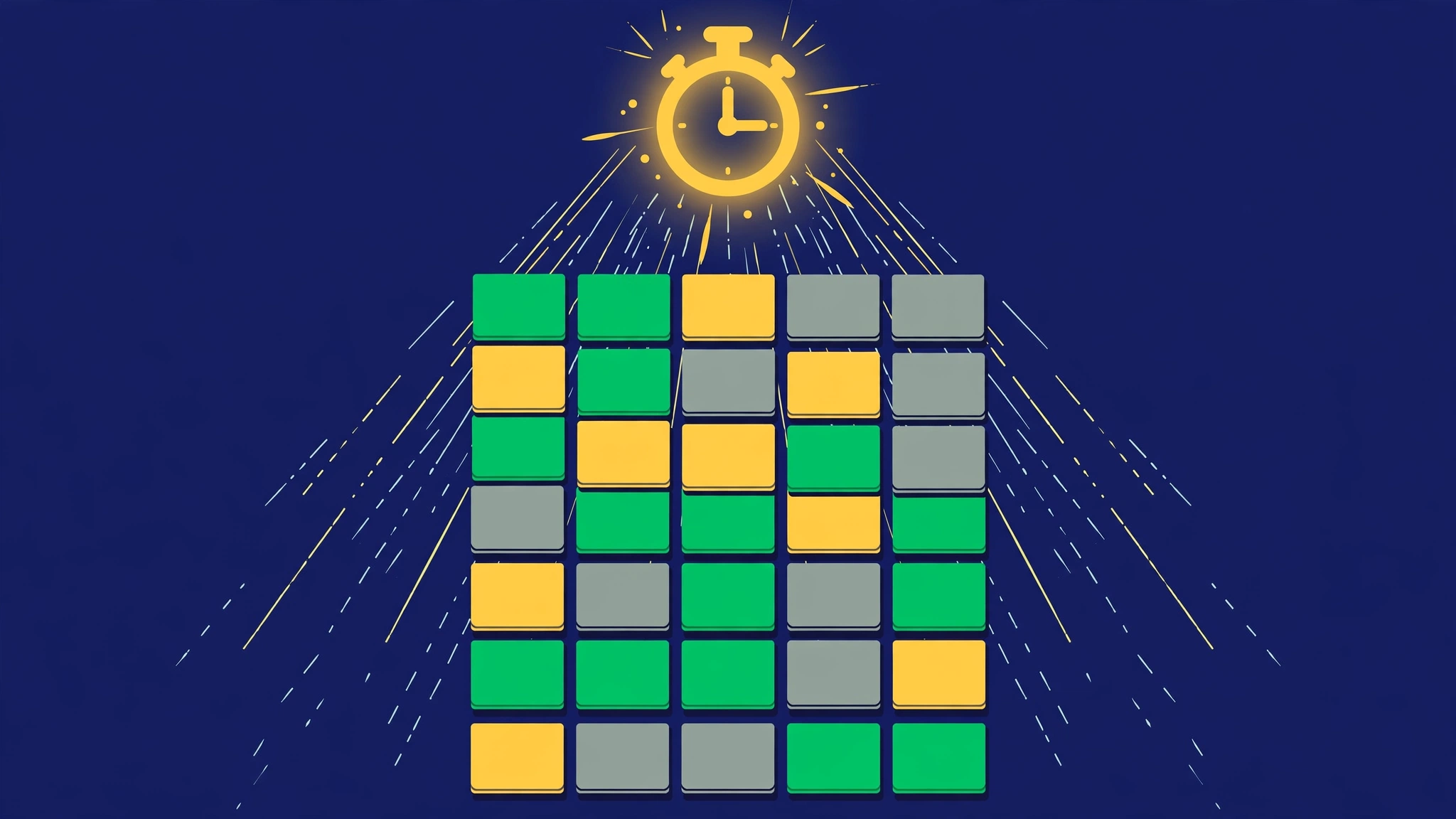
Seven Wordles is a speed-run Wordle variant that asks you to solve seven Wordle puzzles in a row while a prominent timer clocks how long you are taking. Every wrong guess costs you 3 seconds of penalty time, turning Wordle's calm deduction into a fast-paced race against yourself.
If the original Wordle feels too relaxed, Seven Wordles adds the one ingredient it deliberately left out: a clock. Below is everything you need to know, from how it works to where to play and how to get faster.
The short version
- The game: Seven Wordles — solve seven Wordle puzzles back-to-back against a timer.
- The twist: Each incorrect guess adds a 3-second penalty to your total time.
- The format: Six attempts per word, standard Wordle green/yellow/grey feedback, played on portals like wordle-unlimited.io/seven-wordles, dordle.io/seven-wordles and rankdle.io/seven-wordles.
- The origin: Documented in early Wordle-clone roundups (GitHub "wordle-list" collections list "Seven Wordles: Do 7 wordles, timed" at wooferzfg.me/seven-wordles/), and described by Commonsense Education's educator guide as "if Wordle is too easy for you, give Seven Wordles a try."
- The unofficial status: Like most Wordle clones, Seven Wordles is a fan-made game with no connection to the New York Times.
How Seven Wordles works, step by step
- Open the game. Several game portals host their own editions of Seven Wordles; the core rules are the same everywhere.
- The timer starts. A clock begins running the moment your first puzzle loads.
- Solve Wordle #1. You get the usual six attempts to guess a five-letter word, with green, yellow and grey tile feedback after every guess.
- Move on immediately. As soon as one word is solved, the next puzzle starts — there are seven in total.
- Watch the penalties. Every wrong guess across the whole run adds 3 seconds to your time. Slow, careful play and fast, sloppy play both carry costs.
- Finish all seven. Your final score is your total time. Some editions show the correct answer no matter what, so a failed puzzle doesn't end the run.
The 3-second penalty: why it changes everything
Standard Wordle has no clock, so the optimal strategy is to think as long as you like. Seven Wordles makes thinking itself part of the cost. Because every incorrect guess costs three extra seconds on top of the time you already spent typing and thinking, the game rewards a particular balance:
- Fast solvers who guess aggressively risk stacking up penalty seconds.
- Careful solvers who deliberate too long bleed raw time.
The sweet spot is a brisk, disciplined pace — the same strategic guessing you'd use in Wordle, but with your foot slightly on the accelerator. This dual pressure of speed plus accuracy is what makes Seven Wordles feel like a genuinely different game rather than just "more Wordle."
Seven Wordles vs classic Wordle: side-by-side
| Feature | Classic Wordle (NYT) | Seven Wordles |
|---|---|---|
| Words per session | 1 | 7, played in a row |
| Guesses per word | 6 | 6 |
| Timer | None | Prominent running timer |
| Penalty for wrong guesses | None | 3 seconds added per wrong guess |
| Play limit | Once a day (daily) | Unlimited — play as often as you like |
| Word source | Curated NYT list | Portal-provided lists |
| Official or fan-made | Official (NYT) | Fan-made clones |
The comparison highlights what changes and what stays the same: the core guessing rules are identical — six attempts per five-letter word with the same green/yellow/grey feedback — but everything around them is different. The daily limit disappears, the timer appears, and every wrong guess carries a time cost instead of being free information. That shift in framing is why strategy changes too: in classic Wordle you can deliberate indefinitely, while in Seven Wordles you are constantly trading speed against accuracy across all seven puzzles.
Where to play Seven Wordles
Seven Wordles lives on browser game portals rather than in an app store. Portals that carry their own editions include wordle-unlimited.io/seven-wordles, dordle.io/seven-wordles and rankdle.io/seven-wordles, and the original build is listed at wooferzfg.me/seven-wordles/ in the GitHub "wordle-list" directories of Wordle clones. These are unofficial fan-run pages, not affiliated with the New York Times.
If you prefer the calm original, Plusword's own daily puzzle keeps the classic feel: see how to play Plusword, and compare the two experiences in Plusword vs Wordle.
7 tips for a faster Seven Wordles run
- Use one strong opener for all seven boards. A vowel-heavy starter like AUDIO, CRANE or STARE clears most letters quickly. Consistency beats creativity here.
- Don't burn guesses testing confirmed greys. With a clock running, the penalty of a wasted guess is doubled — a lost attempt plus 3 seconds.
- Type while you think. Since raw time matters, many experienced players start typing their next candidate while still reading the tile feedback.
- Know your common patterns. Letter pairs like CH, SH, TH, CK, ER and EE solve late-game stalls fast; hesitation is the timer's best friend.
- Keep position knowledge across puzzles. Seven puzzles back-to-back rewards the solver who maintains a mental list of remaining letters per position.
- Accept some wrong guesses. A run with a few penalties and fast solving beats a slow "perfect" run. The 3-second cost is deliberately small.
- Practice on unlimited editions. Because portals let you replay endlessly, run the same session several times to learn the word list — your times will drop quickly.
Seven Wordles in the multi-Wordle family
Seven Wordles sits between two older ideas in the Wordle-clone ecosystem. It is not the simultaneous-solving games (Dordle's two boards, Quordle's four, Sedecordle's sixteen, Duotrigordle's thirty-two) — those are about splitting attention across boards at once. Seven Wordles is sequential: one word at a time, seven in a row, with a clock. That puts it closer to a speedrun format than to the multi-board format, and it fills the niche for players who want Wordle with urgency rather than Wordle with more boards.
The bottom line
Seven Wordles takes the world's calmest puzzle and adds the world's oldest game mechanic — a timer. Seven puzzles, six tries each, and three seconds of penalty for every miss. If one Wordle a day leaves you wanting more, this is the speed-run fix. It will not replace the original's quiet daily ritual — the two games serve different moods — but for players who want to test how fast their Wordle instincts really are, Seven Wordles is the most honest measure in the clone universe. Pick one opener, keep your typing brisk, accept a few penalties, and watch your times fall.
What is Seven Wordles?
Seven Wordles is a timed Wordle variant in which you solve seven Wordle puzzles in a row against the clock. Each wrong guess adds a 3-second penalty to your total time.
How many guesses do you get in Seven Wordles?
You get the standard six attempts per word — 42 total guesses across the seven puzzles — with green, yellow and grey tile feedback.
What is the penalty in Seven Wordles?
Every incorrect guess adds 3 seconds to your final time. The penalty applies across all seven puzzles in the run.
Is Seven Wordles official?
No. Seven Wordles is a fan-made clone hosted on independent game portals, with no affiliation to the New York Times or the official Wordle game.
Where can I play Seven Wordles?
Browser portals host editions of the game, including wordle-unlimited.io, dordle.io and rankdle.io. The original is listed at wooferzfg.me/seven-wordles/ in Wordle-clone directories.
How is Seven Wordles different from Dordle or Quordle?
Dordle, Quordle and similar games are simultaneous multi-board puzzles you solve at once. Seven Wordles is sequential — one word at a time, seven in a row — with a timer and penalties.
Can you replay Seven Wordles?
Yes. Unlike the once-a-day official Wordle, portal editions of Seven Wordles can be played as many times as you like per day.
What is a good Seven Wordles time?
There is no official benchmark, but competitive players aim for fast, consistent runs with minimal penalties — practice with a fixed opener and common letter pairs to bring your time down.