
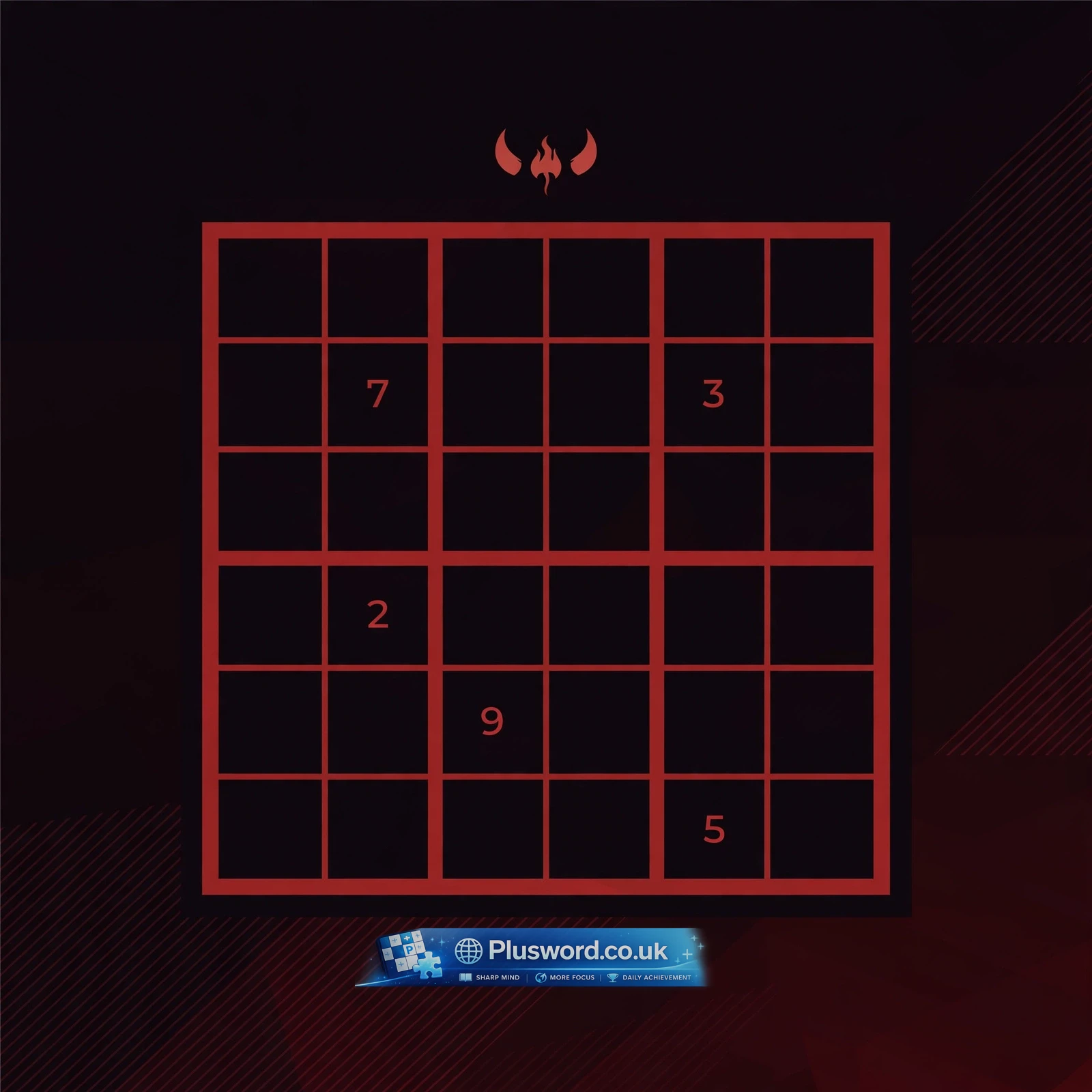
If you have worked your way up from easy grids to hard ones and started wondering what comes next, the answer on most sudoku sites is a level with an intimidating name: evil. Evil sudoku is the hardest standard difficulty level offered by online sudoku platforms such as Sudoku.com, LiveSudoku and WebSudoku. It uses the normal 9×9 grid and the exact same rules, but gives very few starting clues and demands advanced solving techniques like X-Wing, Swordfish and XY-Wing.
This is not a variant with new rules or a trick mode. It is classic sudoku pushed to its logical extreme. This guide explains what the evil level means, how it compares to hard and expert, the techniques you need, and where to play it free.
What Does “Evil” Mean in Sudoku?
The name comes from the difficulty grading system popularised by Sudoku.com, and it has since been adopted by many other puzzle sites. On some platforms the same top tier is labelled “extreme” or “diabolical”, but it refers to the same thing: the hardest puzzles the site’s generator produces.
An evil puzzle is defined by its solving path, not by different rules. What changes is how little information you are given and how deep the logic must go. Where a hard puzzle might yield to locked candidates and hidden pairs, an evil puzzle will stall completely until you spot multi-unit patterns such as an X-Wing or a Swordfish.
Evil vs Other Sudoku Difficulty Levels
Most sudoku sites use a five-step scale. Here is how evil compares:
| Level | Typical starting clues | Key techniques needed | Best for |
|---|---|---|---|
| Easy | 35+ | Naked singles, hidden singles | Beginners, warm-ups |
| Medium | 30–35 | Naked/hidden pairs, pointing pairs | Regular players |
| Hard | 26–30 | Locked candidates, hidden pairs, box/line reduction | Confident solvers |
| Expert | 24–27 | X-Wing, simple colouring | Advanced players |
| Evil | 22–26, sometimes fewer | X-Wing, Swordfish, XY-Wing, forcing chains | Expert solvers only |
The clue counts above are typical ranges, not fixed rules — difficulty is really about the solving path. Some evil puzzles approach the mathematical minimum of 17 given digits, the fewest clues ever proven to allow a unique 9×9 solution.
What Makes Evil Sudoku So Hard?
Three things separate evil puzzles from everything below them:
- Very few givens. With barely two dozen starting digits, there are almost no easy singles to anchor on. You must build a full candidate grid before real progress begins.
- Deep solving paths. A single placement can depend on a chain of five or six eliminations. Miss one candidate update and the key pattern stays invisible.
- Multi-unit patterns. Hard puzzles mostly reward logic inside one row, column or box. Evil puzzles force you to track a single digit across several rows and columns at once — exactly what X-Wing and Swordfish are for.
Importantly, a well-made evil puzzle never requires guessing. Every one is solvable by pure logic. If you find yourself tempted to try a digit “just to see”, that is a signal you have missed a pattern — not that the puzzle is broken.
Techniques You Need to Solve Evil Sudoku
Before attempting evil, have the hard-level toolkit (naked/hidden singles and pairs, locked candidates, pointing pairs) completely automatic. On top of that, evil demands the following.
X-Wing
The workhorse of evil-level solving. When a candidate digit appears in exactly two cells in two different rows, and those four cells line up in the same two columns (forming a rectangle or “X”), that digit must occupy opposite corners of the rectangle. You can therefore eliminate the digit from every other cell in those two columns. The same logic works with rows and columns swapped.
Swordfish
Swordfish is X-Wing’s bigger sibling: the same idea extended to three rows and three columns. If a candidate appears in two or three cells in each of three rows, and all of those cells fall within the same three columns, you can eliminate the candidate from the other cells in those columns.
XY-Wing
Also called Y-Wing, this uses three cells with exactly two candidates each. A “pivot” cell holds candidates XY, and two “pincer” cells hold XZ and YZ, each sharing a row, column or box with the pivot. Any cell that can see both pincers cannot contain Z.
Colouring and Forcing Chains
Simple colouring tracks a single digit through pairs of cells: the digit must be in one of each pair, so you colour them alternately and follow the chain to find contradictions. Forcing chains extend the idea into if-then sequences — if a cell were X, a chain of consequences follows, and a contradiction eliminates X. Treat these as a last resort after the pattern-based techniques.
Unique Rectangles
A bonus pattern: if four cells forming a rectangle in two rows, two columns and two boxes all contain the same two candidates, placing them wrongly would create a puzzle with two solutions. Since valid puzzles have exactly one solution, you can eliminate accordingly.
Where to Play Evil Sudoku Online Free
Several well-established sites include an evil tier alongside their easier levels:
- Sudoku.com — the site that popularised the “evil” label; daily evil puzzles plus a full archive.
- LiveSudoku — evil boards with a smart hint system that explains the next advanced step.
- WebSudoku — classic interface with easy, medium, hard and evil levels in the browser.
- 1sudoku.com — five levels from easy to evil, free and unlimited, with printable puzzles.
- SudokuOnline.io — easy, medium, hard and evil puzzles with a clean modern interface.
Most of these work on mobile, tablet and desktop with no sign-up required.
Tips for Solving Evil Sudoku
- Fill in complete pencil marks first. Evil solving lives or dies on candidate accuracy. Write every possible candidate in every empty cell before hunting for patterns.
- Update candidates after every move. A single stale candidate can hide the X-Wing you need.
- Scan by digit, not by cell. Pick one digit and inspect where it can still go across rows and columns. Fish patterns are far easier to see this way.
- Exhaust the basics before going advanced. Always re-scan for singles, pairs and pointing pairs after each elimination — they cascade, and many solvers waste time hunting Swordfish when a hidden triple would do.
- Check both orientations. X-Wing and Swordfish work row-based and column-based. If you only scan rows, you miss half the patterns.
- Drop back to hard for training. If evil feels too slow, play hard puzzles and focus on clean, fast candidate elimination. That habit carries directly into advanced patterns.
Frequently Asked Questions
- What is evil sudoku? Evil sudoku is the hardest standard difficulty level on sudoku sites, using the normal 9×9 grid and rules but very few starting clues. Solving it requires advanced techniques such as X-Wing, Swordfish and XY-Wing.
- Is evil sudoku harder than hard sudoku? Yes. Hard sudoku is usually solved with locked candidates, naked pairs and hidden pairs. Evil sudoku adds advanced multi-unit patterns like X-Wing, Swordfish, XY-Wing and forcing chains, with a much deeper solving path.
- What is the hardest sudoku difficulty? On most sudoku websites, “evil” is the hardest labelled difficulty, sitting above expert. Some sites call the same tier “extreme” or “diabolical”, but they all mean the top difficulty level.
- How many clues does an evil sudoku have? Evil puzzles typically start with around 22 to 26 given digits, and some approach the proven mathematical minimum of 17 clues for a unique 9×9 solution. Fewer clues mean a longer, harder solving path.
- What techniques do I need to solve evil sudoku? You need everything from the lower levels plus X-Wing, Swordfish, XY-Wing, simple colouring, forcing chains and ideally unique rectangles. Full, accurate pencil marks are essential before any of these work.
- Can beginners play evil sudoku? Beginners can try, but it will not be enjoyable yet. Evil assumes you already solve hard puzzles comfortably. Work up through medium and hard first, and learn X-Wing before attempting your first evil grid.
- How long does an evil sudoku take to solve? It varies widely. Experienced solvers may finish in 15 to 30 minutes, while most players need 45 minutes to over an hour for their first evil puzzles.
- Do you have to guess in evil sudoku? No. Every valid evil puzzle is solvable by pure logic with no guessing. If you feel forced to guess, you have missed a pattern — audit your candidates and scan by digit again.
- Is evil the same as expert sudoku? Not quite. Expert is usually the level just below evil and introduces X-Wing and simple colouring. Evil adds Swordfish, XY-Wing, forcing chains and even sparser clues, making it a clear step harder.
- Where can I play evil sudoku online for free? Sudoku.com, LiveSudoku, WebSudoku, 1sudoku.com and SudokuOnline.io all offer free evil-level puzzles playable in the browser on phone, tablet or desktop, with no sign-up needed for basic play.
Final Thoughts
Evil sudoku is the summit of standard sudoku difficulty — the same 9×9 grid, stripped down to a handful of clues and solvable only through genuinely advanced logic. It rewards patience, immaculate candidate notes and the quiet satisfaction of spotting a Swordfish that cracks the whole grid open.
Start by mastering X-Wing on hard puzzles, then take on your first evil grid with full pencil marks and no rush. And if you want structured practice first, try choosing the right sudoku puzzle book, or test yourself on our Plusword daily puzzles between sessions.
What is evil sudoku?
Evil sudoku is the hardest standard difficulty level on sudoku sites, using the normal 9×9 grid and rules but very few starting clues. Solving it requires advanced techniques such as X-Wing, Swordfish and XY-Wing.
Is evil sudoku harder than hard sudoku?
Yes. Hard sudoku is usually solved with locked candidates, naked pairs and hidden pairs. Evil sudoku adds advanced multi-unit patterns like X-Wing, Swordfish, XY-Wing and forcing chains, with a much deeper solving path.
What is the hardest sudoku difficulty?
On most sudoku websites, “evil” is the hardest labelled difficulty, sitting above expert. Some sites call the same tier “extreme” or “diabolical”, but they all mean the top difficulty level.
How many clues does an evil sudoku have?
Evil puzzles typically start with around 22 to 26 given digits, and some approach the proven mathematical minimum of 17 clues for a unique 9×9 solution. Fewer clues mean a longer, harder solving path.
What techniques do I need to solve evil sudoku?
You need everything from the lower levels plus X-Wing, Swordfish, XY-Wing, simple colouring, forcing chains and ideally unique rectangles. Full, accurate pencil marks are essential before any of these work.
Can beginners play evil sudoku?
Beginners can try, but it will not be enjoyable yet. Evil assumes you already solve hard puzzles comfortably. Work up through medium and hard first, and learn X-Wing before attempting your first evil grid.
How long does an evil sudoku take to solve?
It varies widely. Experienced solvers may finish in 15 to 30 minutes, while most players need 45 minutes to over an hour for their first evil puzzles.
Do you have to guess in evil sudoku?
No. Every valid evil puzzle is solvable by pure logic with no guessing. If you feel forced to guess, you have missed a pattern — audit your candidates and scan by digit again.
Is evil the same as expert sudoku?
Not quite. Expert is usually the level just below evil and introduces X-Wing and simple colouring. Evil adds Swordfish, XY-Wing, forcing chains and even sparser clues, making it a clear step harder.
Where can I play evil sudoku online for free?
Sudoku.com, LiveSudoku, WebSudoku, 1sudoku.com and SudokuOnline.io all offer free evil-level puzzles playable in the browser on phone, tablet or desktop, with no sign-up needed for basic play.