
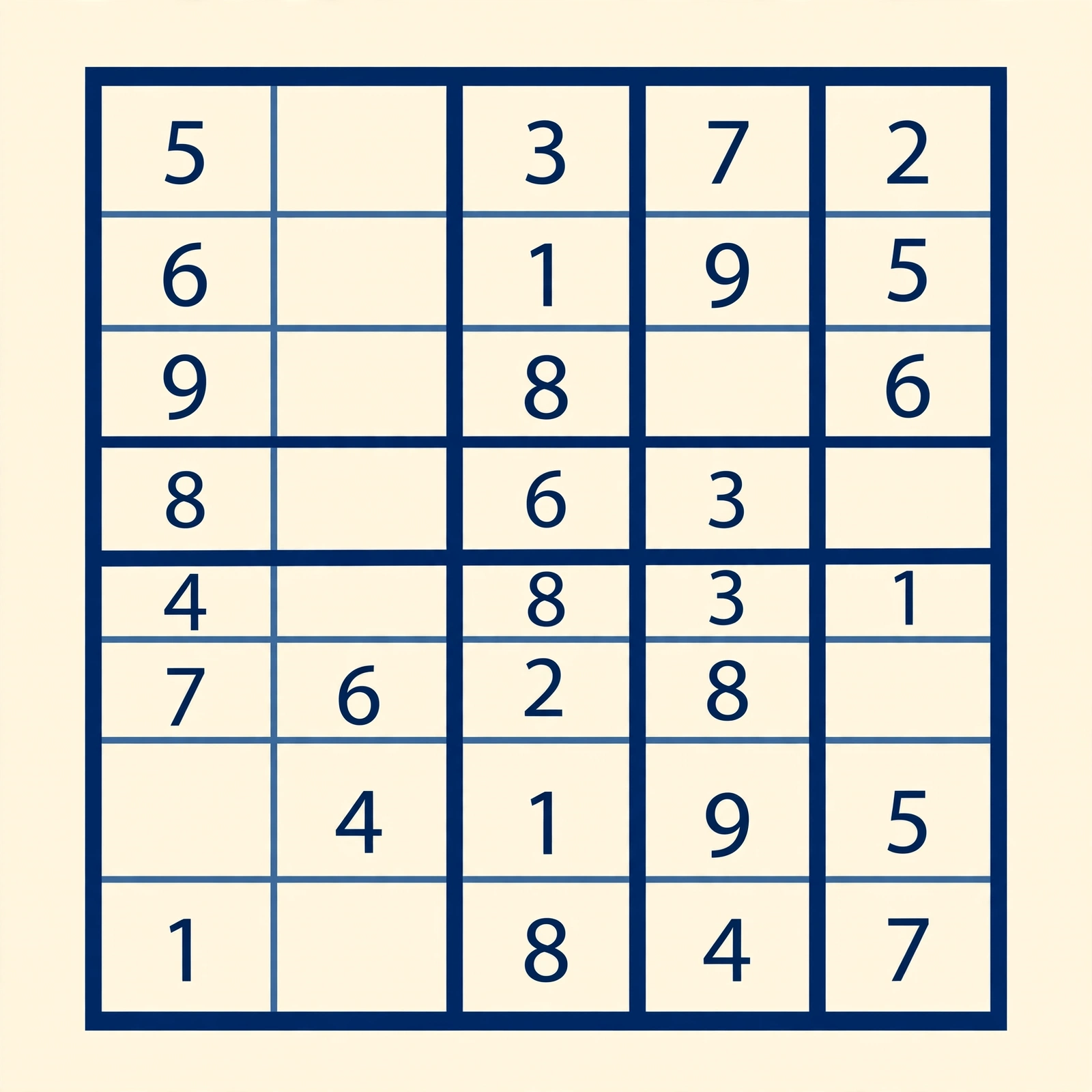
A sudoku grid is a 9×9 arrangement of 81 cells, divided into nine 3×3 boxes. The goal is to fill every row, every column, and every box with the digits 1 to 9, each appearing exactly once. No arithmetic is involved — it's pure logic. Here's the full anatomy of the grid, the rules, and the verified story of how it conquered the world.
The Anatomy of a Sudoku Grid
Every classic sudoku grid has the same skeleton (Sudoku on Wikipedia):
- 81 cells — nine rows by nine columns.
- 9 rows — horizontal lines of nine cells.
- 9 columns — vertical lines of nine cells.
- 9 boxes — the grid is subdivided into nine 3×3 subgrids, also called blocks or regions, each holding nine cells.
- Givens — the pre-filled digits the puzzle setter provides as your starting point.
The rule is a single elegant constraint: each row, each column, and each 3×3 box must contain all digits from 1 to 9, with no repeats (Sudoku on Wikipedia). A well-posed puzzle has exactly one solution — give the same grid to two solvers, and even working completely different paths, they'll arrive at identical completed grids.
Key terms
| Term | Meaning |
|---|---|
| Grid | The full 9×9 arrangement of cells |
| Cell | One individual square, filled with a single digit |
| Row | A horizontal line of 9 cells |
| Column | A vertical line of 9 cells |
| Box | A 3×3 region of 9 cells (also called block or region) |
| Given | A pre-filled cell that starts the puzzle |
| Solution grid | A completely filled grid with no contradictions |
How the Grid Constrains the Solution
Because every digit must appear exactly once in each row, column, and box, each of the digits 1–9 appears exactly nine times in a finished grid — 81 cells divided by 9 digits. That triple constraint is what makes the puzzle solvable by logic alone: a candidate digit is eliminated from a cell the moment it already appears in that cell's row, column, or box.
This is also why the placement of givens matters so much. Nikoli, the Japanese publisher that popularised the puzzle, introduced two refinements in 1986: limiting the number of givens to no more than 32, and making puzzles symmetrical — the givens distributed in rotationally symmetric cells. Symmetry isn't just aesthetic; it helps guarantee a single clean solution path.
The Verified History of the Sudoku Grid
The 9×9 grid has a surprisingly well-documented past (Sudoku on Wikipedia):
- 1979 — Number Place. The modern puzzle first appeared in Dell Magazines' puzzle books under the name Number Place, designed by Howard Garns, a 74-year-old retired architect and freelance puzzle constructor from Connersville, Indiana. Garns died in 1989, before his creation became a worldwide phenomenon.
- 1984 — Japan. The puzzle was introduced in Japan by Nikoli in the magazine Monthly Nikolist as "Suuji wa dokushin ni kagiru" — "the digits must be single" or "the digits are limited to one occurrence."
- 1986 — Sudoku. Nikoli president Maki Kaji abbreviated the name to Sudoku, from "su" (number) and "doku" (single). Sudoku remains a registered trademark in Japan, where the puzzle is often called Number Place (Nanpure).
- 1997–2004 — Wayne Gould. New Zealander Wayne Gould, a retired Hong Kong judge, encountered the puzzle in a Tokyo bookshop in 1997 and spent years writing a computer program to mass-produce unique puzzles.
- November 2004 — The Times. The Times of London began printing Gould's puzzles in November 2004, and within weeks every British newspaper had a grid on its puzzle page. From there it swept the US and the world.
The roots run even deeper: French newspapers featured similar number-grid puzzles in the 1890s, and the Latin squares behind them trace back to the 18th-century mathematician Leonhard Euler (japaninc.com).
Reading a Sudoku Grid Like a Solver
New players often stare at 81 empty cells and freeze. Train your eye on the grid's structure instead:
- Start with the most frequent given digit. Each given eliminates that digit from its entire row, column, and box — so the digit with the most givens gives you the most information.
- Work box by box. Each 3×3 box is a self-contained mini-puzzle: find which digits are missing, then use row and column constraints to place them.
- Scan for singles. A cell whose row, column, and box collectively rule out eight digits must hold the ninth.
- Count, don't calculate. Remember: no maths is required — the digits are symbols. The puzzle would work identically with letters or shapes (Sudoku on Wikipedia).
- Cross-hatch rows and columns. Pick a digit, then sweep each row: if the digit already appears in a row, it can't appear again in the same row's cells of any box. Do the same down each column. Where the blocked rows, columns, and existing box digits leave only one open cell, you've found a placement — the most fundamental sudoku technique of all.
Want more number puzzles? Our guide to sudoku puzzle books explains how to choose the right difficulty, and crossword books for adults covers the word-puzzle side.
Common Sudoku Grid Misconceptions
- "It's a maths puzzle." It isn't — no calculations are ever applied to the numbers. The digits are symbols, and the puzzle would work identically with letters or shapes. It's pure logic.
- "Harder puzzles have fewer givens." Not necessarily. A well-posed puzzle with 26 givens can be harder than a sloppy one with 22. Difficulty comes from the depth of logic required, not the raw count.
- "The boxes are just decoration." The 3×3 boxes are the third constraint that makes the puzzle work — without them, the puzzle would be a simple Latin square with far less interesting logic.
- "You must fill the grid row by row." The best solvers work wherever the grid gives information — boxes, columns, or rows. Chasing a single row while ignoring the rest is a classic beginner trap.
How many cells are in a sudoku grid?
81 cells — a 9×9 arrangement divided into nine 3×3 boxes ([Sudoku on Wikipedia](https://en.wikipedia.org/wiki/Sudoku)).
What are the three rules of sudoku?
Each row must contain digits 1–9, each column must contain digits 1–9, and each 3×3 box must contain digits 1–9, with no repeats in any of them ([Sudoku on Wikipedia](https://en.wikipedia.org/wiki/Sudoku)).
Who invented the sudoku grid?
The modern 9×9 puzzle was designed by Howard Garns and first published as “Number Place” by Dell Magazines in 1979; it was named Sudoku by Nikoli’s Maki Kaji in 1986 ([Sudoku on Wikipedia](https://en.wikipedia.org/wiki/Sudoku)).
Why is it called Sudoku?
From the Japanese “su” (number) and “doku” (single), shortened from “suuji wa dokushin ni kagiru” — “the digits must be single” ([Sudoku on Wikipedia](https://en.wikipedia.org/wiki/Sudoku)).
Do you need maths to solve sudoku?
No — no calculations are applied to the numbers. The digits are symbols; letters or shapes would work identically ([Sudoku on Wikipedia](https://en.wikipedia.org/wiki/Sudoku)).
When did sudoku become popular?
The Times of London began publishing Wayne Gould’s computer-generated puzzles in November 2004, triggering the global craze ([Sudoku on Wikipedia](https://en.wikipedia.org/wiki/Sudoku)).
What is a 3×3 box in sudoku?
One of the nine subgrids the 9×9 grid is divided into. Each box holds nine cells and must contain the digits 1–9 with no repeats — the third constraint alongside rows and columns.
Can a sudoku grid have more than one solution?
A well-posed puzzle has exactly one solution. Two solvers working completely different paths will arrive at identical completed grids.