
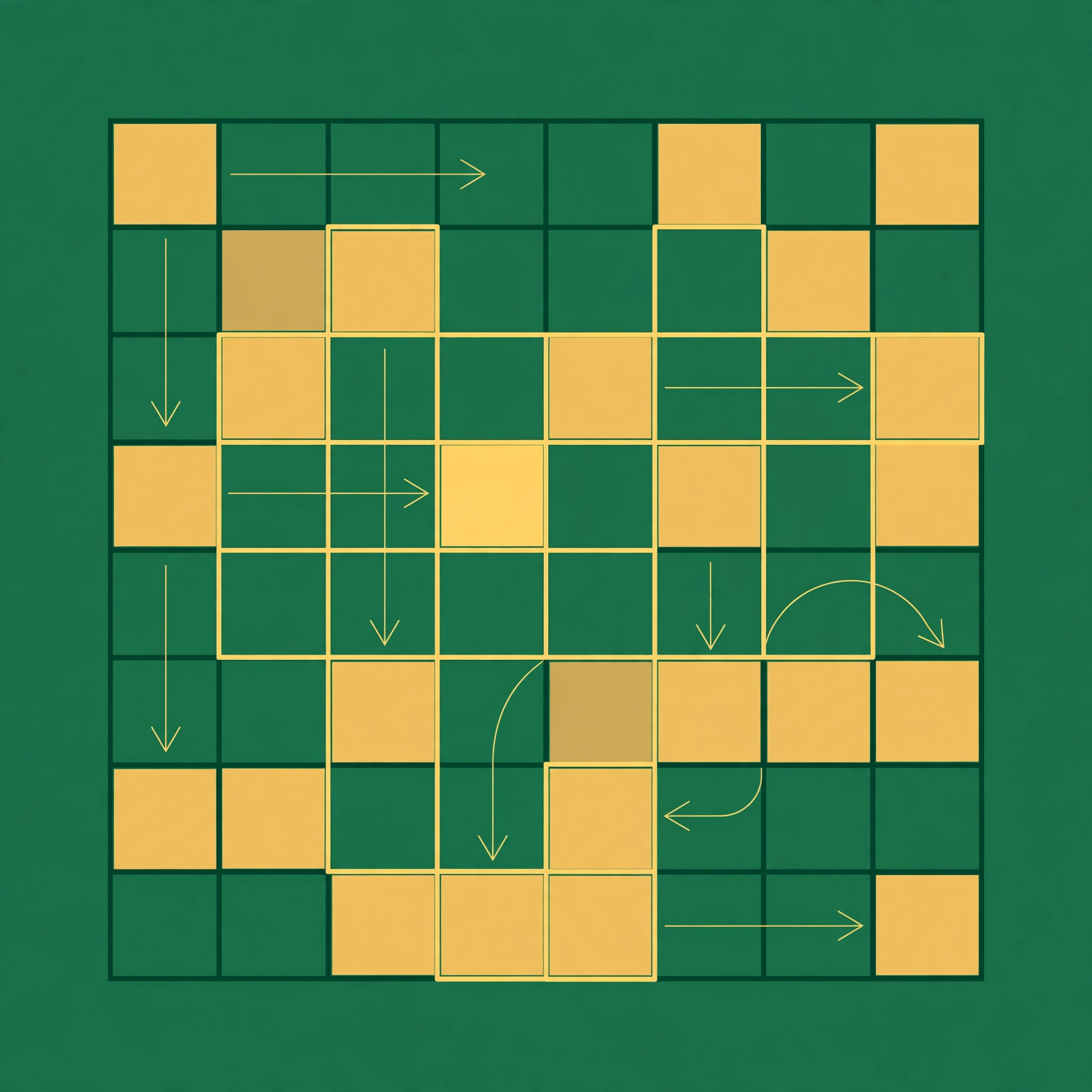
Sudoku tactics are the named logical techniques solvers use to crack puzzles without guessing — from simple scanning to advanced patterns like X-Wing and Swordfish. Every tactic answers one question: "what must logically go here?" Learn them in order, and each difficulty level becomes a matter of applying the right tool at the right time.
> This is a tactics reference — the formal toolkit. For general solving advice and practice habits, see our sudoku tips and tricks guide.
The Tactics Ladder: When to Use What
| Tactic | Level | When to use it |
|---|---|---|
| Scanning | Beginner | First pass on any puzzle |
| Cross-hatching | Beginner | Placing a specific number across the grid |
| Naked singles | Beginner | A cell has only one candidate |
| Hidden singles | Beginner | A number fits only one cell in a unit |
| Naked pairs / triples | Intermediate | Two/three cells share the same candidates |
| Pointing pairs (locked candidates) | Intermediate | Candidates line up within a box |
| Box-line reduction | Intermediate | Box candidates confined to one row/column |
| X-Wing | Advanced | A candidate forms a rectangle across rows/columns |
| Swordfish | Advanced | A candidate forms a 3×3 pattern |
| XY-Wing | Advanced | Three cells with paired candidates pivot |
Beginner Tactics
Scanning
Look at each row, column and 3×3 box in turn and ask what is missing. Nearly full units often reveal their missing digits immediately. Do a full scan at the start of every puzzle.
Cross-hatching
Pick one number (say, 7). Trace the rows and columns that already contain a 7 — the cells they cross off are eliminated. In each 3×3 box missing a 7, the remaining possible cells are often reduced to one. Repeat for each digit 1–9.
Naked singles
When pencil marks show that a cell has only one possible candidate, that number must go there. Fill it in immediately — it often unlocks further singles.
Hidden singles
A subtler find: a number appears as a candidate in only one cell within a row, column or box — even though that cell has other candidates too. That number is forced into that cell.
Intermediate Tactics
Naked pairs and triples
If two cells in the same row, column or box contain exactly the same two candidates, those numbers are locked into those cells — remove them as candidates everywhere else in the unit. The same logic extends to three cells sharing three candidates.
Pointing pairs (locked candidates)
When all instances of a candidate inside a 3×3 box line up in a single row or column, that candidate cannot appear elsewhere in that row or column outside the box. Eliminate it from the rest of the line.
Box-line reduction
The mirror image: when a candidate in a row or column is confined to a single box, eliminate it from the other cells of that box.
Advanced Tactics
X-Wing
Find a candidate that appears in exactly two cells in each of two rows, with the cells aligned in the same two columns — forming a rectangle. That candidate can be eliminated from all other cells in those two columns. (The same works with columns and rows swapped.)
Swordfish
The X-Wing's bigger sibling: a candidate appears in two or three cells across three rows, aligned in the same three columns. Eliminate the candidate from the rest of those columns.
XY-Wing
Three cells form a pivot: one cell with candidates XY, one with XZ, one with YZ. If the pivot is XY, the Z can be eliminated from any cell that sees both "wing" cells.
A Worked Example: Spotting an X-Wing
Theory is easier with a concrete picture. Imagine scanning the grid for the number 5 and finding it as a candidate in exactly two cells of row 2 (columns 3 and 7) and exactly two cells of row 8 (columns 3 and 7). Those four cells form a rectangle — the X-Wing. Because the 5 must occupy one cell in each row, it must sit in opposite corners of the rectangle, which means no other cell in columns 3 or 7 can contain a 5. Cross those candidates out, and the puzzle often collapses into singles. Once you have spotted your first real X-Wing, you will start seeing the pattern everywhere.
Common Tactic Mistakes
- Skipping pencil marks — intermediate tactics are nearly impossible to spot without full candidate notation. Mark everything.
- Forgetting to re-scan — every placement changes the grid. After each fill, re-check for singles before hunting advanced patterns.
- Misidentifying pairs — a naked pair requires the two cells to share exactly the same two candidates and sit in the same unit. Close is not enough.
- Applying tactics out of order — always exhaust singles and pairs before reaching for X-Wing. Advanced tactics on an un-scanned grid waste time.
How to Practise Tactics
- Learn one tactic at a time — master naked singles before touching pairs.
- Use pencil marks religiously — intermediate tactics are invisible without candidate notation.
- Name what you see — saying "that's a pointing pair" trains pattern recognition.
- Replay solved puzzles — revisit a hard puzzle and spot where each tactic applied.
- Drill with targeted puzzle packs. Many sudoku apps and websites offer puzzles tagged by required technique, so you can grind twenty "X-Wing only" puzzles in a row until the pattern becomes reflex. Deliberate practice on one tactic at a time beats solving random hard puzzles where you never know which tool the position needs.
A realistic progression: one week of daily easy puzzles for scanning and cross-hatching, then two to three weeks of medium puzzles forcing pencil marks and pairs, then a month of hard puzzles where you keep an X-Wing checklist beside the grid. By the end, you will not "try tactics" anymore — you will simply see them.
The Bottom Line
Sudoku tactics form a ladder: scanning and singles at the bottom, pairs and pointing in the middle, fish patterns and wings at the top. Climb it one tactic at a time, and no puzzle stays intimidating for long. Start by selecting the right puzzle for your level, then put these tactics to work.
The ladder metaphor hides one truth worth naming: the jump from intermediate to advanced is the real gate. Scanning, singles and pairs are procedural — follow the steps and they work. X-Wing and Swordfish are perceptual — you have to see the rectangle before the logic helps, and seeing it requires hundreds of exposures. Most solvers stall there not because the logic is hard but because they give up before the pattern becomes automatic. Push through with deliberate practice, and one day the rectangle simply appears — which is the moment hard sudoku stops being hard.
What is the best sudoku tactic for beginners?
Cross-hatching combined with scanning solves most easy puzzles. Pick a number, eliminate where it cannot go, and fill the forced cells.
What is the difference between a naked single and a hidden single?
A naked single is a cell with only one candidate. A hidden single is a number that fits in only one cell of a unit, even though that cell lists other candidates.
What is the X-Wing tactic in sudoku?
X-Wing finds a candidate appearing exactly twice in each of two rows, aligned in the same two columns (a rectangle), letting you eliminate that candidate from the rest of those columns.
Do I need advanced tactics for hard sudoku?
Yes — hard puzzles are specifically constructed to require tactics like pointing pairs, triples and X-Wing. Easy tactics alone will stall.
Should I ever guess in sudoku?
Proper tactics never require guessing. If you are guessing, you have missed a tactic — or the puzzle is flawed. Learn the next tactic instead.
What are pencil marks in sudoku?
Small candidate numbers written in empty cells showing which digits could still fit. They are essential for spotting intermediate and advanced tactics.
How long does it take to learn sudoku tactics?
Beginner tactics take a few days of practice; intermediate tactics a few weeks. Advanced patterns like Swordfish can take months to spot reliably — which is part of the appeal.