
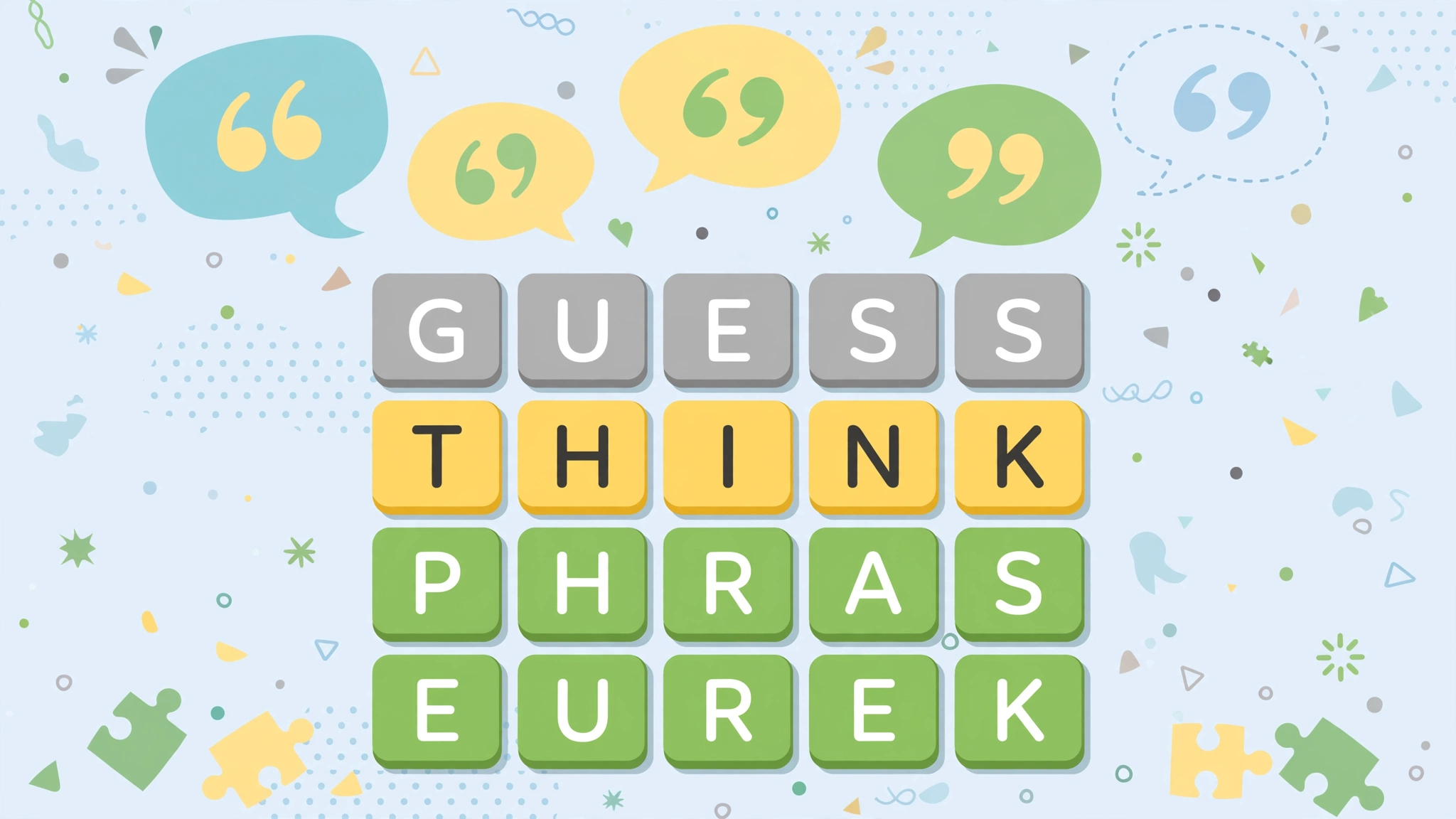
Phrasle is a Wordle-style phrase-guessing game where, instead of guessing a single five-letter word, you guess an entire hidden phrase — an idiom, famous saying, or well-known quote. You get a small number of attempts (usually five) and colour-coded feedback on each letter to work out the full phrase before you run out of guesses.
What Is the Phrasle Game?
Phrasle takes the beloved concept of Wordle and moves it up a level. Rather than a five-letter word, players are presented with the challenge of unravelling a complete phrase. These phrases range from popular sayings and idioms to quotes from movies, books, and historical figures, which makes every round a test of both language skills and general knowledge (source: wordhurdle.co/phrasle).
At the start of each game, Phrasle shows a blank grid representing the hidden phrase. You guess the phrase by inputting letters or words until you correctly unveil the complete answer. After each guess, the game gives colour-coded feedback on the correctness of the letters and their positions, guiding you toward the solution. The game's phrase collection spans many themes, and fresh phrases are added regularly so the experience stays dynamic (source: wordhurdle.co/phrasle).
How to Play Phrasle: Step by Step
Playing Phrasle is straightforward once you know the loop:
- Look at the blank grid. The grid represents the hidden phrase — its layout gives you a sense of the answer's shape.
- Enter your guess. Type letters or words to build a guess at the full phrase, then submit.
- Read the colour feedback. Each letter is highlighted to show how close you are — see the colour key below.
- Refine your guesses. Use the feedback to narrow down the phrase. You have five attempts, so make each one count (source: connections.games/phrasle-game.html).
- Check your statistics. A stats section tracks games played, your success percentage, and how many attempts you used — perfect for measuring improvement (source: connections.games/phrasle-game.html).
There is no time limit in Phrasle, so you can take your time thinking through each guess. If you get stuck, stepping away for a break and returning with fresh eyes often helps crack a difficult phrase.
The Colour Feedback System
Phrasle's feedback works like Wordle's, applied to phrases:
| Colour | Meaning |
|---|---|
| Green | The letter is correct and in the right position |
| Yellow | The letter is in the phrase, but in a different position |
| Grey | The letter does not appear in the phrase at all |
Green letters are your anchors — keep them fixed and work around them. Yellow letters tell you which ingredients you have but not where they go. Grey letters let you rule out whole groups of candidate phrases (sources: wordhurdle.co/phrasle, connections.games/phrasle-game.html).
Phrasle vs Phrazle: Don't Mix Up the Spellings
One letter changes everything. Phrasle (with an S) and Phrazle (with a Z) are different games — and it matters which one you're searching for:
| Feature | Phrasle | Phrazle |
|---|---|---|
| Spelling | P-H-R-A-S-L-E | P-H-R-A-Z-L-E |
| Concept | Guess a hidden phrase/quote | Guess a daily idiom or saying |
| Attempts | Usually 5 | 6 |
| Feedback | Green / yellow / grey letters | Green / gold / purple / grey (purple = letter in a different word) |
| Cadence | Play on demand | New puzzles twice daily, plus unlimited mode |
| Play at | wordhurdle.co and puzzle portals | phrazle.gg |
Phrazle (Z) is the more elaborate product — it offers themed packs (Food, Animals, Sports, Business) and a four-colour feedback system that distinguishes letters in the same word from letters in a different word of the phrase (source: phrazle.gg). Phrasle (S) is the simpler, classic format: five attempts, Wordle-style colours, famous quotes. Both are worth playing, just know which one you sat down to play.
Where to Play Phrasle
Phrasle is a browser game — there's no app to download. You can find it hosted on word-game portals such as wordhurdle.co's Phrasle page, and it also appears on Wordle fan sites like nytwordle.today. It's free to play, works on both desktop and mobile browsers, and requires no sign-up, which keeps the barrier to entry at zero.
Phrasle also comes in multiple languages on some portals — versions exist in English, French, Spanish, and Ukrainian — so the same phrase-deduction mechanic doubles as vocabulary practice if you're learning a language (source: connections.games/phrasle-game.html).
Tips and Strategies for Phrasle
Because you're solving phrases rather than single words, this phrase puzzle rewards a slightly different approach from Wordle:
- Start with common idioms. Open with guesses shaped like familiar sayings — patterns such as "the ___ of the ___" or "a ___ in the ___" are common in phrase puzzles.
- Lock in green letters early. Every confirmed letter shrinks the universe of possible phrases dramatically.
- Think in words, not letters. Unlike Wordle, the answer has to sound like something a person would actually say — use that as a filter.
- Use yellows to reposition. A yellow letter is a confirmed ingredient; try it at the start, middle, and end of the phrase on your next guess.
- Eliminate with purpose. Spend at least one guess testing a broad spread of fresh letters so you can rule out whole families of phrases.
- Read the theme. Themed collections (movie quotes, food idioms, famous sayings) let you brainstorm candidate phrases before you guess.
- Save your stats. Review your games-played and success-rate statistics regularly to see which guessing style works best for you.
If you enjoy Phrasle's phrase format, you may also like Plusword — our own daily word puzzle — and you can sharpen your single-word skills with the strategies in our How to Play Plusword guide or test yourself against multi-word chaos in What Is Quordle?.
Cracking Phrasle: Think in Phrases, Not Words
The players who struggle at Phrasle are usually playing it like Wordle — hunting letters when they should be hunting phrases. The answer is always an idiom, saying or famous quote, so your first job is to think in complete expressions, not vocabulary. Open with guesses built from the most common short words in English idioms — THE, AND, OF, TO, A — because these little words appear in a huge share of sayings and each one you confirm sketches the phrase's skeleton. Once two or three small words lock in, read the shape aloud: English idioms have rhythms, and hearing "the _ _ of _" in your head will surface candidates (think "the best of both worlds" patterns) faster than letter logic alone. Resist fixating on exotic vocabulary — Phrasle's phrases are popular sayings, so the answer is something your grandmother might say, not something from a dictionary's dark corners. And use the statistics section honestly: if your success rate stalls, you are probably overthinking — simpler, more familiar phrases win more often than clever ones.
What is Phrasle?
Phrasle is a Wordle-style game where you guess a hidden phrase — an idiom, saying, or famous quote — within a limited number of attempts, using green, yellow, and grey letter feedback.
Is Phrasle the same as Phrazle?
No. Phrasle (with an S) is a simple five-attempt phrase-guessing game; Phrazle (with a Z, at phrazle.gg) is a separate game with six attempts, twice-daily puzzles, and a four-colour feedback system.
How many attempts do you get in Phrasle?
Most versions of Phrasle give you five attempts to guess the full phrase before the game ends.
Is Phrasle free to play?
Yes. Phrasle is a free browser game — no download, no sign-up, and no payment required on the portals that host it.
What kind of phrases appear in Phrasle?
Phrases range from popular sayings and idioms to quotes from movies, books, and historical figures, with fresh phrases added regularly.
Does Phrasle have a time limit?
No. There is no time limit, so you can think carefully about each guess and take a break mid-game if you’re stuck.
Can I track my progress in Phrasle?
Yes. A statistics section tracks your games played, success percentage, and how many attempts you used, so you can measure improvement over time.
Is Phrasle available in languages other than English?
Some portals offer Phrasle in French, Spanish, and Ukrainian as well as English, which makes it useful for vocabulary practice.
What is the best first guess in Phrasle?
Build it from the most common short words in English idioms — THE, AND, OF, TO. These appear in a huge share of sayings and quotes, so confirming them early sketches the phrase’s structure faster than guessing distinctive letters.
Is Phrasle good for learning English idioms?
Yes. The answer pool is built from popular sayings and famous quotes, so regular play drills exactly the idioms learners need. Some portals even offer Phrasle in French, Spanish and Ukrainian, which makes it useful for vocabulary practice in those languages too.