
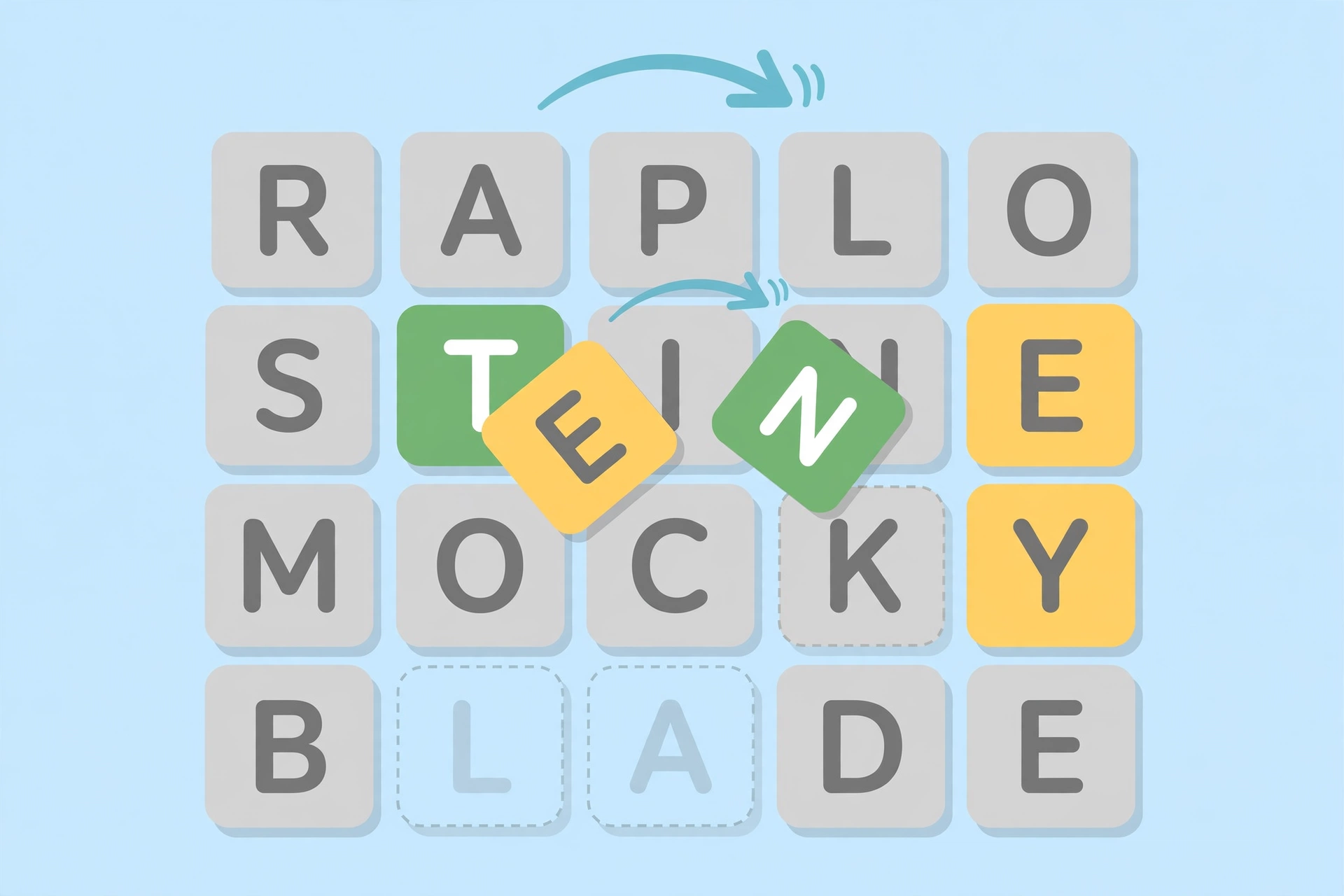
Quintessential Fun is a free daily word game — an anagram puzzle played at quintessential.fun — in which you unscramble a 5×5 grid of scrambled letters to reveal five hidden horizontal words. You swap any two letters to rearrange the grid, using Wordle-style colour clues, and a fresh themed puzzle arrives every day.
What Is the Quintessential Game?
Quintessential is a Wordle-inspired daily puzzle that swaps guessing for unscrambling — a word-jumble game where the board itself, not a blank row, is the challenge. Instead of typing guesses into empty rows, you are handed a 5×5 board where all 25 letters of five five-letter words have been jumbled up. Your job is to put them back where they belong. As The Teal Mango explains, the game presents a 5×5 grid on screen with scrambled words that you click, tap or drag to unscramble, and the tile colours work the same way as Wordle: green means the right letter in the right spot, yellow means the right letter in the wrong spot, and grey means the letter does not belong in that word.
Each day's puzzle also carries a theme, and the five hidden words revolve around it. That thematic hook is one of the things that separates Quintessential from a pure anagram drill: the theme gives you a starting hint about what kind of words to look for, which makes the opening moves much less intimidating than staring at 25 random letters.
The game is browser-based and free to play. Like Wordle, it is a once-a-day puzzle, which is part of its charm — you cannot binge it, so it becomes a small daily ritual rather than an endless time sink.
How to Play Quintessential Fun
Getting started takes under a minute. Open quintessential.fun in your browser and you will see an introductory pop-up explaining the basics. Close it, and the day's scrambled 5×5 grid is in front of you.
The core rules
- Goal: Rearrange the 25 scrambled letters so that each of the five horizontal rows spells a valid word.
- Swapping: Click or tap two letters to swap their positions (on desktop you can also drag them).
- Colour feedback: After swaps, tiles change colour. Green means the letter is in the correct position. Yellow means the letter belongs in that word but is sitting in the wrong slot. Grey means the letter is not part of that word at all.
- Daily theme: The five words share a common theme, which is revealed so you can use it as a clue.
- Move count: Every swap counts as a move. Skilled players can solve the puzzle in as few as eight moves.
- Scoring and sharing: When you finish, a stats box summarises your performance, and you can share your result just like a Wordle score.
A simple first-move routine
- Scan the grid for obvious green tiles — letters that are already sitting in the correct spot cost you nothing to leave alone.
- Look at the yellow tiles next: each one tells you the word needs that letter, just not there. Mentally test a few arrangements.
- Use the daily theme to guess one full word outright. If the theme is "fruits", try to assemble APPLE or MANGO from the letters you can see.
- Once one word locks in with all greens, the remaining letters narrow down fast, because every letter you place correctly removes it from the pool of possibilities.
Strategies to Solve Quintessential in Fewer Moves
Because every swap counts, the difference between an 8-move solve and a 30-move grind is entirely down to planning. These build on general word puzzle strategies, with Quintessential-specific tactics:
Solve one word at a time
Resist the urge to fix letters all over the board. Pick the row where you have the most information — usually the one with the most green or yellow tiles — and finish it completely. A completed word removes five letters from circulation, which dramatically shrinks the search space for the remaining four.
Exploit the colour rules ruthlessly
Yellow is more informative than it looks. A yellow tile tells you two things: the letter belongs in this row, and it must not stay where it is. Before swapping, mentally rotate the yellow letters through the empty slots and pick the arrangement that forms a real word connected to the theme. One well-planned swap that places two yellows correctly at once is worth more than four random ones.
Let the theme do half the work
The daily theme is not decoration. If the theme is "animals", your brain can pre-load candidates like HORSE, TIGER, ZEBRA or SNAKE before you move a single tile. Scan the grid for the letters of those candidates. This turns the puzzle from pure anagramming into a matching exercise, which is far faster.
Watch out for double letters
Grids sometimes contain repeated letters, and they are easy to misread. If two identical letters appear in the same row, test whether both belong there before swapping one away. A common mistake is "fixing" a green double letter because it looks wrong.
Work from the edges inward
Consonant clusters at the start of words (TH, SH, CH, BR, ST) are easier to spot than vowel arrangements. If you see a T next to an H anywhere in the grid, there is a good chance they start a word together. Assemble the skeleton of each word with its consonants first, then drop vowels into the gaps.
Keep a mental move budget
A perfect solve takes eight moves, but anything under fifteen is a strong result. If you catch yourself swapping speculatively, stop and re-read the board. Speculative swaps are the number one cause of inflated move counts.
Quintessential Fun vs Wordle: Key Differences
| Feature | Quintessential Fun | Wordle |
|---|---|---|
| Core mechanic | Unscramble a 5×5 letter grid | Guess a hidden 5-letter word |
| Number of words | Five words per puzzle | One word per puzzle |
| Input method | Swap letter tiles | Type guesses |
| Colour feedback | Green, yellow, grey per tile | Green, yellow, grey per guess |
| Daily theme | Yes, words share a theme | No theme |
| Attempts/moves | Counted swaps, ~8 minimum | Six guesses |
| Extra hints | The theme itself | None |
| Best for | Anagram and pattern lovers | Quick daily guessing |
Both games share the once-a-day cadence and the satisfying colour feedback loop, but Quintessential leans harder on spatial rearrangement and vocabulary breadth, while Wordle is a purer logic-deduction game. For a head-to-head of two other daily word games, see Plusword vs Wordle.
Who Should Play Quintessential Fun?
Quintessential is ideal for players who enjoy anagrams, crosswords and jigsaw-style rearrangement puzzles. Because you are moving letters rather than typing blind guesses, it feels more tactile than Wordle, and the five-word structure gives you multiple small victories inside a single puzzle. It is also a strong vocabulary builder: unscrambling words under a theme forces you to retrieve words by meaning category, which is excellent mental exercise.
It suits short sessions perfectly. A focused solve takes three to five minutes, making it a natural fit for a morning coffee routine, a lunch break or an evening wind-down — the same daily-puzzle habit slot that Wordle, Connections and Strands occupy for millions of players. For more puzzles in that slot, browse our daily puzzle games list.
Game Modes and Variations
Quintessential is a single-mode game: one themed 5×5 grid per day, and that is the entire offering. There are no difficulty tiers, practice modes, or unlimited-play options — the once-a-day cadence is the point, and it is what turns the puzzle into a ritual rather than a binge. The variety comes entirely from the daily themes, which rotate through categories like animals, foods, and places, so each day's five hidden words test a different corner of your vocabulary. That focused design is deliberate: with no modes to configure and no settings to fiddle with, you open the page, close the intro pop-up, and start swapping tiles within seconds.
Where to Play Quintessential Fun
The official home of the game is quintessential.fun, where the daily puzzle is free to play in any modern browser — no download, no account, and no app install required. The game works on desktop and mobile: on a computer you can click or drag tiles to swap them, while on a phone or tablet you tap two letters to exchange their positions. Because it is a lightweight browser game, it loads quickly even on modest connections, making it easy to fit the daily puzzle into a commute or a coffee break. As with any popular web puzzle, stick to the official address — the real Quintessential Fun needs nothing installed, so treat any lookalike page asking for downloads or personal details with suspicion.
What is Quintessential Fun?
Quintessential Fun is a free daily word game at quintessential.fun where you unscramble a 5×5 grid of jumbled letters to form five horizontal words, using Wordle-style green, yellow and grey tile clues and a daily theme.
Is Quintessential Fun free to play?
Yes. The game runs entirely in your browser at quintessential.fun and is free, with one new puzzle released each day.
How do you win at Quintessential?
You win by rearranging all 25 letters so that each of the five rows spells a valid word. There is no fail state — the challenge is to finish in as few swaps as possible.
What do the colours mean in Quintessential?
Green means the letter is in the correct position. Yellow means the letter belongs in that word but is in the wrong slot. Grey means the letter is not part of that word.
What is the minimum number of moves in Quintessential?
The fastest possible solve takes eight moves, though that requires near-perfect planning. Most satisfying solves land between ten and twenty moves.
Does Quintessential have a theme every day?
Yes. Each daily puzzle has a theme, and all five hidden words relate to it. Using the theme as a clue is one of the best strategies for a fast solve.
Is Quintessential like Wordle?
It is inspired by Wordle and uses the same colour-feedback idea, but the gameplay is different: you rearrange a grid of letters instead of guessing a hidden word, and you solve five words per puzzle instead of one.
Can you play old Quintessential puzzles?
The game is designed as a once-a-day experience with a single daily puzzle. Check the site for any archive or practice options, as these can change over time.