
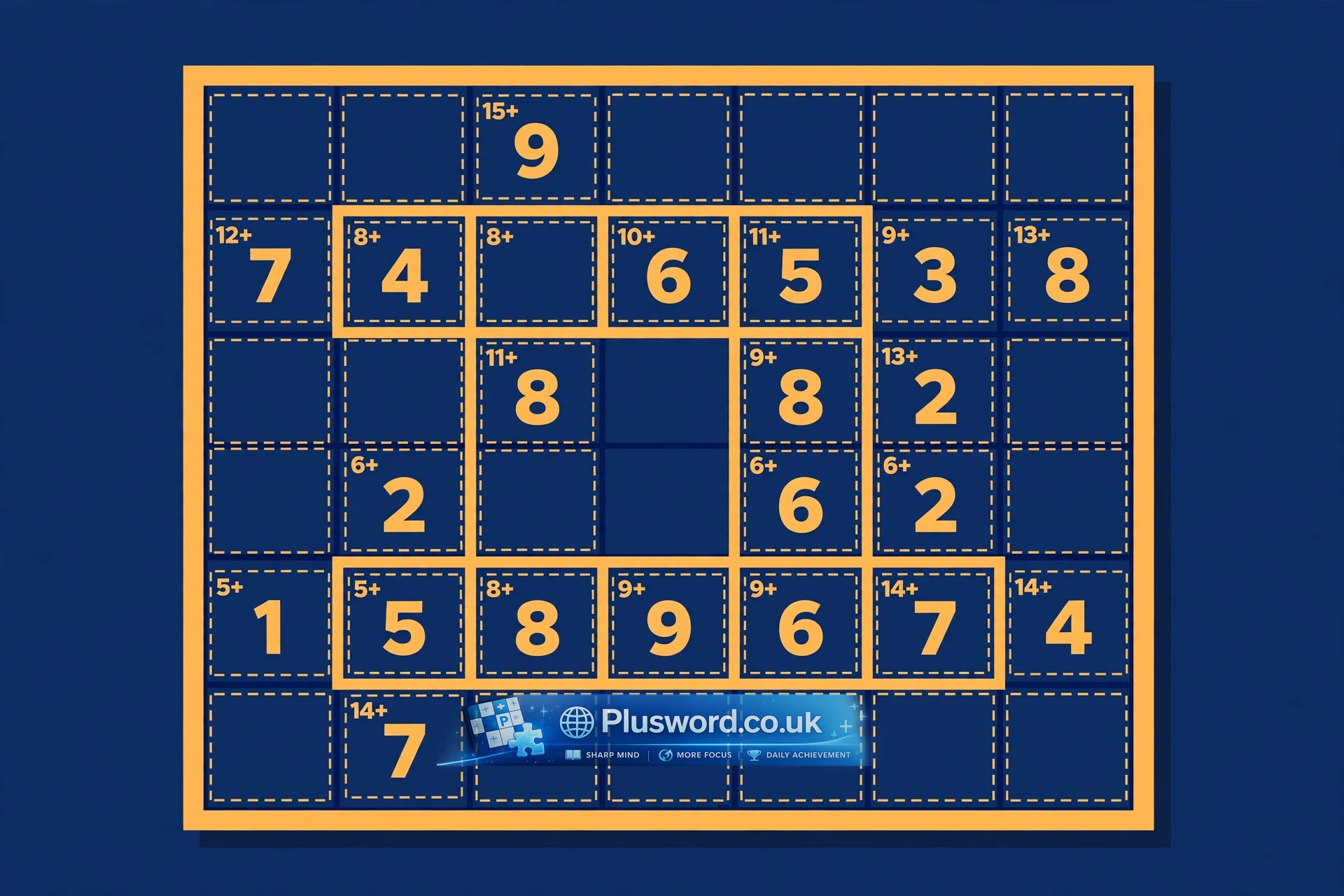
If regular sudoku feels too easy, killer sudoku raises the stakes. You get a blank 9×9 grid divided into dashed cages, each marked with a small sum, and must work out which digits fill every cage while obeying classic sudoku rules.
Killer sudoku blends sudoku with the arithmetic of kakuro, and it has tested solvers since The Times introduced it to British readers in 2005. This guide covers how killer sudoku works, its three rules, the famous rule of 45, the cage combinations worth memorising, and a step-by-step method for solving your first puzzle.
What Is Killer Sudoku?
Also called sumdoku or addoku, killer sudoku uses the familiar 9×9 grid with nine 3×3 boxes (nonets). The twist is the start: a standard sudoku hands you around 25 givens, but a killer grid usually begins completely empty.
Instead, the grid is partitioned into cages: irregular groups of cells outlined with dashed lines. Each cage carries a small number in its top-left corner, the cage sum, which all its digits must add up to. A two-cell cage marked 3 can only hold 1 and 2.
Because no digits are given away, every placement is earned through arithmetic plus classic sudoku logic, which is why solvers find it so satisfying.
Killer Sudoku Rules
Just three rules apply:
- Every row, column and 3×3 box must contain the digits 1 to 9 exactly once, as in standard sudoku.
- The digits inside each cage must add up to the cage sum printed in its corner.
- No digit may repeat within a single cage, even if the cage stretches across two boxes.
Every published killer has exactly one solution, found by logic alone with no guessing. The no-repeat rule is what makes cage sums informative: a two-cell 4 could be 1+3 or 2+2 arithmetically, but only 1+3 is legal.
| Classic Sudoku | Killer Sudoku | |
|---|---|---|
| Starting clues | Pre-filled digits (givens) | Cage sums only; the grid usually starts blank |
| Extra rule | None | Digits in each cage must total the cage sum |
| Repeats in a cage | Not applicable | Never allowed |
| Maths needed | None | Basic addition |
| Core techniques | Scanning, singles, pairs | The same, plus cage combinations and the rule of 45 |
How Cages Work
To read a cage, find the dashed group of cells and note the small number in its top-left cell: your target total. Your task is to find which set of distinct digits produces that sum.
A three-cell cage marked 7 can only be 1+2+4. The order is unknown, but sudoku logic now decides which goes where. That rhythm, arithmetic first and logic second, repeats for the whole puzzle.
The Rule of 45
The most powerful killer technique is also the simplest: 1 to 9 add up to 45, so every row, column and 3×3 box totals exactly 45.
If whole cages covering a box total 38 plus one cell sticking out, that cell is 45 − 38 = 7. In reverse: cages totalling 52 with one cell outside the box make that cell 52 − 45 = 7.
It scales up: three rows total 135, a band of three boxes totals 135, the whole grid 405.
Innies and Outies
An innie is an uncovered cell inside a unit; an outie is a cage cell sticking outside it. Both fall to the 45 rule, so scan every unit for them first.
Cage Combinations Worth Memorising
Some sums allow only one digit set: free information. You know the digits, just not their order. Memorise these.
| Cells | Sum | Only possible digits |
|---|---|---|
| 2 | 3 | 1, 2 |
| 2 | 4 | 1, 3 |
| 2 | 16 | 7, 9 |
| 2 | 17 | 8, 9 |
| 3 | 6 | 1, 2, 3 |
| 3 | 7 | 1, 2, 4 |
| 3 | 23 | 6, 8, 9 |
| 3 | 24 | 7, 8, 9 |
| 4 | 10 | 1, 2, 3, 4 |
| 4 | 11 | 1, 2, 3, 5 |
| 4 | 29 | 5, 7, 8, 9 |
| 4 | 30 | 6, 7, 8, 9 |
Learn each cage size’s limits: 3–17 for two cells, 6–24 for three, 10–30 for four. Near either limit the options collapse: a five-cell 16 must be 1+2+3+4+6.
A two-cell 10 never holds a 5 (5+5 is illegal); a three-cell 8 always holds a 1; a three-cell 22 always holds a 9.
How to Solve Killer Sudoku: A Step-by-Step Method
- Mark forced cages. Note the digit set for every cage with only one combination.
- Apply the 45 rule to every box. Where cages almost cover a unit, innies and outies give free digits.
- Apply the 45 rule to rows and columns too. They are easy to overlook.
- Turn cage sets into candidates. Mark the possible digits in pencil.
- Switch to ordinary sudoku technique. Naked and hidden singles, pairs and pointing pairs all apply now.
- Alternate. Each placement changes the cage arithmetic; each resolved cage changes the candidates.
7 Practical Tips for Beginners
- Start with extreme sums. Very small or large totals have the fewest combinations.
- Use exclusions. A three-cell 7 must be 1+2+4, ruling out 3, 5 and everything above 4.
- Write everything down. Holding cage sets in your head invites mistakes.
- Check cage limits. Near the minimum or maximum, combinations collapse fast.
- Use contained cages as sets. A cage fully inside one box eliminates its digits from the rest of that box.
- Re-check the 45 rule after every placement. Each digit changes the arithmetic around it.
- Keep using standard sudoku skills. Late in the grid, hidden singles outwork the arithmetic.
Common Mistakes to Avoid
- Repeating a digit inside a cage. The most frequent error: 2+2 never fills a four-sum cage.
- Forgetting cages can cross boxes. The no-repeat rule belongs to the cage, not the box.
- Ignoring cage minimums and maximums. Impossible sums reveal a wrong turn fast.
- Treating the puzzle as arithmetic only. Cage sums open the grid, but classic sudoku logic finishes it.
- Rushing the opening. Ten careful minutes on forced cages saves far more later.
Killer Sudoku Difficulty Levels
| Level | What it demands | Typical solving time |
|---|---|---|
| Easy | Forced cages, 45 rule on boxes | 10–20 minutes |
| Medium | Innies and outies, cages as naked sets | 20–40 minutes |
| Hard | 45 rule across bands, pairs, pointing pairs | 40–70 minutes |
| Expert | Multi-unit 45 combos, advanced chains | 1–2 hours |
Killer puzzles run longer than classic sudoku at every level, since each deduction needs arithmetic as well as logic. That is normal.
Frequently Asked Questions
Is killer sudoku harder than normal sudoku?
Usually yes, because it adds arithmetic bookkeeping on top of the logic and starts with no givens. The maths itself never goes beyond adding single digits.
What is the rule of 45 in killer sudoku?
Every row, column and 3×3 box sums to 45, since 1 to 9 add to 45. Comparing cage totals against 45 reveals the value of uncovered cells, known as innies and outies.
Can a number repeat inside a killer sudoku cage?
No. Every cage must hold distinct digits, even when the cage spans two boxes. This is the standard rule used by all major publishers.
Do you need to be good at maths to play killer sudoku?
No. The arithmetic never goes beyond adding single digits. What the puzzle really demands is careful bookkeeping of each cage’s possible digit sets.
What is the difference between killer sudoku and kakuro?
Kakuro is a pure arithmetic crossword with no 9×9 grid. Killer sudoku keeps the full sudoku grid with its row, column and box rules, and adds kakuro-style cage sums on top.
Which cage sums have only one possible combination?
Two cells: 3, 4, 16 and 17. Three cells: 6, 7, 23 and 24. Four cells: 10, 11, 29 and 30. Learn these first, because they give you free digits.
Conclusion
Killer sudoku looks intimidating because the grid starts empty, but that blankness is misleading. You have around thirty cage constraints instead of the usual scattering of givens, and together they are more informative.
Start with the forced cages, lean on the rule of 45, write down your candidates, and let ordinary sudoku technique finish the job. One easy grid with this method and the variant clicks into place.
For graded practice material, good sudoku puzzle books ramp you from easy killers to genuinely hard ones — and if you enjoy letter-based deduction too, our word games guides round out the collection. For younger solvers, puzzle books for adults also make great gifts for the puzzle-obsessed.