
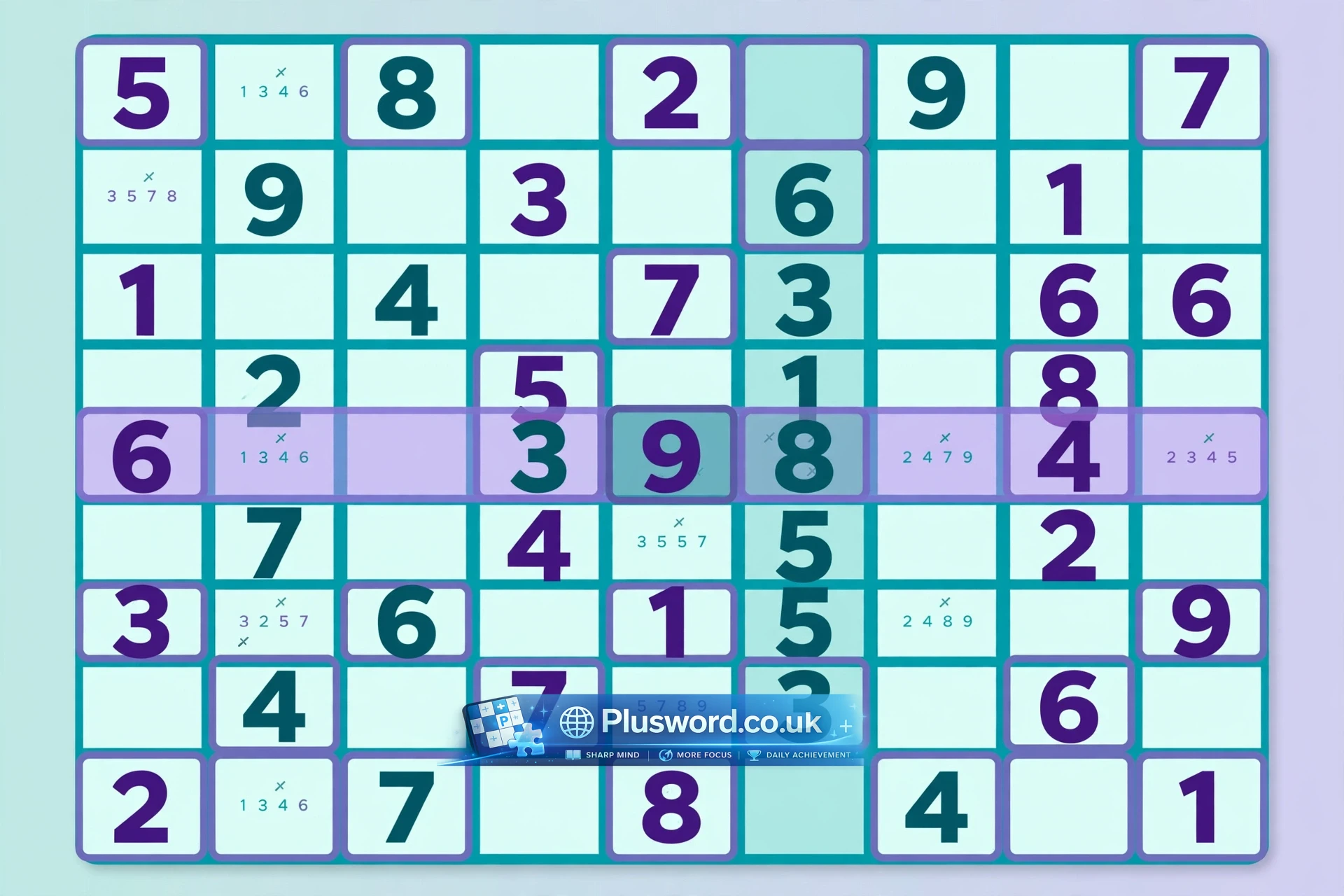
You know the feeling. The grid is half full, every row is a tangle of possibilities, and the tricks that carried you through easy puzzles have run out. This is where hard Sudoku begins — and where most solvers give up or start guessing.
Don’t. The best hard Sudoku strategies — X-Wing, Swordfish, XY-Wing, simple colouring and forcing chains — eliminate candidates through pure logic. No guessing required. Here are seven techniques in plain language, in learning order.
Explore our puzzle guides for more strategy content across the site.
Start Here: Full Pencil Marks (Without Them, Nothing Works)
Every advanced technique here depends on one habit: writing every candidate in every empty cell. These notes — pencil marks or candidate notation — make the invisible visible. Patterns like X-Wing are literally impossible to spot without them.
How to mark candidates properly
- In each empty cell, note every digit that could still go there.
- After each placement, erase that digit from the same row, column and 3×3 box.
- Keep marks updated — stale candidates hide patterns and cause false leads.
- Most apps do this automatically; on paper, write small with a sharp pencil.
It feels tedious at first, but within a week full notation becomes second nature — the single biggest leap a solver can make.
1. Naked and Hidden Pairs
Before the fancy patterns, squeeze everything out of pairs — they resolve a surprising number of stuck moments.
A naked pair: two cells in one unit holding exactly the same two candidates (say, 4 and 9). Those digits must occupy those cells, so delete them from every other cell in the unit.
A hidden pair: two digits appearing as candidates in only the same two cells of a unit. They’re locked in — erase all other candidates from those two cells.
The logic extends to triples (three cells, three candidates). Rarer, but a triple often cracks the puzzle open.
2. Locked Candidates (Pointing Pairs)
If every 7 in a 3×3 box sits in the same row, that 7 must go in that row inside the box — so eliminate 7 from the rest of that row outside the box.
The reverse works too: if a row’s only possible spots for a digit all fall inside one box, the digit is “claimed” — remove it from the rest of that box. This box-line overlap is a skill you’ll reuse constantly.
3. X-Wing
The X-Wing is the first true pattern technique most solvers learn, and it cracks more hard puzzles than anything else here. The logic: when a candidate appears in exactly two cells in each of two rows, and those cells share the same two columns, they form a rectangle. The candidate must sit on one diagonal — so delete it from every other cell in those two columns. It works in reverse too: two columns sharing two rows lets you eliminate along the rows.
How to spot an X-Wing
- Pick one digit; scan its pencil marks across the grid.
- Find two rows where it appears in exactly two cells each.
- Check the cells line up in the same two columns, forming a rectangle.
- Erase the digit from all other cells in those two columns.
X-Wings rarely place a number directly — their power is mass elimination that triggers cascades of singles.
4. Swordfish
The Swordfish is the X-Wing scaled up — a “3-fish”. When a candidate appears in two or three cells in each of three rows, all within the same three columns, it’s trapped: each row must place the digit inside those columns, so eliminate it from every other cell in the three columns. (Column-based works identically, eliminating along rows.) The 3×3 grid needn’t be complete — six to nine cells suffice; what matters is the 3-rows-to-3-columns lock.
| Pattern | Base lines | Cover lines | Eliminate from |
|---|---|---|---|
| X-Wing | 2 rows (or columns) | 2 columns (or rows) | Other cells in the 2 cover lines |
| Swordfish | 3 rows (or columns) | 3 columns (or rows) | Other cells in the 3 cover lines |
| Jellyfish | 4 rows (or columns) | 4 columns (or rows) | Other cells in the 4 cover lines |
How to spot a Swordfish
- Choose a digit and scan its candidates row by row.
- Find three rows where it appears in only two or three cells each.
- Check all those cells sit inside the same three columns.
- Delete the digit from every other cell in those three columns.
Swordfish appears almost only in the hardest puzzles — hunt for it when singles, pairs, locked candidates and X-Wing have run dry.
5. XY-Wing
The XY-Wing is a small, local chain built from three cells. Find a pivot with two candidates (say 3 and 6), plus two wings sharing a unit with it: one holding 3 and 2, the other 6 and 2.
Follow the logic: if the pivot is 3, wing one must be 2; if the pivot is 6, wing two must be 2. Either way, one wing is a 2 — so any cell that “sees” both wings cannot be 2. Erase it.
XY-Wings are common and satisfying: three tiny cells, one clean deduction. Watch for clusters of two-candidate cells — that’s where they hide.
6. Simple Colouring
Simple colouring (singles chains) tracks one digit through chains of conjugate pairs — a unit where a candidate appears in exactly two cells, one of which must be true.
Colour one cell blue, its partner green, then extend: wherever a coloured cell forms another conjugate pair, colour the partner the opposite colour. One colour will prove true across the chain — giving you two elimination rules.
The two colouring rules
- Colour contradiction: two same-colour cells that see each other can’t both be true — so that colour is false, and the opposite colour is true chain-wide.
- Colour trap: an uncoloured cell that sees every cell of one colour can’t hold the digit — erase the candidate.
Colouring looks intimidating but it’s mechanical, and devastating on expert grids.
7. Forcing Chains (the “What If” Test)
When nothing else works, forcing chains let you test a candidate without truly guessing. Pick a two-candidate cell and ask: what if this is true? Follow the consequences — placements force placements. If the chain hits a contradiction (a doubled digit, a cell with no candidates left), the assumption was wrong: eliminate that candidate for real.
Unlike guessing, you never commit the placement — only the elimination stays. It’s slower than pattern techniques, which is why it sits last, but it solves puzzles nothing else can.
Quick Reference: Which Technique to Try First
Work this order every time you’re stuck.
| Order | Technique | Try it when… |
|---|---|---|
| 1 | Full pencil marks | Always — before anything else |
| 2 | Naked/hidden pairs & triples | Candidates are fresh and cluttered |
| 3 | Locked candidates | A digit is boxed into one line |
| 4 | X-Wing | One digit keeps appearing twice per row |
| 5 | Swordfish | X-Wing found nothing and the grid is still stuck |
| 6 | XY-Wing | You see clusters of two-candidate cells |
| 7 | Simple colouring | Long conjugate chains are visible |
| 8 | Forcing chains | Everything else has failed |
Mistakes That Keep Solvers Stuck
- Guessing instead of eliminating. Every valid Sudoku has a logical path — a lucky guess teaches nothing and can corrupt the grid.
- Stale pencil marks. Forgetting to update candidates after a placement is the top cause of “impossible” puzzles.
- Hunting advanced patterns too early. Check pairs and locked candidates first; Swordfish can’t help while a hidden pair sits unnoticed.
- Fixating on one corner. After each breakthrough, re-scan the whole grid — eliminations in one area create singles in another.
Conclusion
Hard Sudoku isn’t about being clever — it’s about being systematic. Pencil marks make the invisible visible; pairs and locked candidates clear the clutter; X-Wing, Swordfish and XY-Wing exploit the remaining patterns; colouring and forcing chains finish the rest.
Learn these seven in order and practise on graded puzzles — good sudoku puzzle books ramp you from medium to genuinely hard — and “impossible” puzzles start looking very possible.
Frequently Asked Questions
What is the hardest Sudoku technique to learn?
Simple colouring and forcing chains — they need long logical chains, not fixed shapes like X-Wing.
Can every hard Sudoku be solved without guessing?
Yes — every valid Sudoku is solvable by pure logic, though the hardest need advanced chains to prove it.
What is the difference between X-Wing and Swordfish?
X-Wing locks a candidate across 2 rows and 2 columns; Swordfish is the same idea across 3 rows and 3 columns, making it more powerful but harder to spot.
Do I need pencil marks to solve hard Sudoku?
Absolutely. Advanced techniques like X-Wing and Swordfish are patterns in the candidates themselves — without full notation, they’re invisible.
How long should a hard Sudoku take to solve?
Anywhere from 15 minutes to over an hour depending on the grade and your experience; speed comes naturally as pattern recognition improves.
What does XY-Wing stand for?
The X and Y are the pivot cell’s two candidates and the wings each share one of them; the shared third candidate (Z) is the one you eliminate.