
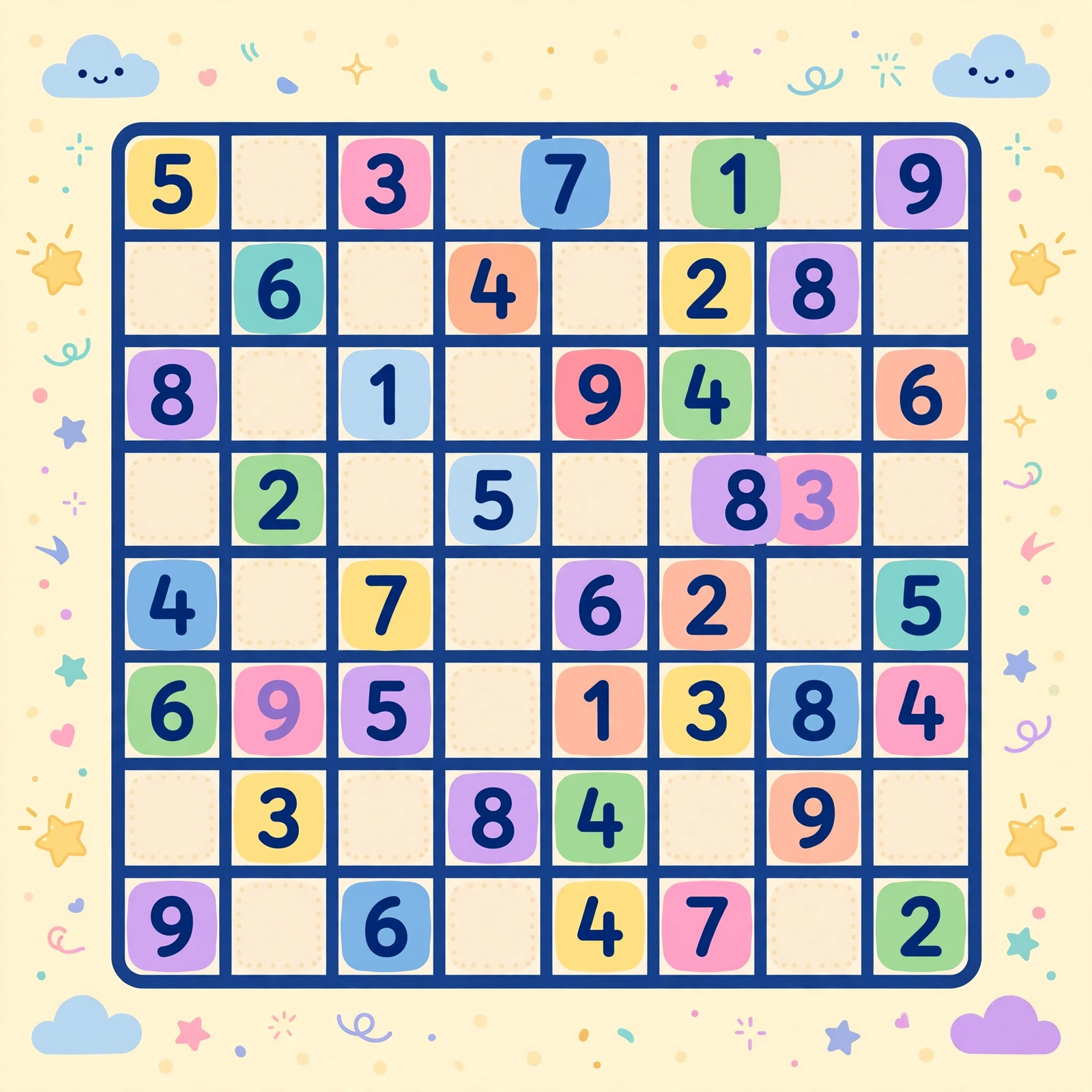
Easy sudoku for kids uses smaller grids — usually 4×4 or 6×6 instead of the standard 9×9 — with plenty of starting numbers filled in. The rules are identical to regular sudoku: every row, column, and box must contain each number exactly once. Below is a complete guide to the rules, teaching tips, and the best free printable sources.
What Is Easy Sudoku for Kids?
Easy sudoku for kids is the classic logic puzzle adapted for young beginners. Instead of the standard 9×9 grid with digits 1–9, children's versions use smaller grids that are far less intimidating:
- 4×4 grids use the numbers 1–4, with four 2×2 boxes — the simplest possible sudoku.
- 6×6 grids use the numbers 1–6, with six 2×3 boxes — the next step up.
- Easy 9×9 grids keep the full grid but come with many cells already filled in, so kids only need to find a few missing numbers.
Some versions also swap numbers for shapes, letters, or pictures, which works well for children who aren't yet confident with digits (thesprucecrafts.com).
The Rules (Kid-Friendly Version)
The rules never change — only the grid shrinks. Teach kids these three rules, in this order:
- Every row must contain each number exactly once. In a 4×4 grid, each row holds 1, 2, 3, and 4 with no repeats.
- Every column must contain each number exactly once. Same idea, reading top to bottom.
- Every small box must contain each number exactly once. In 4×4 sudoku these are 2×2 boxes; in 6×6 they are 2×3 rectangles.
That's it. There is no arithmetic involved — sudoku is a logic puzzle, not a maths puzzle — which is why children as young as five or six can enjoy it once the rules click.
A Worked Example (4×4)
Show your child a nearly finished 4×4 grid and ask: "Which number is missing from this row?" Starting with almost-complete grids teaches the pattern before asking them to solve from scratch. When they can spot a missing number in a row, move on to columns, and finally boxes — one skill at a time.
Why Sudoku Is Great for Kids
- Logic over maths: Since no calculation is needed, children who find arithmetic hard can still succeed — success builds confidence.
- Concentration: Each puzzle rewards careful, sustained attention, a skill that transfers directly to schoolwork.
- Pattern recognition: Kids learn to scan rows, columns, and boxes systematically — early algorithmic thinking.
- Patience and persistence: A puzzle that resists solving teaches children to try another angle instead of giving up.
- Screen-free fun: Printable puzzles work on planes, in restaurants, and during power cuts — no device required.
Tips for Teaching Kids Sudoku
1. Start with 4×4, always
Even if your child is bright, begin with 4×4 grids. The goal of the first few puzzles is to make the rules feel obvious. Move to 6×6 only when 4×4 feels boring (thesprucecrafts.com).
2. Use shapes or colours first for very young kids
Sites like Math in English offer shape and letter sudokus — ideal for pre-readers or children who mix up digits (thesprucecrafts.com).
3. Solve the first puzzles together
Sit side by side and think aloud: "This row has 1, 2, and 4 — what's missing?" Narrating your reasoning teaches the method, not just the answer.
4. Let them use pencil, not pen
Mistakes are part of learning. A pencil (or a laminated sheet with a dry-erase marker) removes the fear of getting it wrong.
5. Check answers, don't just give them
Always print or keep the solution page handy so kids can verify their own work — self-checking is part of the learning (thesprucecrafts.com).
6. Keep sessions short
Ten to fifteen minutes is plenty for young children. End on a success — a finished puzzle — rather than pushing through frustration.
Where to Find Free Easy Sudoku Puzzles for Kids
These sources were rounded up by The Spruce Crafts and remain the best free options (thesprucecrafts.com):
| Source | What you get | Best for |
|---|---|---|
| Math in English | 4×4 number, shape, and letter sudokus; 6×6 grids; easy 9×9 | Ages 4–8 |
| Sudoku Download | 60 easy 4×4 puzzles (numbers and letters); 6×6, 7×7, easy 9×9; solutions included | Beginners |
| Print Activities | 4×4 and 6×6 grids, some with solving hints | First-timers |
| Krazy Dad ("Kidoku") | Huge collection, downloadable 8 at a time, all answers included | Bulk printing |
| Puzzles.ca | Hundreds of easy 9×9 puzzles with printable solutions | Graduating to 9×9 |
| Memory Improvement Tips | 25+ free easy puzzles, four per page, separate solution sheet | Quick printouts |
| Print My Sudoku | 12 pages of easy 9×9 grids; option to create custom puzzles | Custom difficulty |
The Spruce Crafts notes that easy puzzles simply have more clues filled in, while harder ones leave more cells blank — so if a source's "easy" still feels hard, print more and let your child pick the friendliest-looking grid (thesprucecrafts.com).
Sudoku Books for Kids
If you prefer a bound book to loose printouts, puzzle publishers sell kids' sudoku books by age band — typically ages 4–6 (4×4 grids), 6–8 (4×4 and 6×6), and 8–12 (easy 9×9). Look for large-print editions with one puzzle per page and solutions at the back; our guide to choosing puzzle books covers what to check before buying any sudoku book, and our crossword book guide has similar advice for word puzzles.
Turning Sudoku Into a Game, Not Homework
The difference between a child who loves sudoku and one who dreads it is framing, not difficulty. Start by making it social: solve the first few puzzles together, thinking aloud ("this row needs a 3 — where can it go?") so the logic becomes a shared discovery rather than a test. Keep sessions to ten or fifteen minutes and always end on a win — a finished 4×4 beats a half-finished 9×9 for building the habit. Celebrate the reasoning, not just the completion: "great spotting!" when your child eliminates a candidate teaches them that the thinking is the fun part. Use physical puzzles over apps for young kids — pencil, eraser and paper remove screen-time negotiations and let mistakes vanish cleanly, which keeps frustration low. Introduce novelty before difficulty: shape or picture sudoku, coloured grids and themed printables all teach the same logic as number grids while feeling like new games. And resist the urge to correct mid-solve — let them find the contradiction themselves, because the "aha" of catching your own error is the moment sudoku clicks.
What age can kids start sudoku?
Most children can start 4×4 sudoku around age 5–6, once they recognise numbers 1–4. Shape-based sudoku works even earlier, from about age 4 (thesprucecrafts.com).
What is the easiest sudoku for kids?
A 4×4 grid using numbers 1–4 with most cells pre-filled is the easiest sudoku for kids. Shape or picture versions are easier still for very young children.
Do kids need to know maths to play sudoku?
No. Sudoku uses numbers as symbols only — no adding, subtracting, or multiplying is involved. It’s a logic puzzle.
How is kids’ sudoku different from regular sudoku?
The rules are identical. The difference is grid size (4×4 or 6×6 instead of 9×9), more starting clues, and often larger print or friendlier themes.
Where can I print free sudoku puzzles for kids?
Math in English, Krazy Dad’s Kidoku section, Print Activities, and Sudoku Download all offer free printable kids’ sudoku with answer sheets (thesprucecrafts.com).
How long should a child spend on sudoku?
Ten to fifteen minutes per session is ideal for young kids. Short, successful sessions build the habit better than long frustrating ones.
When should my child move from 4×4 to 9×9?
Move up when 4×4 puzzles feel easy and a bit boring — usually via 6×6 first. There’s no rush; comfort with the logic matters more than grid size.
Are there sudoku apps for kids?
Yes, but printable puzzles are usually better for young children — they avoid screen-time battles and let kids erase mistakes freely. Try printables first.
Can sudoku help my child with school maths?
It builds logical reasoning, pattern recognition and concentration — but sudoku involves no arithmetic at all, so treat it as a logic workout that supports thinking skills generally rather than as maths practice specifically.
What if 4×4 sudoku is still too hard for my child?
Drop down to shape or picture sudoku, which works from about age 4 — matching symbols instead of numbers teaches the identical logic with zero number anxiety. Move to 4×4 numbers once the shapes feel easy. Looking for more family-friendly puzzles? Explore the [Plusword puzzle hub](https://plusword.co.uk/) for daily word games and brain teasers for all ages.