
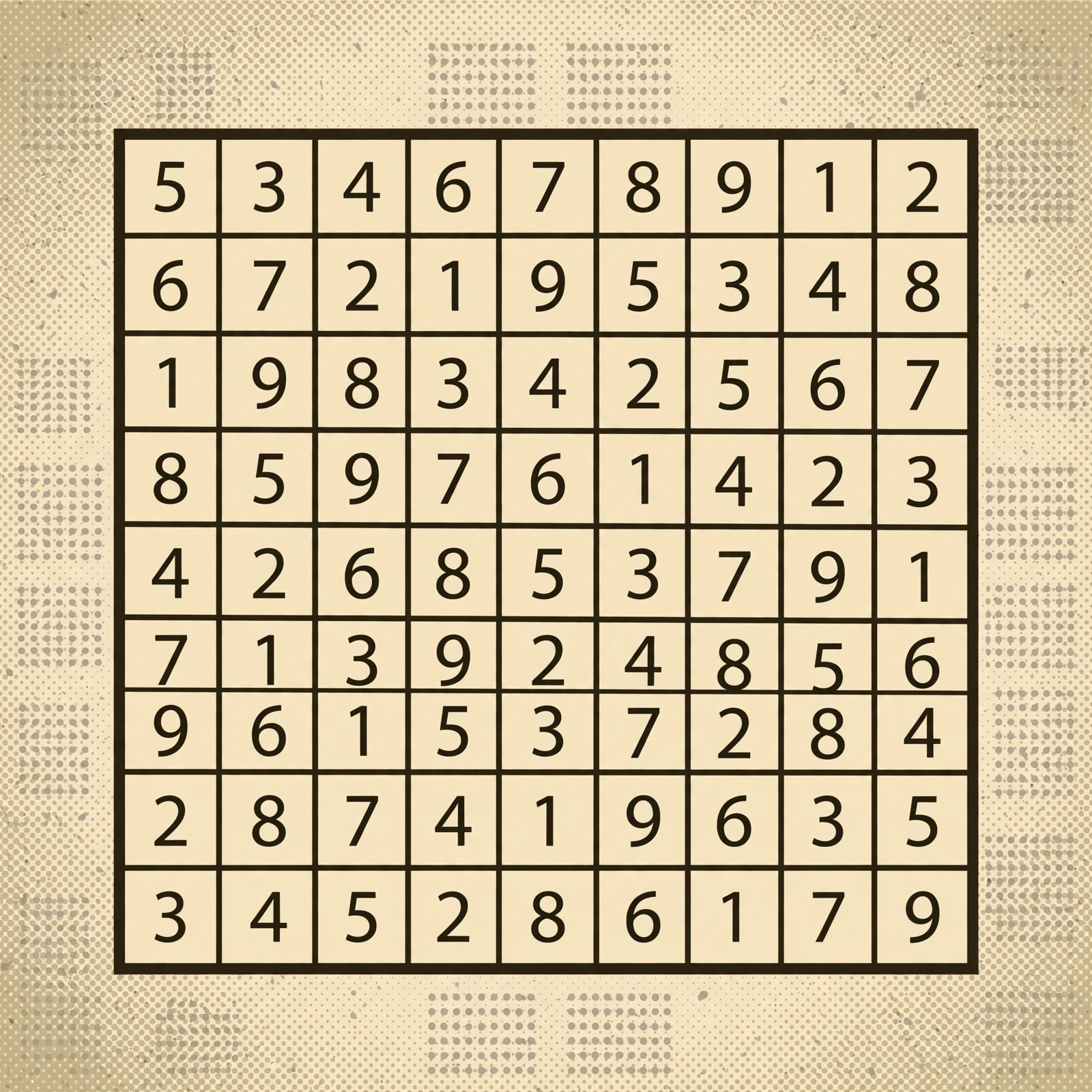
NYT Sudoku is the New York Times Games daily sudoku puzzle, offering Easy, Medium and Hard grids with a clean interface, a hint feature, and a candidate mode for pencil marks. The current day's puzzle is free to play; older puzzles in the archive require a Games subscription. Here is the complete guide to the rules, levels, and strategies.
What Is NYT Sudoku?
NYT Sudoku is the sudoku game inside the New York Times Games portfolio — the same family that includes Wordle, Connections, Spelling Bee and the Mini Crossword (nytimes.com). It follows the classic sudoku format: a 9×9 grid divided into nine 3×3 boxes, partially filled with starting digits, and a single unique solution per puzzle.
The puzzles are designed for fair, logical solving — no guessing is required, and each grid has exactly one solution. According to the NYT's puzzle team, the grids are crafted and vetted so the logic holds together cleanly at every difficulty level (gamlio.com). A fresh puzzle is published every day, so there is always a new grid waiting alongside the rest of the Games lineup.
As a daily number puzzle, NYT Sudoku fills the classic newspaper-sudoku role in the Games portfolio: the quiet logic counterpart to Wordle's word guessing and Connections' pattern sorting. The 9×9 format is the same classic the puzzle's 2000s boom made famous — givens placed so each deduction follows from the last — but the NYT adds the modern app layer: candidate notation, conflict flagging and a hint system that teaches rather than tells. For solvers who want their sudoku with editorial quality control and a daily rhythm, it is one of the most polished free options available.
Difficulty Levels: Easy, Medium and Hard
The New York Times Sudoku offers three difficulty levels, and you pick one before you start. Understanding them helps you choose a puzzle that matches your skill (gameerrors.com; gamlio.com):
| Level | What to expect | Best for |
|---|---|---|
| Easy | Plenty of starting digits, few empty cells, solvable with basic scanning | Beginners, relaxed daily solves |
| Medium | Roughly balanced between filled and empty cells, needs hidden singles and naked pairs | Regular players ready for real logic |
| Hard | Sparse grids with few givens, requires X-wings, swordfish and candidate tracking | Experienced solvers who want a workout |
Difficulty depends on the logic a puzzle demands, not just the number of empty cells — experienced solvers note that some Medium grids can feel tougher than Hard ones when they hide trickier patterns (gamlio.com). If you are new, start with Easy and move up as the techniques below become second nature.
How to Play: The Rules
The rules are the standard sudoku rules, applied on a 9×9 grid:
- Each row must contain the digits 1 to 9, with no repeats.
- Each column must contain the digits 1 to 9, with no repeats.
- Each of the nine 3×3 boxes must contain the digits 1 to 9, with no repeats.
That's it — sudoku is pure logic, not maths. No arithmetic is involved, and every well-constructed puzzle (including the NYT's) is solvable without guessing.
Normal Mode vs Candidate Mode
The NYT Sudoku interface gives you two entry modes (gameerrors.com):
- Normal mode: Tap a cell and enter the digit you are confident about. Use this for placements you know are correct.
- Candidate mode: Add small pencil-mark candidates to empty cells, then remove them as logic rules digits out. This is essential for Medium and Hard puzzles, where tracking possibilities is the only way to spot hidden patterns.
Where to Play NYT Sudoku
You can play on the New York Times Games website in any browser, or in the NYT Games app on iOS and Android — open the Games section and look for Sudoku (nytimes.com).
Free access: The daily puzzle is free to play. The free tier gives you the day's sudoku at your chosen difficulty without paying anything.
Subscription access: Access to past puzzles in the archive typically requires a paid NYT Games subscription, which also unlocks ad-free play and the full back catalogue of every NYT game (gamlio.com). If you only want the daily fix, the free puzzle is plenty.
Helpful Features in the NYT Interface
- Hint feature: If you get stuck, the NYT Sudoku interface provides a hint button that nudges you toward the next logical step instead of just giving away an answer (gamlio.com).
- Conflict feedback: Entering a digit that clashes with the row, column or box is flagged immediately, so mistakes don't silently compound.
- Pencil marks (candidate mode): The notes system described above keeps your deductions organized on harder grids.
- Daily rhythm: One new puzzle per day keeps it a habit rather than a marathon — though the archive means subscribers never run out.
Strategies and Tips for NYT Sudoku
These tactics are built for the NYT's three levels, from first principles to advanced patterns.
1. Start with a full scan
Before entering anything, look at each digit from 1 to 9 and scan every row, column and 3×3 box for where it can still go. This simple pass alone often cracks most of an Easy puzzle.
2. Fill naked singles immediately
A "naked single" is an empty cell with only one possible digit left. Fill these straight away — each one unlocks placements elsewhere. Candidate mode makes singles obvious.
3. Learn hidden singles (your Medium key)
If a digit appears as a candidate in only one cell of a row, column or box, it must go there — even if that cell holds other candidates. This is the signature technique of Medium NYT puzzles.
4. Use naked pairs
When two cells in the same unit hold exactly the same two candidates, those digits are locked to those cells — delete them from every other cell in that unit. Pair eliminations routinely break open Medium grids.
5. Step up to X-wings and swordfish (for Hard)
On Hard grids you will need intermediate patterns. The X-wing: if a digit has only two possible spots in two different rows, and those spots share the same two columns, the digit can be eliminated from the rest of those columns. Swordfish extends the same logic across three rows and columns. These are the techniques the Hard level is built around (pocket-or-print-pop.com).
6. Use the hint before you guess
Stuck? Take the free hint rather than guessing — guessing breaks the logic chain and teaches nothing, while a hint shows you which technique you were missing.
7. Keep one puzzle habit
Because the NYT publishes one sudoku a day, treat it like the crossword: same time, same difficulty progression. A daily Easy-to-Medium climb builds pattern recognition faster than sporadic Hard attempts.
NYT Sudoku vs Other Free Sudoku Sites
| NYT Sudoku | Metro Sudoku | websudoku | |
|---|---|---|---|
| Free to play | Daily puzzle free; archive needs subscription | Yes, fully free | Yes |
| Difficulty levels | Easy, Medium, Hard | Easy, Medium, Hard | Easy, Medium, Hard, Evil |
| Daily puzzles | Yes, one per day | Yes | Daily + unlimited generated |
| Special features | Hint feature, candidate mode, conflict flagging | Puzzles newsletter, Puzzles+ extras | Simple unlimited classic play |
| Sibling games | Wordle, Connections, Spelling Bee, Mini Crossword | Quick Crossword, Word Wheel, Cryptic | Sudoku only |
The NYT's edge is editorial quality: hand-crafted, vetted puzzles with a polished interface and a generous hint system. If you want volume and variants instead, a dedicated site gives you more — see our sudoku puzzle book guide for printed alternatives.
Is NYT Sudoku free?
The daily puzzle is free to play on the New York Times Games website and app. Access to the archive of older puzzles generally requires a paid NYT Games subscription (gamlio.com).
What difficulty levels does NYT Sudoku have?
Three: Easy, Medium and Hard. Choose before you start, based on how much logic you want to wrestle with (gameerrors.com).
Do I need an account to play?
You can open and play the daily puzzle without a full subscription, though the NYT experience (saving streaks and stats across devices) works best with an NYT account. The archive requires a paid Games subscription (gamlio.com).
What is candidate mode in NYT Sudoku?
Candidate mode lets you enter small pencil-mark candidates in empty cells and remove them as you eliminate possibilities — essential for Medium and Hard puzzles (gameerrors.com).
Are new NYT Sudoku puzzles published daily?
Yes. A fresh sudoku is released every day, one per difficulty level, so there is always a new grid to solve.
Who makes the NYT Sudoku puzzles?
The puzzles are crafted and vetted by the New York Times puzzle team to ensure a single solution and balanced logical structure (gamlio.com).
What should I play if I want more sudoku variants?
For printed practice, our [sudoku puzzle book guide](https://plusword.co.uk/sudoku-puzzle-book/) covers how to choose the right book for your level, and our [crossword books for adults](https://plusword.co.uk/crossword-books-for-adults/) round out the puzzle shelf.