
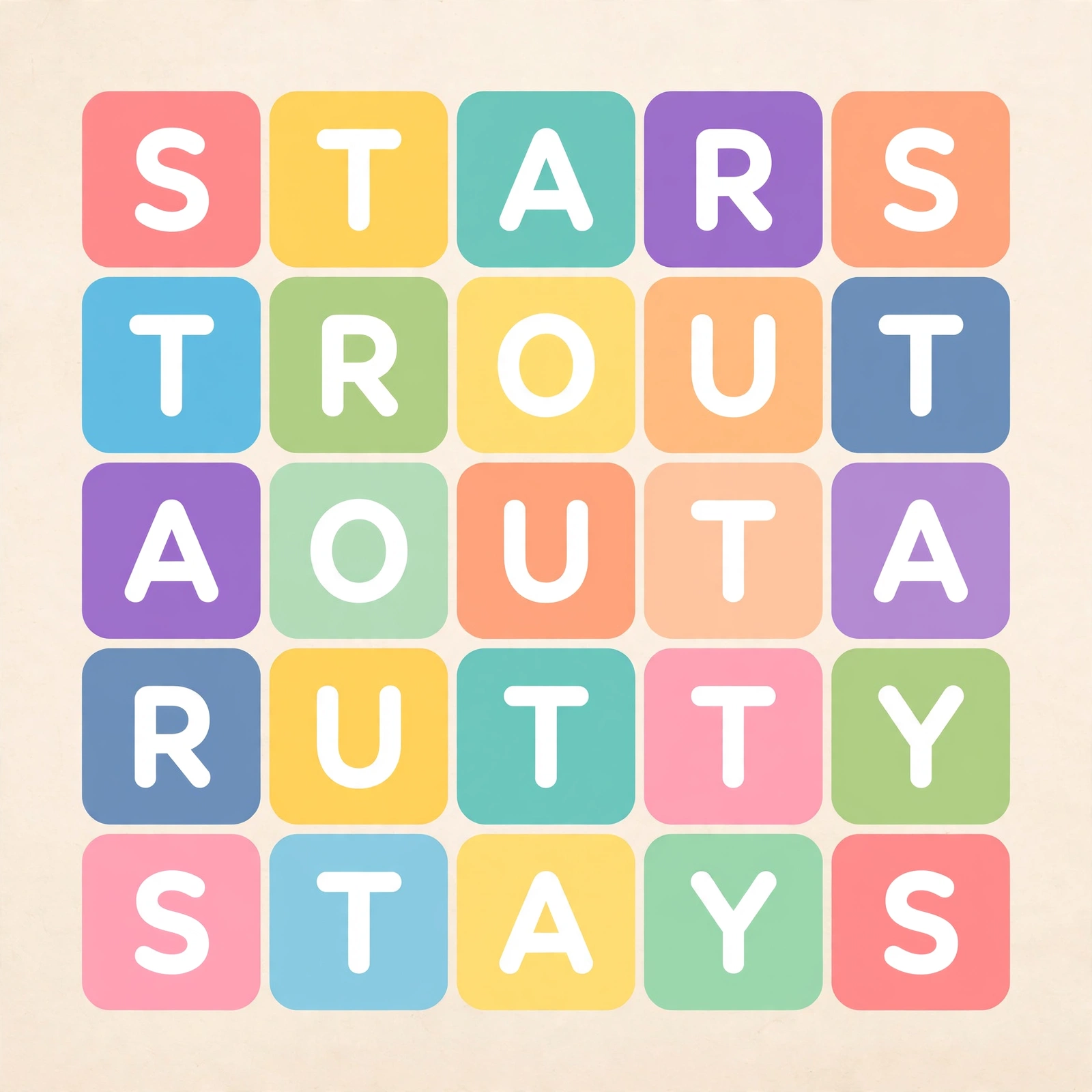
A word square game challenges you to arrange words in a square grid so the same words can be read both across and down. Rooted in the ancient Sator Square and reborn in modern puzzle apps, it tests vocabulary, logic, and pattern recognition — here is the complete guide to how it works, famous examples, and where to play.
What Is a Word Square?
A word square is a type of acrostic: a set of words written out in a square grid so that the same words can be read both horizontally and vertically. The number of words — which always equals the number of letters in each word — is called the "order" of the square. An order-5 square, for example, is five five-letter words stacked so that row 1 reads the same as column 1, row 2 the same as column 2, and so on (en.wikipedia.org).
Here is the classic order-5 example:
| H | E | A | R | T |
| E | M | B | E | R |
| A | B | U | S | E |
| R | E | S | I | N |
| T | R | E | N | D |
Read across: HEART, EMBER, ABUSE, RESIN, TREND. Read down: HEART, EMBER, ABUSE, RESIN, TREND. That symmetry is the whole point — and the whole challenge. Building one of these by hand demands a deep vocabulary and an eye for letter patterns, which is exactly why word square puzzles have survived for centuries.
The word square is a popular puzzle dating well into ancient times, sometimes compared to the numerical magic square — though apart from both using square grids there is no real connection between the two (en.wikipedia.org).
The Sator Square: The Most Famous Word Square
No guide to the word square game is complete without the Sator Square, the first-century Latin word square that the Encyclopedia Britannica called "the most familiar lettered square in the Western world":
| S | A | T | O | R |
| A | R | E | P | O |
| T | E | N | E | T |
| O | P | E | R | A |
| R | O | T | A | S |
Beyond satisfying the basic properties of word squares, the Sator Square is palindromic: it can be read as a 25-letter palindromic sentence, left to right, right to left, top to bottom, and bottom to top. It became a powerful religious and magical symbol in medieval times, and despite more than a century of academic study, its origin and meaning are still debated (en.wikipedia.org).
The Sator Square is the model for many modern word square games, where shuffled letters must be rearranged to rebuild a perfect square — a task far harder than it looks.
How to Play a Word Square Game
Rules vary between versions, but the core mechanic is the same across nearly every word square game:
- You are given a square grid and a set of letters. Some versions show a 5×5 grid with only a few letters filled in; others give you a pool of letters to place.
- Fill the grid with real words. Every row must be a valid word, and every column must read as the same word as its matching row.
- Symmetry is the constraint. Placing a letter in row 2, column 4 automatically fixes row 4, column 2 — because the words across and down must match. This mirrored constraint is what makes the puzzle so tricky.
- Win by completing the square. The puzzle is solved when all rows and columns form valid words and the horizontal and vertical readings match.
Tips for Solving Word Squares
- Anchor the diagonals first. The diagonal cells (row 1/col 1, row 2/col 2, etc.) belong to both their row and their matching column, so they pull double duty — locking them in narrows the possibilities fast.
- Think in palindromic pairs. If your square is also meant to read the same backwards, corner pairs mirror each other, cutting the search space dramatically.
- Use high-frequency letters for the middle. In an odd-order square, the centre cell appears in both the middle row and middle column — common letters like E, A, R, and T are your best bets there.
- Build a mental word bank. Word squares reward players who know lots of short, flexible words. Five-letter words with common letters are the currency of the game.
Modern Word Square Games (Verified)
The ancient concept has inspired several modern games and apps:
- Squardle (play.google.com). A Wordle-style app for Android: guess a square of 5 words of 5 letters (5×5) in fewer than 10 attempts, with green/yellow/grey tile feedback exactly like Wordle. After entering an attempt and pressing Enter, tiles are coloured in each row and on the keyboard — green for a letter in the right place, yellow for a correct letter in the wrong place, grey for a letter not in the solution (play.google.com).
- Pym's Daily Word Square Puzzle (dosgamesarchive.com). A free MS-DOS puzzle game (playable in the browser) where you fill a 5×5 square grid with meaningful English words based on the few letters shown. You get as many tries as you like, the programme shows which letters are correct so far, and a new puzzle is offered each day — or you can use the calendar to pick a puzzle from another date. The game is released under the GPL licence (dosgamesarchive.com).
- Sator Square puzzle games. Fan-made projects (such as the open-source Sator Square game on GitHub) present a shuffled 5×5 grid of letters and challenge you to rearrange them into the correct Sator Square, often with a points system for successful solves (github.com).
Word Square Games Compared
| Game | Grid size | Platform | Format | Cost |
|---|---|---|---|---|
| Classic paper word square | Any (commonly 5×5) | Pen and paper | Build the square yourself | Free |
| Squardle | 5×5 | Android app | Guess the 5×5 square in under 10 attempts | Free (with ads) |
| Pym's Daily Word Square Puzzle | 5×5 | Browser (DOS emulation) | Daily puzzle with unlimited tries | Free (GPL) |
| Sator Square rearrangement games | 5×5 | Browser/desktop | Unshuffle letters to rebuild the square | Free |
If you enjoy the letter-pattern thinking of word squares, you'll also like the daily word puzzle on Plusword, and the site's guide to prize crossword clues scratches the same cryptic itch.
Word Square vs Other Word Puzzles
Word squares sit in a family of letter-grid puzzles but have their own flavour:
- Crosswords interlock words at shared letters but don't require across/down symmetry; for a deeper dive, see the Plusword guide to choosing crossword books.
- Wordle and its variants test single-word deduction with colour feedback; a word square multiplies that into five simultaneous words.
- Anagrams rearrange letters into one word; word squares rearrange them into five that all agree with each other.
What is a word square game?
A word square game is a puzzle where you fill a square grid with words so that the same words read both across and down. The order of the square is the number of words, equal to the number of letters in each word (en.wikipedia.org).
What is the most famous word square?
The Sator Square — SATOR, AREPO, TENET, OPERA, ROTAS — a first-century Latin word square that reads the same in all four directions and became a medieval religious and magical symbol (en.wikipedia.org).
How big is a standard word square?
Order 5 (a 5×5 grid) is the classic size, with five five-letter words. Smaller and larger squares exist but become much harder or easier to construct.
Is there a word square app?
Yes. Squardle on Google Play is a Wordle-style 5×5 word square game where you guess five 5-letter words in under 10 attempts with green/yellow/grey feedback (play.google.com).
Can I play a word square game for free online?
Yes. Pym’s Daily Word Square Puzzle is free to play in the browser, offering a new daily 5×5 puzzle with unlimited tries (dosgamesarchive.com).
Are word squares good for vocabulary?
Yes. Building and solving word squares forces you to juggle hundreds of candidate words and their letter patterns, making them excellent vocabulary and pattern-recognition exercise.
What is the difference between a word square and a magic square?
A word square uses letters to form identical words across and down; a magic square uses numbers that sum to the same total in every row, column, and diagonal. They share only the square grid (en.wikipedia.org).