
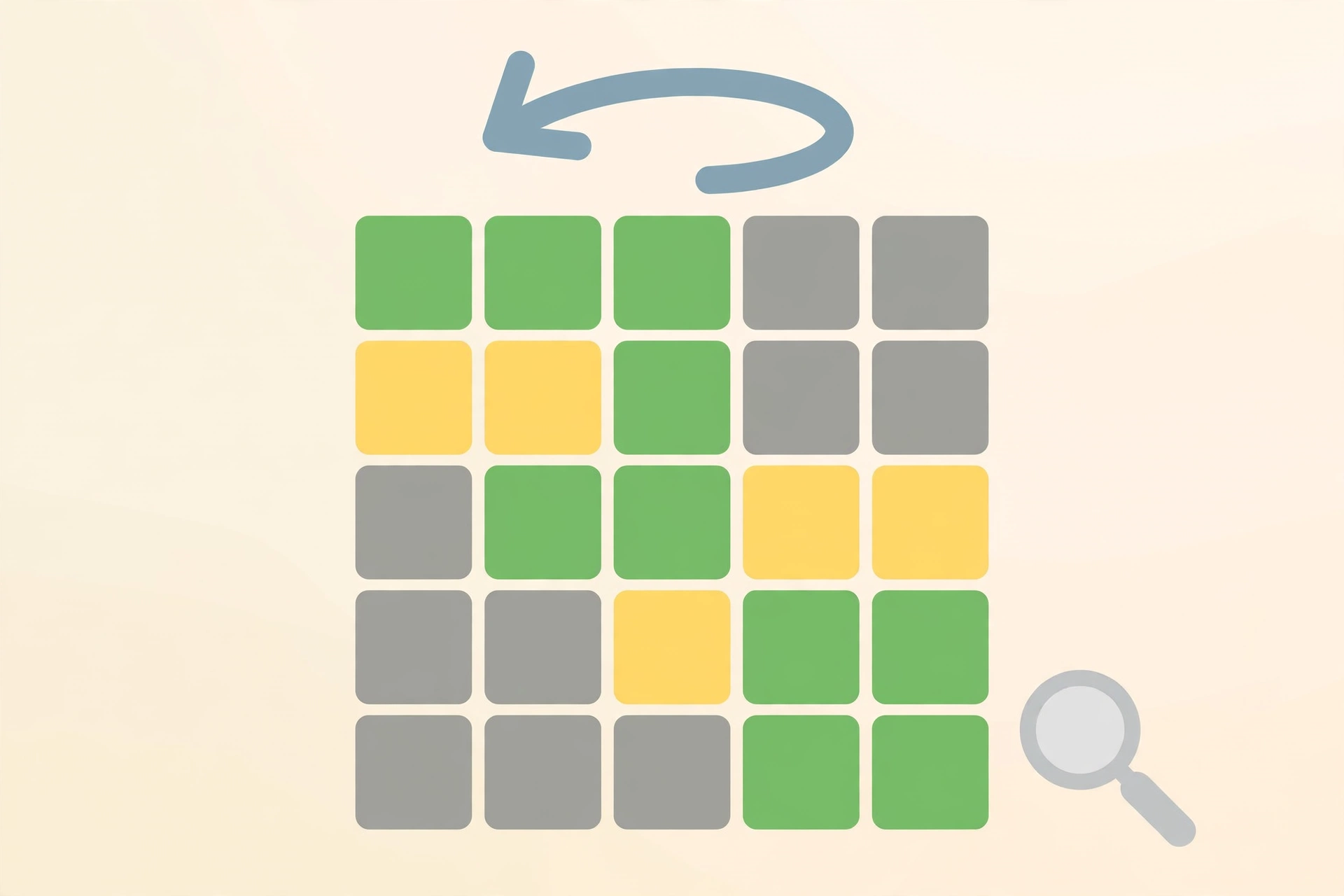
Reversle is a Wordle variant played in reverse: the five-letter solution is already revealed in the grid, and your challenge is to reconstruct the guessing path that leads to it. You get four attempts on a 5×5 grid, working around fixed coloured tiles, and the time you take directly affects your score.
What Is Reversle?
Reversle takes the familiar Wordle formula and turns it backwards. In standard Wordle you guess toward a hidden answer; in Reversle the answer is sitting in front of you from the very first second, shown as an "all green" completed row at the bottom of the board. Your job is to play as though you were tracing your steps back to that solution — entering four valid five-letter guesses that are consistent with the coloured tile constraints already fixed in the grid (wordle2game.com).
The game was created by Kiru, an independent developer whose social bio describes him as a "recursive problem solver" — a fitting background for a game built on reverse-engineering Wordle's linear guessing logic into a recursive puzzle (wordle2game.com).
Where to Play Reversle
You can play Reversle free in any web browser at reversle.net, on desktop, tablet or mobile — there is nothing to download or install (Nerdschalk's Reversle guide). Like most Wordle spin-offs it is a daily game, so there is one official puzzle per day, though many players use it as a warm-up alongside their regular Wordle routine (Wordle2Game's Reversle page).
How to Play Reversle: The Rules
The board is a 5×5 grid. The bottom row already contains the solution, fully revealed in green. The four rows above it contain fixed coloured tiles that act as constraints: every word you enter must be consistent with those tiles, exactly as if those rows were previous guesses that produced that colour pattern.
- Green tiles are fixed: the letter shown is correct and locked in that column, so your guess must keep it.
- Yellow tiles mean the letter belongs to the solution word but sits in a different column — your guess must include that letter somewhere else.
- Grey tiles mean the letter does not appear in the solution at all — your guess must avoid it.
Each of your four guesses must be a real, valid five-letter English word. A running timer tracks how long you spend on each row, and your total time becomes your score when you complete the puzzle — so both accuracy and speed matter.
A worked example
Say the revealed answer is PLANT. The row above shows: column 1 grey (letter R), column 2 yellow (letter L), column 3 green (letter A), columns 4 and 5 grey (letters O and D). Your guess must be a real word with A in position 3, containing L somewhere other than position 2, and using none of R, O or D. PEALS (P-E-A-L-S) fits perfectly: A stays green in position 3, L appears in position 4 instead of 2, and no banned letters appear. That is the essence of Reversle — thinking backwards from the answer.
Reversle vs Wordle
| Feature | Wordle | Reversle |
|---|---|---|
| Goal | Discover the hidden word | Reconstruct guesses toward a revealed word |
| Attempts | 6 | 4 |
| Grid | 6 rows x 5 columns | 5×5 (4 guess rows + answer row) |
| Feedback | Earned per guess | Fixed in advance as constraints |
| Scoring | Streaks and guess count | Total time across rows |
| Daily puzzle | Yes | Yes |
| Creator | Josh Wardle | Kiru (independent developer) |
Strategies and Tips for Reversle
Start from the fixed greens
Green tiles are free information: lock those letters in mentally and build candidate words around them, exactly as you would with confirmed letters in Wordle.
Treat yellows as positional bans
A yellow tile tells you two things at once: the letter must appear, and one specific column is forbidden. List the remaining legal columns before you commit to a word.
Respect the greys absolutely
Grey tiles eliminate letters from the whole puzzle. Keep a mental (or written) ban list — reusing a grey letter is the most common way to waste an attempt.
Think like a crossword solver
Because you are fitting words to a pattern rather than discovering one, Reversle rewards the same skills as crosswords: anagrams, common letter patterns and word families. Keep frequent five-letter endings and beginnings in mind.
Balance speed with accuracy
The timer rewards fast play, but a failed row costs far more time than ten extra seconds of thought. Aim for confident, pattern-checked guesses rather than rushed ones.
Practise reverse thinking
The core skill — holding the answer while generating consistent "wrong" guesses — feels unusual at first. Your first few games will seem strange; by game five the logic clicks and it becomes genuinely addictive.
Common Reversle Mistakes
Ignoring the grey columns entirely. Greys ban letters from the whole puzzle, including letters you might want to reuse in a "clever" anagram. Before typing any guess, scan every grey column and cross those letters off your mental alphabet.
Starting from the top row. Because fixed tiles concentrate in the lower rows, many experienced players start with the row closest to the answer, where constraints are densest. Solving the most constrained row first makes the looser rows above it dramatically easier.
Chasing speed over legality. The timer tempts rushed entries, but an illegal word costs you the seconds you saved plus the frustration. Ten extra seconds spent verifying that every fixed tile is respected is almost always worth it.
Reusing a yellow letter in its banned column. A yellow tile forbids exactly one column for that letter. It is the single most common slip in Reversle — double-check the forbidden column before you hit Enter.
Building Reverse-Logic Speed
Reversle rewards fast, accurate reverse thinking, and speed is trainable with the right drills.
- Practise from the greens outward. Start every row by locking in the confirmed green letters, then brainstorm words around them before touching the keyboard. The habit of anchoring first prevents wasted guesses.
- Keep a mental ban list. Each yellow is a position a letter cannot occupy. Saying the bans out loud — "not second, not fourth" — keeps them active in working memory as the timer runs.
- Drill with unlimited versions. The practice versions on Wordle portal sites let you replay the format endlessly. Use them for pure speed training without risking your daily score.
- Review your slow rows. After each game, recall which row cost you the most time and why. Most players lose time on one specific pattern — usually misplaced yellows — and naming it is the first step to fixing it.
Who created Reversle?
Reversle was developed independently by Kiru, a developer who describes himself as a “recursive problem solver” — the game is his playful inversion of Wordle’s guessing logic (wordle2game.com).
Is Reversle free to play?
Yes. It runs entirely in the browser at reversle.net with no account, download or payment required (nerdschalk.com).
How many attempts do you get in Reversle?
Four. You must fill the four rows above the revealed answer, with each guess satisfying the fixed coloured tiles.
Is Reversle a daily game?
Yes — like most Wordle variants, Reversle offers one official puzzle per day.
Can I play Reversle on my phone?
Yes. The game works in any modern mobile browser as well as on desktop and tablet.
How does scoring work in Reversle?
The game times each row you complete; your total time across all four rows becomes your score, so faster correct solutions rank higher.
Do I need to download anything to play Reversle?
No. Reversle is fully web-based — just open reversle.net in a browser and play.
Can I play Reversle more than once a day?
The official game offers one puzzle per day. Unlimited practice versions on Wordle portal sites let you replay the format as often as you like.
Is Reversle harder than Wordle?
For most players, yes — at least at first. Working backwards from revealed letters is an unfamiliar skill, so expect slower solves until reverse thinking becomes automatic. The timed scoring adds pressure Wordle does not have.
Can I replay a Reversle puzzle I failed?
Not the official daily, which moves on like Wordle. But unlimited practice versions on Wordle portal sites let you replay the format as often as you like. If you enjoy twisting familiar formats into new challenges, our guide to [Quordle](https://plusword.co.uk/what-is-quordle/) covers the four-word Wordle variant, and [Hard Sudoku Strategies](https://plusword.co.uk/hard-sudoku-strategies/) offers the same kind of reverse-engineering thinking for number puzzles.