
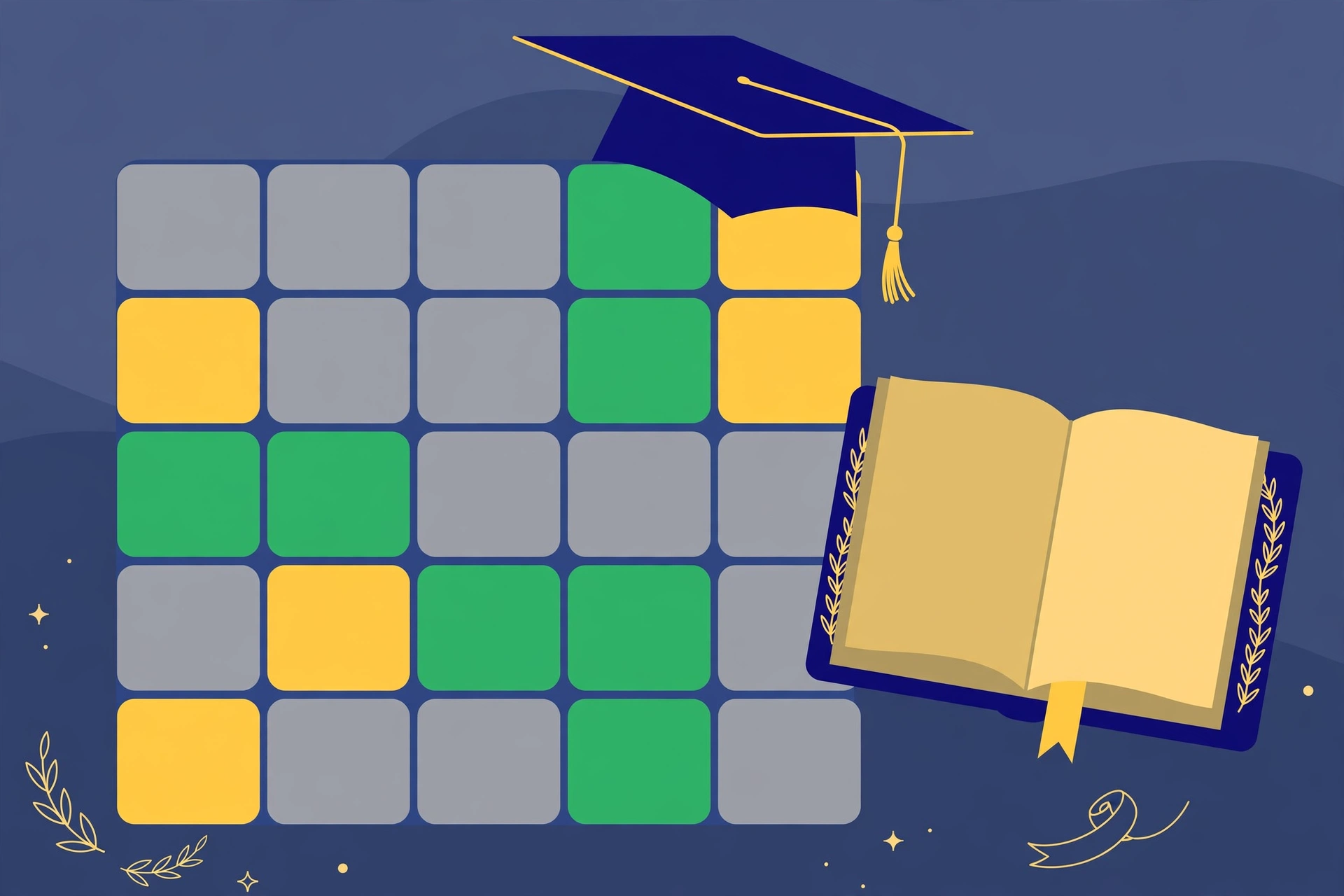
Scholardle is a Wordle spin-off designed for people who love a real challenge: instead of everyday five-letter words, you must guess a five-letter word drawn from academic vocabulary — the kind of jargon found in research papers, scientific journals and university textbooks. Created by the company behind the academic proofreading tool Writeful and launched in early 2022, it follows the familiar Wordle format but with a scholarly word list that will test even seasoned logophiles (TechRadar). Think of it as Wordle reimagined as a vocabulary puzzle for the university crowd: the same six-attempt word-guessing game, but the answer pool is scholarly terminology rather than common English.
How to Play Scholardle
Scholardle plays just like Wordle, with an academic twist:
- One puzzle per day. A new five-letter academic word is generated every 24 hours.
- Six attempts. You have six guesses to identify the hidden word. Each guess must be a valid word.
- Colour feedback. After each guess, the tiles change colour to guide you:
- Green: the letter is correct and in the right position.
- Yellow: the letter is in the word but in the wrong position.
- Grey: the letter is not in the word at all.
- Streak tracking. The game records your winning streak, just like the original Wordle.
- Free in the browser. Play at scholardle.com on any device with a web browser; no download or sign-up needed.
The game is built on Reactle, an open-source Wordle clone designed to be freely adapted — the same code family behind the Pokémon-themed Squirdle and the Harry Potter-styled Wizarding Wordle, as detailed in TechRadar's launch coverage.
Hard Mode and Display Options
Scholardle includes an optional hard mode that forces you to use any revealed hints in subsequent guesses, preventing you from burning guesses on fresh letters. There are also dark mode and high-contrast display options for comfortable play.
What Makes Scholardle Harder Than Wordle?
The difficulty comes entirely from the word list. While Wordle draws on common English vocabulary, Scholardle's answers come from what its creators describe as a list of top academic words — the esoteric terminology of academia. That scholarly vocabulary is the game's entire identity: you are not testing everyday spelling knowledge but your familiarity with the formal lexicon of research, science and higher education.
This means university students, researchers and professors may have a genuine advantage, having encountered these words in journals and manuscripts. For everyone else, standard Wordle opening strategies still apply, but the answer pool is far less predictable.
Scholardle vs Wordle: Comparison
Side by side, the academic word game looks identical to the original daily word game — the differences are all in the word list and who built it. This comparison shows exactly what changes when a scholarly word list replaces everyday vocabulary:
| Feature | Scholardle | Wordle |
|---|---|---|
| Word list | Academic vocabulary | Everyday English |
| Word length | 5 letters | 5 letters |
| Guesses | 6 | 6 |
| Frequency | Daily | Daily |
| Hard mode | Yes (must use hints) | Yes |
| Creator | Writeful | Josh Wardle |
| Play at | scholardle.com | NYTimes Games |
Where to Play Scholardle
Scholardle is free to play in any web browser at scholardle.com, with no download or account required — it works on desktop, tablet and mobile, so your daily word-guessing habit travels with you. A new five-letter scholarly term is generated every 24 hours, and the built-in streak tracker records your run of wins, giving each day's six attempts real stakes. The open-source Reactle framework it is built on means the game stays light and fast in the browser. When one academic puzzle a day is not enough, our Wordle Unlimited guide points you to endless practice rounds.
Tips for Winning at Scholardle
- Open with vowel-heavy academic words. Starters rich in common letters still help: think "adieu", "audio" or "raise" to map the vowels fast.
- Think like a researcher. Once you have a few letters, brainstorm academic contexts: Latin roots, scientific terms, and formal vocabulary rather than casual words.
- Use hard mode once comfortable. It sharpens discipline by forcing you to build on revealed information instead of fishing with new letters.
- Study common academic word patterns. Five-letter scholarly words often end in patterns like "-ic", "-al" or "-ous" and begin with prefixes like "re-" or "de-".
- Don't fear obscure guesses. In Scholardle, the weird guess is often the right one. If a strange academic term fits the pattern, play it.
- Track your streak. The daily streak tracker adds motivation; protecting a long streak makes every guess feel meaningful.
Common Scholardle Answer Patterns
Because the answers come from scholarly writing, certain letter patterns show up again and again. Recognising them gives you an edge:
- Latin and Greek roots. Academic English is built on classical foundations. Words built from roots like "bio", "geo", "theo" and "phil" appear frequently, and five-letter forms of them are classic Scholardle answers.
- Adjectival endings. Scholarly prose loves adjectives. Endings such as "-ic", "-al" and "-ar" are disproportionately common in the answer list, so a yellow C or L should make you think about these suffixes.
- Formal verbs. Where Wordle might use "plant", Scholardle reaches for more formal equivalents. Thinking in terms of academic register — the way textbooks and papers phrase things — narrows the field considerably.
- Discipline vocabulary. Expect terms borrowed from philosophy, linguistics, sociology and the sciences. If your letters suggest a word you only ever saw in a journal article, trust that instinct.
A Sample Solving Walk-Through
Imagine the answer is a five-letter academic term and you open with "adieu", revealing a yellow E and a grey everything else. A strong second guess like "sport" tests fresh consonants and lands a green O in position three. Now think academically: _ O _ _ _ with an E somewhere. Scholarly candidates ending in "-ose" or "-ote" come to mind, and a guess like "notes" (green N, yellow E) tightens the net. From there, academic word families do the rest — a word like "nodal" or "nomos" might fit, and the forcing logic of hard mode keeps every guess productive.
Scholardle vs Other Hard Wordle Variants
| Variant | Twist | Difficulty |
|---|---|---|
| Scholardle | Academic vocabulary | High |
| Sedecordle | 16 words at once, 21 guesses | Very high |
| Squardle | 5×5 grid of interlocking words | High |
| Quintessential | Swap-based wordplay | Medium-high |
| Standard Wordle | Everyday words | Medium |
Scholardle stands out because its difficulty comes from knowledge rather than mechanics. You are not juggling multiple grids; you are being asked how wide your academic vocabulary really is. If you prefer mechanical difficulty, our Quordle guide covers the four-grid format, while Waffle swaps blind guessing for tile rearrangement.
Who Should Play Scholardle?
Scholardle is ideal for students, academics, researchers, and anyone who found regular Wordle too easy. If you enjoy academic reading, scientific journals, or competitive vocabulary games, this is the Wordle variant built for you. Casual players may find it punishing, but that is entirely the point — it is pitched as Wordle for those who like a challenge. And when one daily puzzle is not enough, Wordle Unlimited offers endless practice rounds.
What is Scholardle?
Scholardle is a daily word-guessing game like Wordle, but the hidden five-letter words come from academic vocabulary instead of everyday English. It was created by Writeful, the company behind an academic proofreading tool.
How do you play Scholardle?
Guess a five-letter academic word in six tries. Green means the right letter in the right spot, yellow means the right letter in the wrong spot, and grey means the letter is not in the word. A new puzzle appears daily.
Is Scholardle free?
Yes. Scholardle is free to play in any web browser at scholardle.com, with no download or account required.
What is Scholardle hard mode?
Hard mode forces you to use any revealed hints in your subsequent guesses, so you cannot waste guesses trying completely new letters once you have green or yellow clues.
Who made Scholardle?
Scholardle was created by Writeful, a company known for its academic proofreading and writing tool. It is built on the open-source Reactle Wordle-clone framework.
Is Scholardle harder than Wordle?
Yes, deliberately so. The academic word list draws on scholarly jargon rather than common vocabulary, making the answers much harder to guess for the average player. INTERNAL LINKS: /what-is-quordle/ /what-is-waffle-word-game/ /wordle-unlimited-explained/