
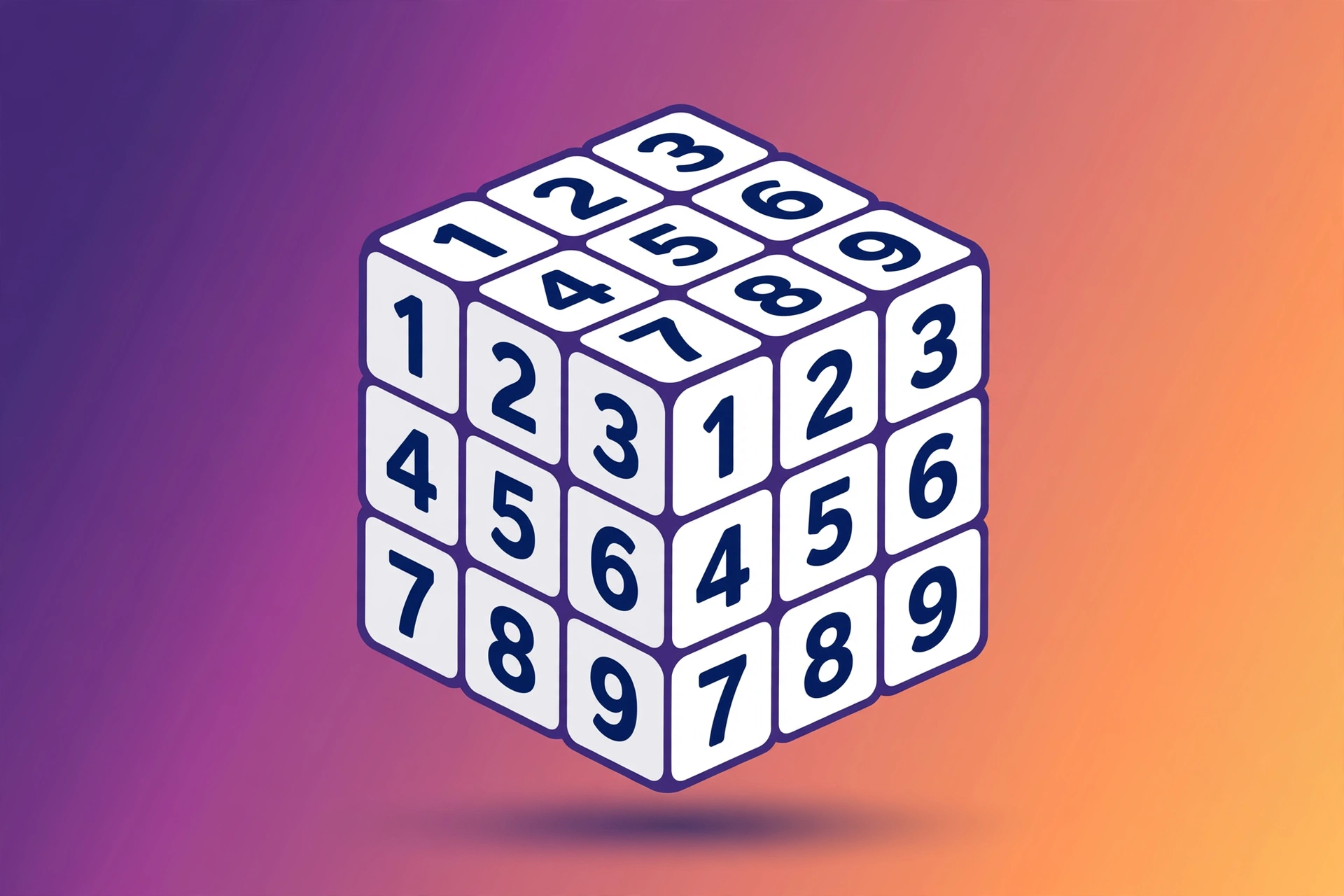
A Sudoku Cube, also known as a Sudokube, is a three-dimensional twist on the classic Sudoku puzzle built into a twistable cube similar to a Rubik's Cube. Instead of filling a flat 9×9 grid, you twist the cube's faces until each side shows the numbers 1 to 9 arranged so that no number repeats in any row or column, effectively solving multiple Sudoku puzzles at once across the cube's faces.
How the Sudoku Cube Works
The concept is simple to describe and fiendishly hard to execute. A standard Sudoku Cube looks like a Rubik's Cube, but instead of coloured stickers, each small square carries a number. The goal is to twist and turn the layers until every face of the cube displays the digits 1 through 9 with no repetitions in any row or column.
Unlike a Rubik's Cube, where each face must become a single solid colour, the Sudoku Cube demands that each face becomes a valid mini-Sudoku: nine different digits arranged in a 3×3 grid. Because the faces share edge and corner pieces, solving one face inevitably disturbs the others, which is exactly what makes it so challenging.
The 18 Puzzles Hidden Inside
According to the original design, the cube's number arrangement contains 18 unique Sudoku puzzles within a single toy. The inventor spent weeks working out a numerical pattern so that the digits could be arranged to create these puzzles across the faces and rows of the cube, then patented that arrangement.
The History of the Sudoku Cube
The Sudoku Cube was invented in 2006 by Jay Horowitz, a veteran American toy maker based in Sebring, Ohio, who specialised in reviving classic toys for the collectibles market.
The origin story is almost as good as the puzzle itself. Horowitz first encountered Sudoku when a woman sitting next to him on a plane explained the puzzle to him during the flight. Captivated, he began thinking about how the two-dimensional number puzzle could be brought into the games business and hit upon the idea of combining it with the Rubik's Cube.
Horowitz had a decisive advantage: he owned the Ideal Toy Company, which held the original moulds for manufacturing Rubik's Cubes. He spent a month working out how to merge the two puzzles, and once he cracked the concept, he reportedly did not sleep for three days while working out how best to arrange the numbers to create 18 unique Sudoku puzzles within the cube.
Mass production was completed in China by American Classic Toy Inc, a company belonging to Horowitz. The product was sold in the United States through retailers such as Barnes & Noble and FAO Schwarz at a price of $9.87 each, a price deliberately chosen because each number on the cube appears only once.
Sudoku Cube vs Rubik's Cube: Key Differences
| Feature | Sudoku Cube | Rubik's Cube |
|---|---|---|
| Goal | Numbers 1-9 with no repeats per face | One solid colour per face |
| Markings | Digits on each sticker | Coloured stickers |
| Skill required | Sudoku logic + spatial reasoning | Algorithms + spatial reasoning |
| Number of solutions | Multiple valid arrangements | One solved state |
| Invented | 2006, Jay Horowitz | 1974, Erno Rubik |
| Difficulty | Often considered harder | Hard, but well documented |
The crucial difference is that the Sudoku Cube has many valid solutions rather than a single solved state. Any arrangement where each face shows 1-9 without repetition counts as solved, which means there is more than one path to victory but also more ways to get stuck.
Popular Sudoku Cube Variants
The original Sudokube is not the only 3D Sudoku toy on the market. Several variants have appeared over the years:
- ThinkFun Colour Cube Sudoku: Instead of numbers, this version uses nine coloured cubes that must be flipped and rearranged into a 3×3 square so that each of six colours appears exactly once in every row and column. ThinkFun claims it has over half a million possible solutions.
- Kanoodle SudoQube: From Educational Insights, this is a Sudoku-style puzzle with a Kanoodle twist. It includes 25 snap-together cubes in five colours, a guide with 100 puzzle challenges, and a double-sided game board that doubles as storage. Designed for ages 7 and up, it uses 4×4 and 5×5 grids rather than the full 9×9.
- Logica Sudoku Cube: A wooden 3D Sudoku puzzle from Logica Giochi, handcrafted in Thailand, where players arrange numbered cubes so that numbers do not repeat in any row or column on each side of the cube, using the third dimension across eight sides.
- Standard retail Sudoku Cubes: Generic twistable number cubes sold by gift retailers (for example, Funtime Gifts sells one in the UK for around £6.99), based on the same principle as the original.
How to Solve a Sudoku Cube: Tips for Beginners
Solving a Sudoku Cube is genuinely difficult, but these strategies will help:
- Learn standard Sudoku first. If you cannot solve a flat 9×9 Sudoku confidently, the cube version will be brutal. Master the basics of rows, columns and 3×3 boxes first.
- Solve one face at a time, then protect it. Work on completing a single face with digits 1-9, then use careful moves that preserve it while working on adjacent faces.
- Think in rows, not just faces. Remember that the puzzle can be treated as a number puzzle on rows wrapping around the cube, not only on individual faces.
- Use the colour-cube logic. On the original cube, each number appears a fixed number of times. Tracking which digits are already placed helps you spot what is missing.
- Start with the Colour Cube Sudoku variant. If the full numbered cube is too hard, ThinkFun's colour version (a 3×3 arrangement task rather than a twisty puzzle) is a gentler introduction to 3D Sudoku thinking.
- Be patient. Even experienced cubers report that the Sudoku Cube takes far longer than a standard Rubik's Cube. Treat it as a long-term project, not a five-minute solve.
For flat-grid technique training, our hard sudoku strategies and killer sudoku guide build the logic muscles the cube demands.
Is the Sudoku Cube Good for Your Brain?
Like all Sudoku variants, the Sudoku Cube exercises logical reasoning, pattern recognition and working memory. The 3D element adds spatial reasoning to the mix, engaging parts of the brain that flat puzzles do not. While no puzzle can promise specific cognitive benefits, regularly tackling challenging puzzles is widely considered good mental exercise.
The 3D twist matters because it forces two kinds of thinking at once: the number logic of Sudoku and the spatial tracking of a twisty puzzle. On a flat grid you only track digits; on the cube you must also track where each face's rows run after a rotation, which taxes working memory in a way the 2D version never does. It is closer to the mental load of playing blindfold chess than to filling in a newspaper grid — which is also why solving one face at a time, the standard beginner strategy, is really a working-memory management technique disguised as a solving tip.
What is a Sudoku Cube?
A Sudoku Cube (Sudokube) is a 3D puzzle combining Sudoku with a Rubik’s Cube. You twist its faces until each side shows the numbers 1 to 9 with no repeats in any row or column.
Who invented the Sudoku Cube?
The Sudoku Cube was invented in 2006 by American toy maker Jay Horowitz of Sebring, Ohio, after he learned about Sudoku from a fellow aeroplane passenger.
Is the Sudoku Cube harder than a Rubik’s Cube?
Most solvers consider it harder. A Rubik’s Cube has one solved state and well-known algorithms, while the Sudoku Cube requires Sudoku logic applied in three dimensions with far less documented solving theory.
How many solutions does a Sudoku Cube have?
Unlike a Rubik’s Cube, the Sudoku Cube has many valid solved states. Any arrangement with digits 1-9 and no repeats per face counts. ThinkFun’s Colour Cube Sudoku variant claims over half a million solutions.
Where can I buy a Sudoku Cube?
Sudoku Cubes are sold by puzzle and gift retailers. In the UK, for example, Foyles stocks a Sudoku Cube game (around £6.99), and variants like ThinkFun’s Colour Cube Sudoku and Kanoodle SudoQube are available from toy retailers and online stores.
What age is the Sudoku Cube suitable for?
It depends on the variant. The original twisty Sudoku Cube suits teens and adults comfortable with Sudoku. Kanoodle SudoQube is designed for ages 7 and up, making it the best entry point for children.
Can you solve a Sudoku Cube with Rubik’s Cube algorithms?
Standard Rubik’s Cube algorithms move pieces without regard to numbers, so they are of limited use. The Sudoku Cube requires its own approach based on Sudoku logic: placing digits so that rows and columns contain no repeats.