
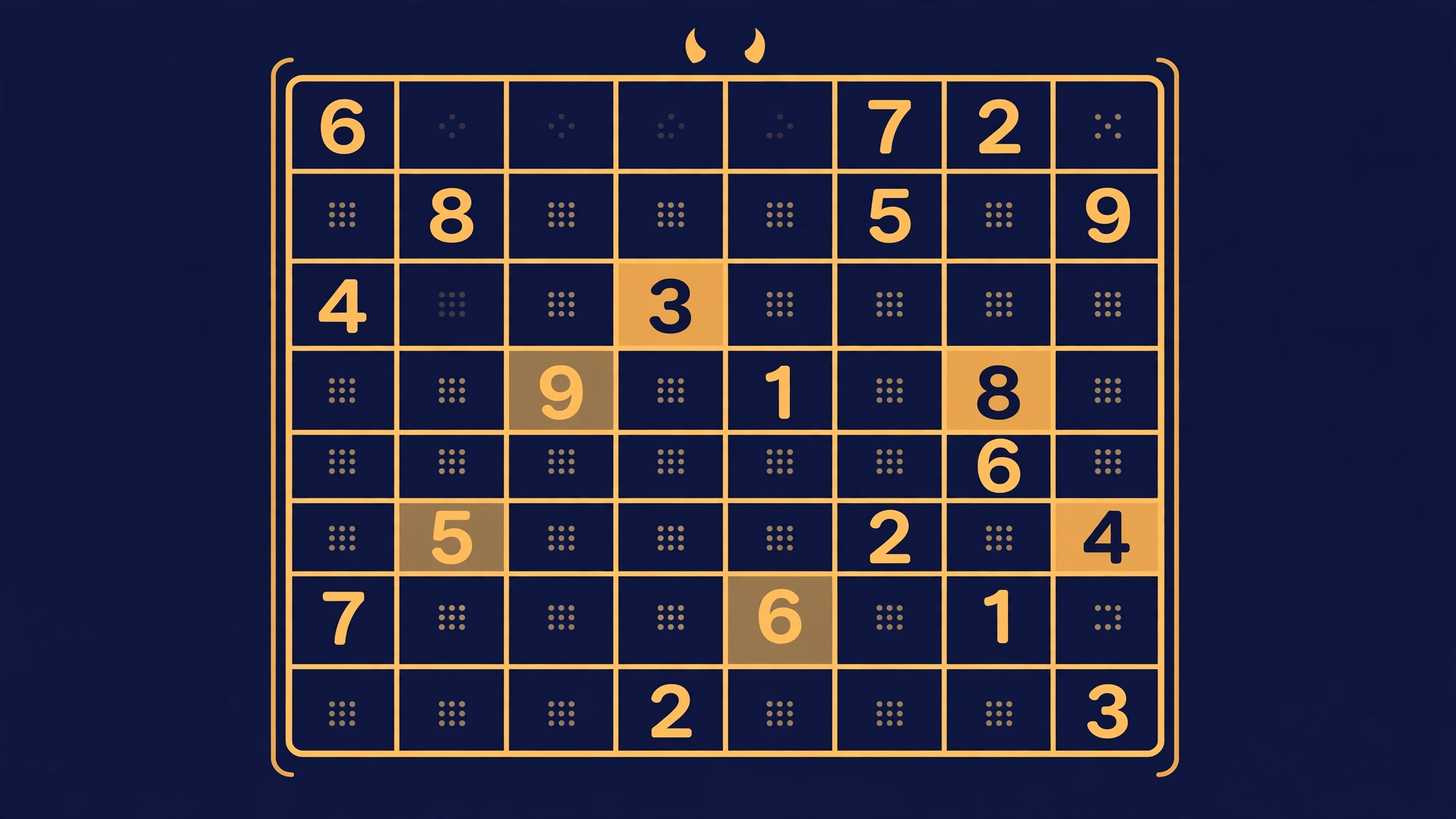
Fiendish Sudoku is the top difficulty rating in The Times' daily Sudoku, sitting above Easy, Medium, Hard and Difficult. A Fiendish puzzle can't be cracked with basic scanning alone — it demands advanced techniques like X-Wing, Swordfish and XY-Wing. Here's what the label means, where it comes from, and how to solve at that level.
Where "Fiendish" Comes From
The Times (London) has published a daily Sudoku since the puzzle's boom in the mid-2000s, using puzzles from Pappocom — the software company of Wayne Gould, the judge who helped popularise Sudoku in the West. The Times grades its puzzles on a five-step ladder:
- Easy — solvable with basic scanning and singles.
- Medium — needs hidden singles and pairs.
- Hard — introduces locked candidates and pairs/triples.
- Difficult — requires X-Wing and Swordfish patterns.
- Fiendish — the toughest tier: advanced pattern techniques, long chains, and deep candidate analysis.
Long-time solvers on the EnjoySudoku forum confirm the ordering, noting that "Fiendish" is ranked above "Difficult" — though individual solvers sometimes find the two tiers trade places depending on which techniques they know best (source).
Other publishers use their own labels ("Diabolical," "Extreme," "Evil"), but Fiendish specifically signals The Times/Pappocom grading.
What Makes a Sudoku "Fiendish"?
A Fiendish puzzle typically has these traits:
- Fewer givens in tricky positions — the starting clues don't unlock easy singles.
- No progress with basic techniques — scanning, naked/hidden singles and simple pairs stall out early.
- Pattern techniques required — X-Wing, Swordfish, and sometimes XY-Wing or forcing chains.
- Deep candidate tracking — you must pencil-mark candidates across much of the grid and reason about eliminations.
- Long solve times — 30–60+ minutes for experienced solvers, versus 5–10 for Easy.
Techniques You Need for Fiendish Puzzles
X-Wing
When a candidate number appears in exactly two cells in each of two rows, and those cells share the same two columns, the number can be eliminated from all other cells in those columns. This rectangle pattern is the gateway technique to the Fiendish tier.
Swordfish
The X-Wing's bigger sibling: the same logic extended across three rows and three columns. Spotting a Swordfish often breaks open a stalled Fiendish grid.
XY-Wing
A three-cell pattern (pivot plus two pincers) that lets you eliminate a candidate from cells seeing both pincers. Essential for the hardest Fiendish puzzles.
Forcing Chains and Trial
Following a candidate's consequences several steps ahead to find contradictions. Use sparingly — strong solvers prefer pure pattern logic, but chains will finish almost any Fiendish.
Fiendish vs Other Difficulty Labels
| Label | Used by | Rough equivalent |
|---|---|---|
| Fiendish | The Times (Pappocom) | Top tier |
| Diabolical | Various UK papers | Top tier |
| Evil | WebSudoku / conceptispuzzles | Top tier |
| Extreme | Sudoku apps | Top tier |
| Samurai | Variant publishers | Multi-grid variant |
Labels aren't standardised across publishers — a "Hard" in one app can be tougher than a "Difficult" in a newspaper. The Times' Fiendish is, however, one of the most widely recognised top-tier marks in the English-speaking puzzle world.
Jellyfish
The pattern family continues: Jellyfish extends the same row/column logic to four rows and four columns. It appears rarely — most Fiendish puzzles break before you need it — but knowing the X-Wing → Swordfish → Jellyfish progression means you will recognise the shape instantly on the day one finally shows up.
Fiendish-Grade Collections Worth Trying
If you want Fiendish-level solving beyond The Times' daily, look for collections explicitly graded at the top tier:
- Nikoli's X-Treme Sudoku books (Workman Publishing) — fiendish-grade puzzles from the Japanese publisher that helped invent modern Sudoku, with a famously strict grading curve.
- App "Extreme" and "Evil" modes — most serious Sudoku apps include a top tier equivalent to Fiendish; the labels differ but the technique requirements (X-Wing and beyond) are the same.
- EnjoySudoku forum puzzles — the community that documents The Times' grading also shares and annotates player-created Fiendish-grade grids, often with step-by-step solving discussions.
Whichever you choose, stick with one grading system for a while: learning what "Fiendish" means in The Times' ladder is more useful than bouncing between publishers whose "Extreme" might be someone else's "Hard."
Common Mistakes at Fiendish Level
- Guessing instead of deducing. Random trial-and-error ("bifurcation") can solve a puzzle but teaches nothing — and often leads to contradictions you can't trace back.
- Incomplete pencil marks. Missing even one candidate can hide the X-Wing or Swordfish that cracks the grid.
- Skipping the re-scan. After every elimination, re-check rows, columns and boxes — new singles appear constantly at this level.
- Burnout. Fiendish puzzles reward patience; taking a break and returning with fresh eyes often reveals the pattern you missed.
How to Work Up to Fiendish Level
- Master the basics cold. Naked singles, hidden singles, pairs and locked candidates should be automatic before you attempt Fiendish.
- Learn one pattern technique at a time. Start with X-Wing, drill it on Difficult puzzles, then add Swordfish.
- Pencil-mark everything. Fiendish solving is candidate-driven — neat, complete notation is non-negotiable.
- Study one puzzle deeply. Take a solved Fiendish and replay the key deductions rather than racing through many puzzles.
- Use solver walkthroughs. Communities like the EnjoySudoku forum annotate Fiendish solves step by step.
Building a Fiendish-Level Daily Habit
Fiendish Sudoku is as much a mental fitness discipline as a puzzle — solvers who attempt one daily report steadily sharper pattern recognition, deeper candidate discipline and faster chain reasoning. If you want the hardest number puzzles as part of a daily routine, treat the Fiendish like training: one grid a day, full pencil marks, and a post-solve review of the key deduction that broke the grid open. Pair it with a daily word puzzle for variety — our what-is-Plusword guide introduces a daily word-deduction puzzle, and the how-to-play guide gets you solving in minutes — a perfect complement to your Sudoku routine. The solvers who climb from Difficult to Fiendish reliably are not the fastest; they are the ones who never skip the basics, annotate every candidate, and study one grid deeply instead of skimming ten.
Sources
- Times Sudoku difficulty levels discussion (Pappocom) — http://forum.enjoysudoku.com/levels-of-sudoku-t1088.html
- Nikoli X-Treme Sudoku (fiendish-grade puzzle collections) — publisher descriptions via Workman Publishing
What is Fiendish Sudoku?
The highest difficulty rating in The Times’ daily Sudoku (by Pappocom), above Easy, Medium, Hard and Difficult — requiring advanced solving techniques.
Is Fiendish harder than Difficult Sudoku?
In The Times’ grading, yes — Fiendish is the top tier and Difficult sits one step below, though individual puzzles can vary.
What techniques do you need for Fiendish Sudoku?
X-Wing, Swordfish, XY-Wing, and often forcing chains, plus thorough candidate pencil-marking.
Who makes The Times Sudoku puzzles?
Pappocom, the company of Wayne Gould, supplies The Times’ Sudoku puzzles and their difficulty grading.
How long does a Fiendish Sudoku take?
Experienced solvers typically need 30–60 minutes or more, compared with under 10 minutes for an Easy.
Is there anything harder than Fiendish?
Some publishers go further (“Super Fiendish,” “Diabolical,” computer-generated extremes), and variant formats like [Killer Sudoku](https://plusword.co.uk/what-is-killer-sudoku/) add extra layers — but within The Times’ ladder, Fiendish is the ceiling.
Do Fiendish Sudoku puzzles have unique solutions?
Yes — like all properly constructed Sudoku puzzles, Fiendish grids have exactly one solution. The difficulty comes from how deeply buried the logical path is, not from ambiguity.
What is the difference between Fiendish and Super Fiendish?
“Super Fiendish” is an unofficial label some publishers and apps use for puzzles even harder than The Times’ Fiendish tier — typically computer-generated extremes requiring long forcing chains. Within The Times’ own ladder, Fiendish remains the ceiling.
Can beginners attempt Fiendish puzzles?
They can try, but it’s far more rewarding to climb the ladder: Easy → Medium → Hard → Difficult → Fiendish, learning each tier’s techniques.
Where can I play Fiendish Sudoku?
The Times publishes one daily (subscription), and many Sudoku apps and [books](https://plusword.co.uk/sudoku-puzzle-book/) include equivalent top-tier puzzles under names like Diabolical, Evil or Extreme.