
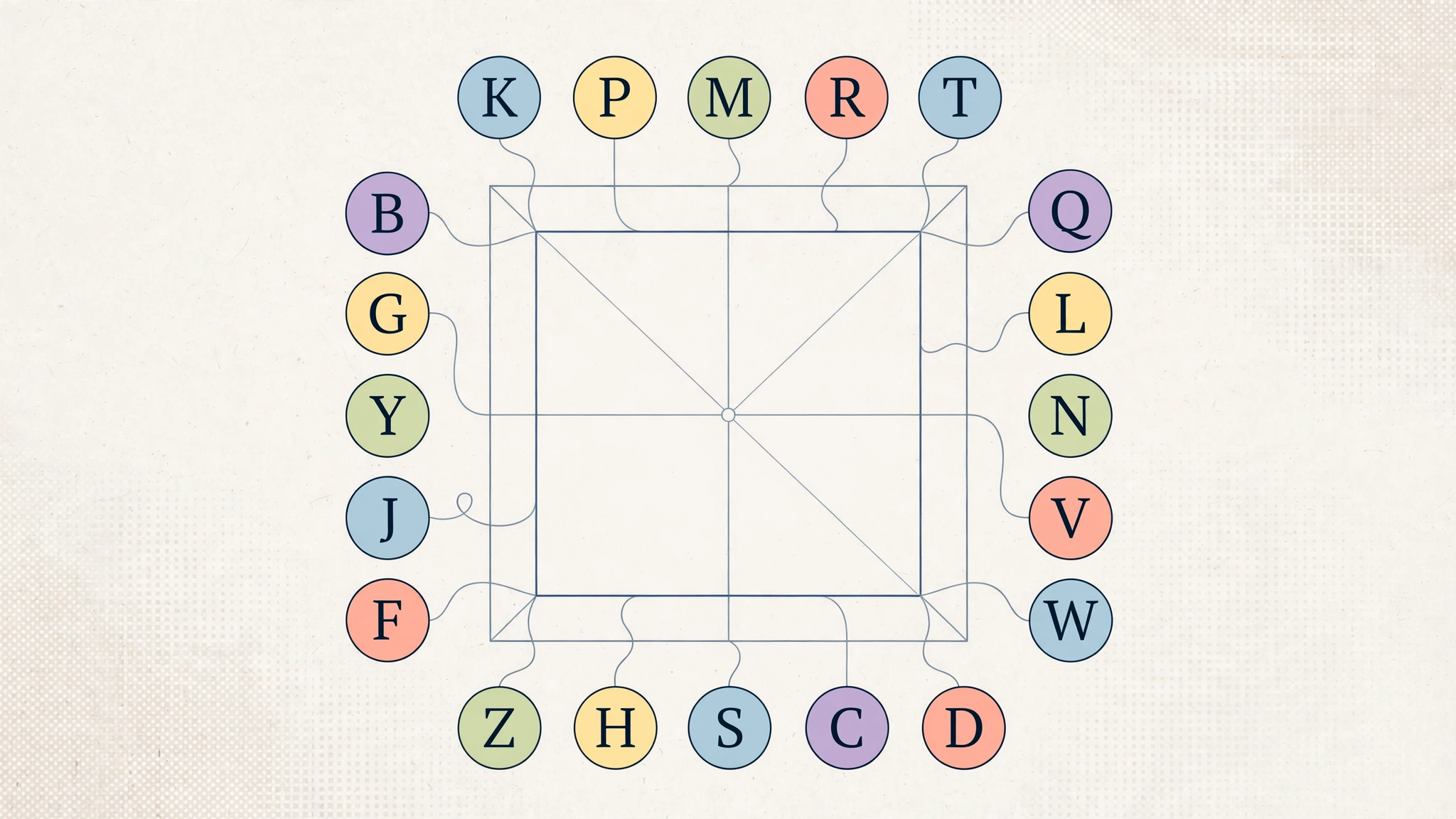
NYT Letter Boxed is a daily word puzzle from The New York Times in which you connect letters arranged around the sides of a square to form words. The goal is to use all 12 letters in as few words as possible — with a two-word solution considered the gold standard. Each new word must begin with the last letter of the previous word, and you can never use two letters from the same side of the square consecutively. For more NYT-style puzzles, learn how to play Plusword or read our Plusword vs Wordle comparison.
What Is Letter Boxed?
Letter Boxed is one of the New York Times Games' daily word puzzles, sitting alongside Wordle, Spelling Bee and Connections. It was created by NYT game designer Sam Ezersky and published in 2019 (soft-launched in 2018) (Wikipedia). Where Wordle asks you to guess a single word, Letter Boxed asks you to build a chain of words that collectively cover every letter on the board. It's a slower, more strategic vocabulary puzzle — there's no time limit and unlimited attempts, so it rewards planning over speed. [nytletterboxedanswers.com]
How to Play Letter Boxed: The Rules
The Setup
- The puzzle is a square with 3 letters on each side — 12 letters total, all different.
- A new puzzle is published daily on the NYT Games website and app.
The Core Rules
- Form words by tapping letters. Click or tap letters around the square to spell a word; lines connect your picks.
- Never use two letters from the same side in a row. If a side holds A, B and C, your word can't place two of them consecutively — you must hop to a different side each time.
- Words must be at least 3 letters long. There's no maximum length.
- Each new word starts with the last letter of the previous word. If your first word ends in N, your second word begins with N.
- Use all 12 letters at least once across your words to solve the puzzle.
- Only valid English words count — no proper nouns, abbreviations or hyphenated words. The game uses a curated NYT dictionary, so some obscure terms may be rejected. [monktech.net]
A Worked Example
Imagine the square shows: Top: T, R, E · Right: N, A, S · Bottom: L, U, D · Left: C, H, O
A possible two-word solution:
- CLOUD — C (left) → L (bottom) → O (left) → U (bottom) → D (bottom)… wait, that breaks the rule: L and O are fine (bottom → left), but U and D are both on the bottom. Not allowed consecutively!
Try again: CLOUDS? Same problem. This is exactly the puzzle's challenge — the side-alternation rule constantly forces you to reroute. A valid chain might be CURL → LACES: C(left) → U(bottom) → R(top) → L(bottom), then L(bottom) → A(right) → C(left) → E(top) → S(right). Every consecutive pair sits on different sides. [techbullion.com]
Strategies: How to Chase the 2-Word Solution
Solving in two words is the "holy grail" — most puzzles are designed so it's possible, and expert solvers aim for it every day. Here's how:
1. Think in Word Chains, Not Single Words
Don't hunt for one giant word. Plan connected pairs: a long first word that ends in a versatile letter (a vowel, or T, R, S, N) which can launch a strong second word. [medium.com]
2. Attack Rare Letters First
Letters like Q, Z, X and J are the hardest to place because few words accommodate them. Build your opening word around them to get them out of the way early.
3. Exploit Suffixes
Endings like -ING, -ED, -ER and -TION are chain gold: they add length (covering more letters) and often end in N, D or R — excellent launch letters for the next word. [monktech.net]
4. Track Unused Letters
Write the 12 letters down and cross them off as you use them. New players lose most often simply by forgetting which letters remain uncovered. [monktech.net]
5. Choose Your Pivot Letter Deliberately
The last letter of word one is the first letter of word two. Before committing to a first word, ask: "Can I start a good word with this ending letter?" Vowels and common consonants (T, R, S, N, L) make the best pivots.
6. Backtrack Without Shame
Stuck on word three with no clean finish? Hit delete repeatedly — it erases back through your previous words, letting you restart from any point. Sometimes the best move is abandoning a decent first word for a great chain. [newyorkersblog.com]
Letter Boxed vs Other NYT Word Games
| Game | Objective | Daily? | Skill Tested |
|---|---|---|---|
| Letter Boxed | Chain words to cover 12 letters | Yes | Vocabulary + planning |
| Wordle | Guess one 5-letter word in 6 tries | Yes | Deduction |
| Spelling Bee | Make words from 7 letters | Yes | Vocabulary breadth |
| Connections | Group 16 words into 4 categories | Yes | Lateral thinking |
Letter Boxed is unique in the NYT lineup: it's the only game about linking words strategically rather than guessing or grouping them. [medium.com]
Is Letter Boxed Free?
The daily Letter Boxed puzzle is available on the NYT Games website and app. Like most NYT puzzles beyond Wordle and the Mini, full archive access sits within the Games subscription — but the current day's puzzle is playable, and the rules above are all you need to start solving.
Practice Approach for Beginners
- Solve in any number of words first. Don't chase two words on day one — just finish the puzzle.
- Then aim for fewer. Once you can reliably solve, try beating your word count.
- Study the official solution. After solving, compare with the NYT's suggested answer to learn new chain patterns.
- Build a mental word bank. Keep a list of flexible "bridge" words (ending in -ING, starting with common letters) you can reach for daily.
Final Thoughts
NYT Letter Boxed is the thinking person's daily word puzzle — part vocabulary test, part route-planning exercise. Master the side-alternation rule, learn to love the two-word chase, and you'll have a satisfying daily ritual that rewards patience over reflexes.
Enjoyed this? Compare it with the original daily phenomenon in our Wordle game guide, or try the Telegraph's crossword-Wordle hybrid, Plusword.
Sources: rules and strategies via nytletterboxedanswers.com, monktech.net and techbullion.com; game comparisons via medium.com; computational overview via arxiv.org.
What are the rules of NYT Letter Boxed?
Form words from 12 letters arranged around a square (3 per side). You can’t use two letters from the same side consecutively, each word must start with the previous word’s last letter, words need 3+ letters, and you must use all 12 letters. [nytletterboxedanswers.com]
What is a good Letter Boxed score?
Fewer words is better. A **two-word solution** is considered optimal — the puzzle’s “holy grail.” Most casual solvers finish in 3–5 words, which is perfectly respectable.
Can you reuse letters in Letter Boxed?
Yes — letters can appear in multiple words and multiple times within a word. The only restriction is never using two same-side letters back-to-back.
Are proper nouns allowed in Letter Boxed?
No. Proper nouns, abbreviations and hyphenated words are not accepted; the game checks against the NYT’s curated word list. [monktech.net]
What time does Letter Boxed reset?
A new puzzle is published daily in the early morning US Eastern Time on the NYT Games website and app. [techbullion.com]
Is there a Letter Boxed archive?
NYT Games subscribers can access past puzzles. Free players get the current daily puzzle.
How is Letter Boxed different from Spelling Bee?
Spelling Bee asks you to make as many words as possible from 7 letters around a central letter. Letter Boxed asks you to chain words covering 12 letters on a square with the side-alternation and word-linking rules — it’s a planning puzzle, not a word-hunt.
Any tips for finding the 2-word solution?
Start with the rarest letters (Q, Z, X, J), aim for a long first word ending in a flexible letter, and use -ING/-ED suffixes to bridge awkward letters. Track unused letters on paper as you go.