
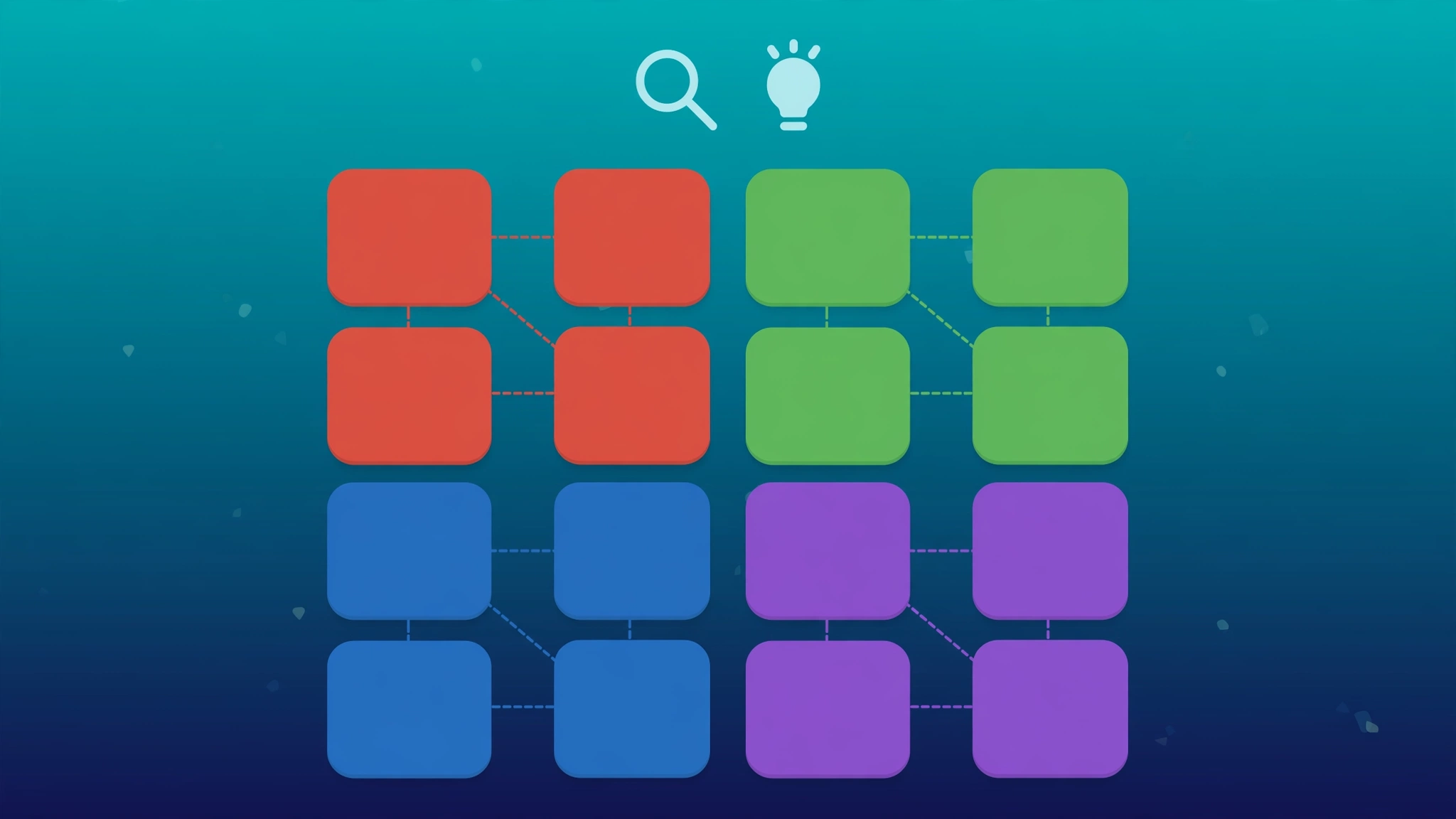
Conexo is a daily word puzzle that challenges you to sort 16 words into four groups of four, where every word in a group shares a common connection. It was developed by Daydash — the same studio behind Contexto and Letroso — and it has become a popular alternative to the New York Times Connections puzzle.
What Is the Conexo Game?
Conexo is a word-based puzzle that invites players to uncover hidden relationships among sets of words. Each puzzle consists of 16 distinct words arranged in a 4×4 grid, and the challenge is to group them into clusters of four words that share a unifying attribute, theme, or concept [3].
The game was developed by Daydash, who also produced Contexto and Letroso. Conexo distinguishes itself with its distinctive color-coded categories: Rust Red, Green, Blue Chill, and Purple [3]. Though it shares similarities with popular games like Connections and Only Connect, Conexo operates independently and delivers a fresh twist on the word-grouping format [3].
Daily Conexo puzzles become available at midnight, with an archive of past puzzles going back to February 1, 2024 [3]. Players can also explore Spanish and Portuguese editions, adding a multilingual dimension to the game [3].
How to Play Conexo
The rules are simple, but the deductions can be fiendish:
- Look at the 16-word grid. The words are arranged randomly in a 4×4 grid [1].
- Find four words that share a connection. The links can be based on synonyms, categories, shared attributes, themes, or wordplay — "things that are tiny", "file extensions", or "US federal departments" are typical groups [3].
- Select the four words by clicking or tapping them to highlight your group.
- Submit the group. The game instantly checks whether your selection is correct — if the group shares the common characteristic, the category is revealed and locked in [2].
- Watch for red herrings. Some words seem to fit multiple categories, so think about which grouping is most likely the intended one.
- Solve all four groups to complete the daily puzzle. The four categories are color-coded, with different colors indicating different difficulty tiers [3].
Conexo vs Connections: Key Differences
| Feature | Conexo | NYT Connections |
|---|---|---|
| Developer | Daydash (maker of Contexto) | New York Times |
| Grid | 16 words in a 4×4 grid | 16 words in a 4×4 grid |
| Groups | 4 groups of 4 words | 4 groups of 4 words |
| Color coding | Rust Red, Green, Blue Chill, Purple | Yellow, Green, Blue, Purple |
| Archive | Past puzzles back to Feb 1, 2024 | Limited archive (via subscription) |
| Languages | English, Spanish, Portuguese | English only |
| Cost | Free | Free (NYT Games subscription for extras) |
Conexo is entirely unique and not affiliated with the New York Times Connections game or the BBC's Only Connect, even though the formats look similar [5].
7 Tips to Win at Conexo
- Find the easy group first. Locking in one obvious category (like "US federal departments") removes four words and clarifies the rest [3].
- Beware the five-word trap. Sometimes five words seem to fit one category — finding the right connection often means figuring out which word belongs elsewhere [4].
- Think beyond meanings. Groups can be built on wordplay: words that precede or follow a common word, rhymes, or shared prefixes.
- Use the colors as difficulty hints. Rust Red is typically the most straightforward group; Purple is the trickiest [3].
- Say the words aloud. Hearing them can reveal phonetic connections that are invisible on screen.
- Work backwards from leftovers. With two groups solved, the remaining eight words only split one way.
- Check the archives. Past puzzles going back to February 2024 are available, so you can practice on older editions any time [3].
Where to Play the Conexo Game
Conexo is free to play in a web browser. Daily puzzles go live at midnight, and the archive of past puzzles — dating back to February 1, 2024 — lets you catch up on anything you missed [3]. Because the game is developed by Daydash, the same studio behind Contexto and Letroso, players who enjoy those games will find the interface and polish familiar [3].
Conexo in Spanish and Portuguese
One of Conexo's most distinctive features is its multilingual support. Alongside the English edition, Conexo offers full Spanish and Portuguese versions [3]. This makes it one of the few daily word-grouping games built with non-English speakers in mind from the start. If you play the Spanish edition, expect groups built around Spanish vocabulary — things like "verbos irregulares" or "países de Sudamérica" — which makes it an excellent vocabulary-building tool for learners as well as native speakers. Switching between languages is also a fun way to replay the archive: a category that felt easy in English can feel completely different when the words change language [3].
Love daily word puzzles? Try Plusword — our daily word puzzle — and see how it stacks up in Plusword vs Wordle.
Conexo Mistakes (and How to Fix Them)
Sixteen words, four groups of four — Conexo looks like Connections, but its own traps await. Avoid these:
- Locking in the first obvious group. The clearest-looking set of four is sometimes a red herring built from decoy words. Before submitting, check whether any of its words fit suspiciously well elsewhere too.
- Ignoring the Daydash house style. Conexo comes from the makers of Contexto, and their puzzles share a taste for clever, slightly lateral categories. Expect wordplay, not just trivia — the fourth group is rarely the boring one.
- Forgetting one-away feedback. Like Connections, near-misses usually earn a "one away" nudge. Use it: if three words are right, the fourth is the only problem — do not reshuffle the whole board.
- Grouping by spelling instead of meaning. Words that look alike or rhyme are classic decoys. The real connections are semantic — shared categories, shared contexts, shared wordplay — not visual similarity.
- Burning all mistakes on one group. Most grouping games limit wrong attempts. Spread your risk: confirm the two easiest groups first, which shrinks the remaining pool and makes the hard groups easier.
- Playing only the daily. Conexo's archive and practice modes let you study the game's category style in bulk. Ten practice puzzles teach you more about its tricks than a month of dailies.
What is the Conexo game?
Conexo is a daily word puzzle by Daydash where you sort 16 words into four groups of four that share a common connection, with color-coded categories [3].
Who made Conexo?
Conexo was developed by Daydash, the studio that also created the popular word games Contexto and Letroso [3].
Is Conexo the same as Connections?
No. Conexo shares the word-grouping format with the NYT Connections game, but it is developed independently by Daydash and is not affiliated with the New York Times [3][5].
Is the Conexo game free?
Yes — Conexo is free to play in a web browser, with daily puzzles and an archive of past games [3].
What are the Conexo category colors?
Conexo’s four categories are color-coded: Rust Red, Green, Blue Chill, and Purple [3].
When does the daily Conexo puzzle come out?
New Conexo puzzles become available at midnight each day [3].
Does Conexo have other languages?
Yes — alongside English, Conexo offers Spanish and Portuguese editions [3].
Can I play old Conexo puzzles?
Yes — the archive goes back to February 1, 2024, so you can play hundreds of past puzzles any time [3]. **Sources:** [1] https://immaculategrid.io/conexo · [2] https://wordhurdle.co/conexo · [3] https://Word.tips/conexo-todays-hints-answers/ · [4] https://fandomwire.com/daily-conexo-contexto-and-letroso-solutions-for-today-august-5-2025/ · [5] https://ladypuzzle.pro/conexo-hint-answer
Who makes the Conexo game?
Conexo was developed by Daydash, the studio also behind Contexto and Letroso — which explains its polished daily-puzzle feel and its taste for clever wordplay categories.
Is Conexo the same as NYT Connections?
The format is nearly identical — sixteen words into four groups of four — but Conexo is an independent game by Daydash with its own puzzle style, categories and daily schedule.