
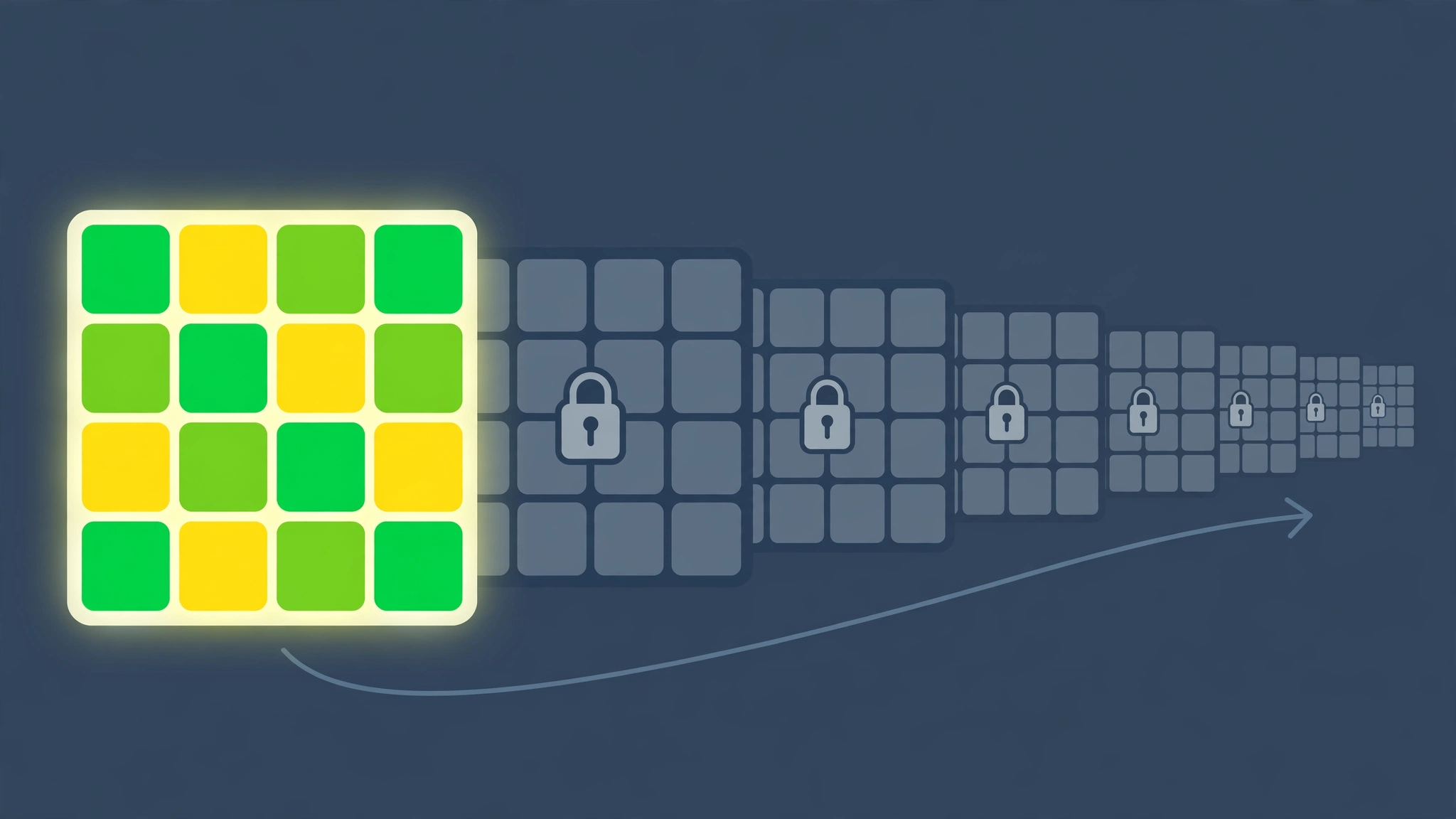
Octordle Sequence is a game mode inside Octordle — the popular eight-word Wordle spin-off — that flips the standard multi-grid formula on its head. Instead of solving all eight five-letter words simultaneously, Sequence mode makes you solve them one at a time, in a fixed order, with 15 total guesses for the whole run. Most players consider it the hardest Octordle mode, and this guide explains exactly how it works and how to beat it.
What Is Octordle Sequence?
Standard Octordle shows you eight Wordle grids at once: every guess you type is applied to all eight unsolved boards simultaneously, and you have 13 total guesses to crack all eight words. It is a game of parallel deduction.
Sequence mode changes one fundamental thing: only one unsolved word is visible at a time. You focus entirely on the first board; the moment you solve it, the second board unlocks, then the third, and so on until all eight are done. Because you cannot gather clues from eight boards at once, the game compensates with extra attempts — 15 guesses instead of the standard 13 (world3dmap.com; medium.com).
The result is a very different puzzle. Standard Octordle rewards breadth — guesses that harvest information across many boards in this multi-board word puzzle. Sequence rewards depth — squeezing maximum information out of a single board before moving on, because clues from a solved word do not carry forward the way parallel boards share them.
Octordle Sequence Rules
- Eight five-letter words, the same count as standard Octordle.
- One board at a time. Only the current unsolved word is shown; the next board unlocks when you solve the current one.
- 15 total guesses for all eight words — two more than standard Octordle's 13, to offset the harder format.
- Standard Wordle feedback. Green means the letter is correct and in the right position, yellow means it is in the word but misplaced, and grey means it is not in the word.
- Daily puzzle. Like the main game, Sequence refreshes once a day with the same eight words for everyone, plus archive and practice options on most Octordle sites.
How Scoring Works in Sequence Mode
Octordle scores each word by the number of guesses it took, then adds them up. Words solved on guesses 11, 12 or 13 are displayed as clock emojis — 🕚 for 11, 🕛 for 12 and 🕐 for 13 — because there are no number emojis above 10, and because the "time pressure" symbolism fits the endgame (world3dmap.com). Any word you fail to solve counts as 14 points, so a perfect run scores as low as possible.
In Sequence mode this scoring punishes inefficiency harshly: since you only see one board at a time, a word that drags to 8 or 9 guesses eats guesses you might need for a tricky word later in the sequence. The practical goal is to average under two guesses per word — which sounds impossible until you realise solved words still inform your letter knowledge for later boards.
Sequence vs the Other Octordle Modes
Octordle currently offers several ways to play (medium.com):
| Mode | Boards | Guesses | Format |
|---|---|---|---|
| Daily (standard) | 8 at once | 13 | Parallel — one guess hits all boards |
| Sequence | 8, one at a time | 15 | Serial — boards unlock in order |
| Rescue | 8 at once | 9 | Four words pre-guessed for you |
| Unlimited | 8 at once | 13 | Fresh random words every game |
| Archive | 8 at once | 13 | Replay any past daily puzzle |
Sequence is the only serial mode, which is why it feels so different. Rescue is arguably the gentlest entry point (four words already solved for you), while Unlimited is the best training ground because you can practise without touching your daily streak.
Best Strategies for Octordle Sequence
Sequence strategy differs sharply from standard Octordle strategy. Here is what works:
- Open with two letter-disjoint words. Since you only see one board, your first two guesses should share no letters, testing as many distinct letters as possible up front. Classic pairs like ADIEU + SPORT or CRANE + LIGHT cover ten unique letters in two guesses.
- Finish nearly-solved boards immediately. A board sitting at four green letters is still "costing" you nothing extra to close out — but every wasted guess on a solved-in-spirit board is a guess stolen from later words. Close it and move on (medium.com).
- Check the keyboard before typing, not after. The on-screen keyboard shows which letters are still live. In Sequence, where each guess only informs one board, guessing an already-eliminated letter is pure waste.
- Reuse confirmed letters across the sequence. Letters confirmed in word 3 are still confirmed knowledge for word 7. Keep a mental (or written) note of strong letters.
- Vary word structures. Try words with different letter arrangements — plurals, -ING forms, double letters — to maximise what each guess teaches you about the single visible board.
- Do not chase a stuck word. If a board resists after 5–6 guesses, consider that you may be misreading a yellow; re-examine the feedback before burning more attempts.
Where to Play Octordle Sequence
Sequence mode is built into the main Octordle game on octordle.com — look for the mode selector offering Daily, Sequence, Rescue and Unlimited options. It runs in the browser on both phone and desktop with no sign-up, and most versions include a colourblind-friendly palette and dark theme alongside daily hints and a word finder if you get stuck (medium.com). An archive of past dailies lets you practise Sequence on older puzzles too.
Sequence Mode Practice Drills
Sequence mode punishes broad, shallow play. These drills build the deep-solving skill it demands.
- Drill single-board speed. Play standard Wordle with a timer, aiming to solve in three or four guesses. Sequence mode is eight of these back-to-back, so single-board efficiency is the foundation.
- Practise the handoff. In Sequence, finishing one board starts the next immediately. Drill the mental reset: clear your head of the old word's letters before reading the new board's feedback.
- Use two disjoint openers. Open every Sequence run with the same pair of letter-disjoint words — for example, a vowel-heavy word followed by a consonant-heavy one. Consistency turns the opening into reflex.
- Replay in archive mode. Most Octordle sites let you replay past Sequence puzzles. Use them to practise without the pressure of the daily streak.
What is Octordle Sequence?
Octordle Sequence is a mode of the eight-word puzzle game Octordle in which you solve the eight five-letter words one at a time, in order, instead of all at once.
How many guesses do you get in Octordle Sequence?
15 total guesses for all eight words — two more than standard Octordle’s 13, to compensate for the harder one-at-a-time format.
Is Octordle Sequence harder than regular Octordle?
Most players say yes. You cannot gather clues from eight boards in parallel, so every guess has to work harder on a single board.
What are the other Octordle modes?
Daily (standard 8-board, 13 guesses), Rescue (four words pre-solved, 9 guesses), Unlimited (fresh random words each game) and Archive (replay past dailies).
What do the clock emojis mean in Octordle scores?
Words solved on the 11th, 12th or 13th guess are shown as 🕚, 🕛 and 🕐 respectively, since there are no number emojis above 10.
Can I play old Octordle Sequence puzzles?
Yes — most Octordle sites include an archive where you can replay any earlier daily puzzle, including in Sequence mode.
Is Octordle Sequence free?
Yes. Octordle runs free in the browser with no account required.
Do I need a different strategy for Sequence mode?
Yes. Standard Octordle rewards broad guesses that inform many boards; Sequence rewards deep, efficient solving of one board at a time — open with two letter-disjoint words and finish nearly-solved boards immediately.
Can I play Octordle Sequence on my phone?
Yes. Octordle runs in mobile browsers with no download needed, so Sequence mode is fully playable on your phone.
What is the best opening pair for Octordle Sequence?
Two words with no shared letters that together cover the most common letters — typically one vowel-heavy and one consonant-heavy. Using the same pair every day turns your opening into reliable muscle memory. Love multi-word puzzles? Try [Plusword](https://plusword.co.uk/how-to-play-plusword/) for a fresh daily challenge, and browse our [daily puzzle games](https://plusword.co.uk/daily-puzzle-games/) roundup for more word-game tactics. Sources: technorbar.co.uk; pulchra.org; world3dmap.com; medium.com (@noorulaminkhanq, Sep 2026).