
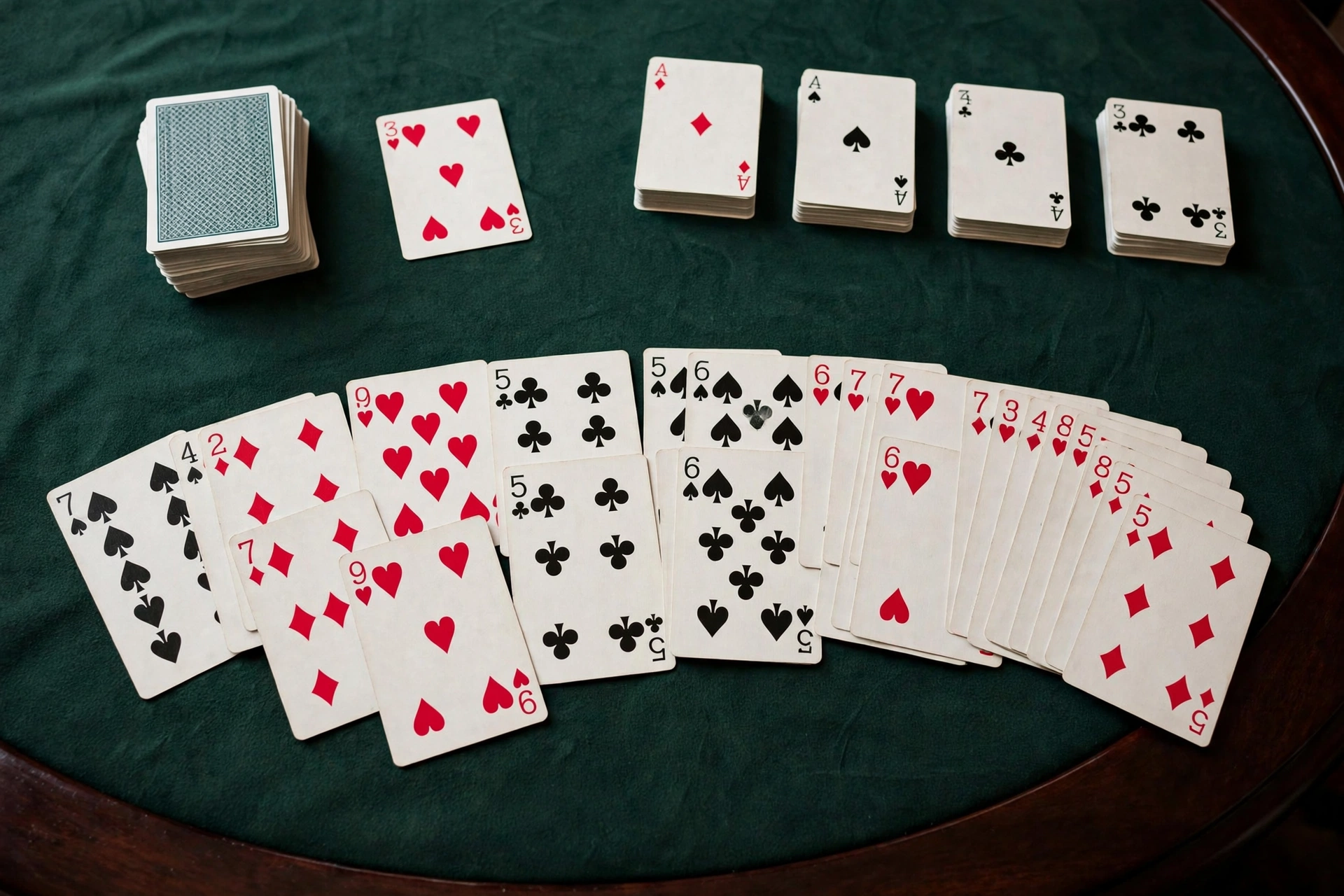
Solitaire — Klondike, if we're being proper about it — is the card game most of us learned from a computer screen, not a person. You deal seven columns from a standard 52-card deck, then work every card up onto four foundation piles, Ace to King by suit. Get all 52 home and you win. Below are the complete solitaire rules, plus the mistakes I made for years before anyone corrected me.
How I Learned (and What I Got Wrong for Years)
I didn't learn solitaire from a grandparent with a deck of cards. I learned it from Windows — that grey-green window and the little bouncing-card cascade when you finally won. I'd play hands while pretending to do homework, clicking away with total confidence.
Here's the embarrassing part: for years, I played it badly. Every card that could go up to the foundations went up immediately — Aces, twos, threes, whoosh. It felt productive. And my win rate was miserable. I just assumed solitaire was mostly luck. Some games are unwinnable, but most of my losses were self-inflicted: rushing the foundations was the culprit. Once someone explained why, my win rate roughly doubled.
The One-Minute Version
Here's the shape of it. Seven columns of cards, mostly face down (the tableau). Twenty-four cards aside as the stock, flipped one or three at a time into the waste pile. Four empty foundation piles above the tableau.
Your job: move all 52 cards onto the foundations, one suit per pile, Ace up to King. Fourth King lands, you win. Everything below is just mechanics.
Setting Up: The Bit Everyone Gets Wrong First
The deal is where beginners quietly break the game before it starts. Shuffle a standard 52-card deck (no jokers), then deal seven columns left to right:
| Column | Face-down cards | Face-up cards | Total cards |
|---|---|---|---|
| 1 | 0 | 1 | 1 |
| 2 | 1 | 1 | 2 |
| 3 | 2 | 1 | 3 |
| 4 | 3 | 1 | 4 |
| 5 | 4 | 1 | 5 |
| 6 | 5 | 1 | 6 |
| 7 | 6 | 1 | 7 |
The pattern: column one gets a single face-up card, and each column after that gets one more face-down card than the last, always finished with one face-up card on top. Column seven ends up with six face-down cards and one face-up.
That accounts for 28 cards. The remaining 24 go face down to one side — your stock. Leave room above for the four foundations and a waste pile. Fiddly the first time; automatic by the third deal. If you want a breather between card games, our free word tools are a good palate cleanser.
How a Turn Actually Works
There's no turn order to memorise — you just keep making legal moves until you run out. Here's the rhythm:
Hunt the Aces. Any face-up Ace goes straight to a foundation to start its suit's pile. Free progress, no decision needed.
Build downward, alternating colours. Red 7 on black 8, black Queen on red King. Only the face-up cards at column bottoms can move.
Flip every card you uncover. The moment a move reveals a face-down card, turn it face up. This is the highest-priority habit in solitaire — every flipped card is a new option. When I stopped auto-playing to the foundations and started prioritising flips instead, my results changed.
Feed the foundations — but don't rush. Aces and twos can go up freely, but from about five upwards, pause. That red 5 might be the only card your black 6 can ever sit on.
Work the stock when the tableau stalls. Flip the top stock card (or three in Draw 3) onto the waste pile. When the stock runs out, turn the waste over without shuffling and start again.
Park Kings in empty columns. Only a King — alone or carrying a sequence — may move into an empty column. Never empty one unless a King is ready.
Win, or deal again. Keep cycling until all four foundations run Ace to King. No legal moves left and foundations incomplete? The game is lost. Shuffle, redeal, don't take it personally — you'll lose more than you win. Everyone does.
The Rules That Trip Everyone Up
These five cause most arguments, confusion, and my own years of bad play:
Foundations are not one-way. Move a card back down to the tableau whenever you like. The first time someone told me this, it felt like cheating. It isn't — it's a standard tactic for unlocking a stuck column.
Only Kings fill empty columns. Someone always tries to park a 7 in an empty space. No. Kings only.
In Draw 3, only the top waste card is playable. You flip three but can only touch the top one until it moves.
Don't strip-mine the tableau for the foundations. The number-one beginner error: every card sent up early is a card that can't help you build downward later.
Alternate the colours. Two reds can never stack, whatever their ranks. Obvious — and forgotten at speed.
Every legal move, for reference:
| Move | From → To | Condition |
|---|---|---|
| Build the tableau | Card → tableau column | Must land on an opposite-colour card exactly one rank higher (e.g. red 6 on black 7) |
| Start a foundation | Ace → foundation | Any Ace may start its suit's foundation pile |
| Build a foundation | Card → foundation | Must be the same suit and exactly one rank higher than the top card (2 on Ace, 3 on 2 … King on Queen) |
| Move a sequence | Tableau → tableau | A face-up descending, alternating-colour sequence may be moved as one unit |
| Fill a gap | King → empty column | Only a King (with or without its attached sequence) may start an empty column |
| Draw | Stock → waste | Flip 1 card (Draw 1) or 3 cards (Draw 3); only the top waste card is playable |
| Rescue a card | Foundation → tableau | Allowed at any time — useful when you need a card back to unlock the tableau |
Draw 1 vs Draw 3: My Honest Take
You'll be asked to choose, so here's my advice: learn on Draw 1. One card at a time, no buried triples to plan around, and a far kinder win rate while you're building instincts.
Draw 3 is the "proper" game the way espresso is the "proper" coffee — technically true, and miserable for beginners. It roughly halves your chances and punishes every sloppy habit. Anyone who tells a new player to start on Draw 3 is showing off. Get comfortable on Draw 1 first; Draw 3 will still be there when you're ready.
Scoring (Which I Mostly Ignore)
The classic scoring system — the one from the Windows version — goes like this:
- Waste to tableau: 5 points
- Waste to foundation: 10 points
- Tableau card turned face up: 5 points
- Tableau to foundation: 10 points
- Foundation back to tableau: minus 15 points
- Recycling the stock: each pass after the first costs points (typically minus 100 in Draw 1, minus 20 in Draw 3)
Timed games add speed bonuses. I'll be honest, though: I ignore the score completely. A win is a win, and chasing points encourages exactly the rushed foundation play that loses games. Learn the strategy first; the points will follow. For the game's background, the Klondike solitaire article on Wikipedia) is worth a read.
If Klondike Clicks, Try These
Once the rules feel automatic:
- Spider solitaire): two decks, ten columns, same-suit sequences King to Ace. Longer and harder — my pick for when Klondike feels easy.
- FreeCell: all 52 cards face up, four free cells. Nearly every deal is winnable — the purest strategy of the three.
- Pyramid: remove pairs totalling 13 (Kings go singly). More puzzle than sequencing.
And if you like games with clear rules and a daily habit, our Crosswordle guide might be your next rabbit hole.
Frequently Asked Questions
What is the goal of solitaire?
Move all 52 cards onto the four foundation piles, each suit from Ace to King. When the fourth King lands, you’ve won — and after a long game it feels earned.
Can you move a whole sequence of cards at once in the tableau?
Yes — any face-up, descending, alternating-colour run moves as one unit. It matters most when a King heads the sequence: that’s your ticket into an empty column, and often the move that cracks a stuck game open.
Can any card go into an empty tableau column?
No, only a King — so never empty a column unless one is ready and waiting. A King carrying a long sequence into an empty column is one of the strongest positions in the game.
What happens when the stock pile runs out?
Flip the waste pile face down, without shuffling — it’s your new stock. Caveat: some Draw 3 rule sets cap recycles at around three passes.
What is the difference between Draw 1 and Draw 3 solitaire?
Draw 1 flips one stock card at a time; Draw 3 flips three but only lets you play the top one. Draw 1 is the learning game — friendlier odds, simpler decisions. Try Draw 3 once Draw 1 feels comfortable.
Can you take a card back off the foundation?
Yes, it’s fully legal. The classic moment: you’ve sent a 6 up, then realise your 7 has nowhere to go without it. Pull the 6 back down, park the 7, carry on. It costs 15 points in standard scoring — and wins games.