
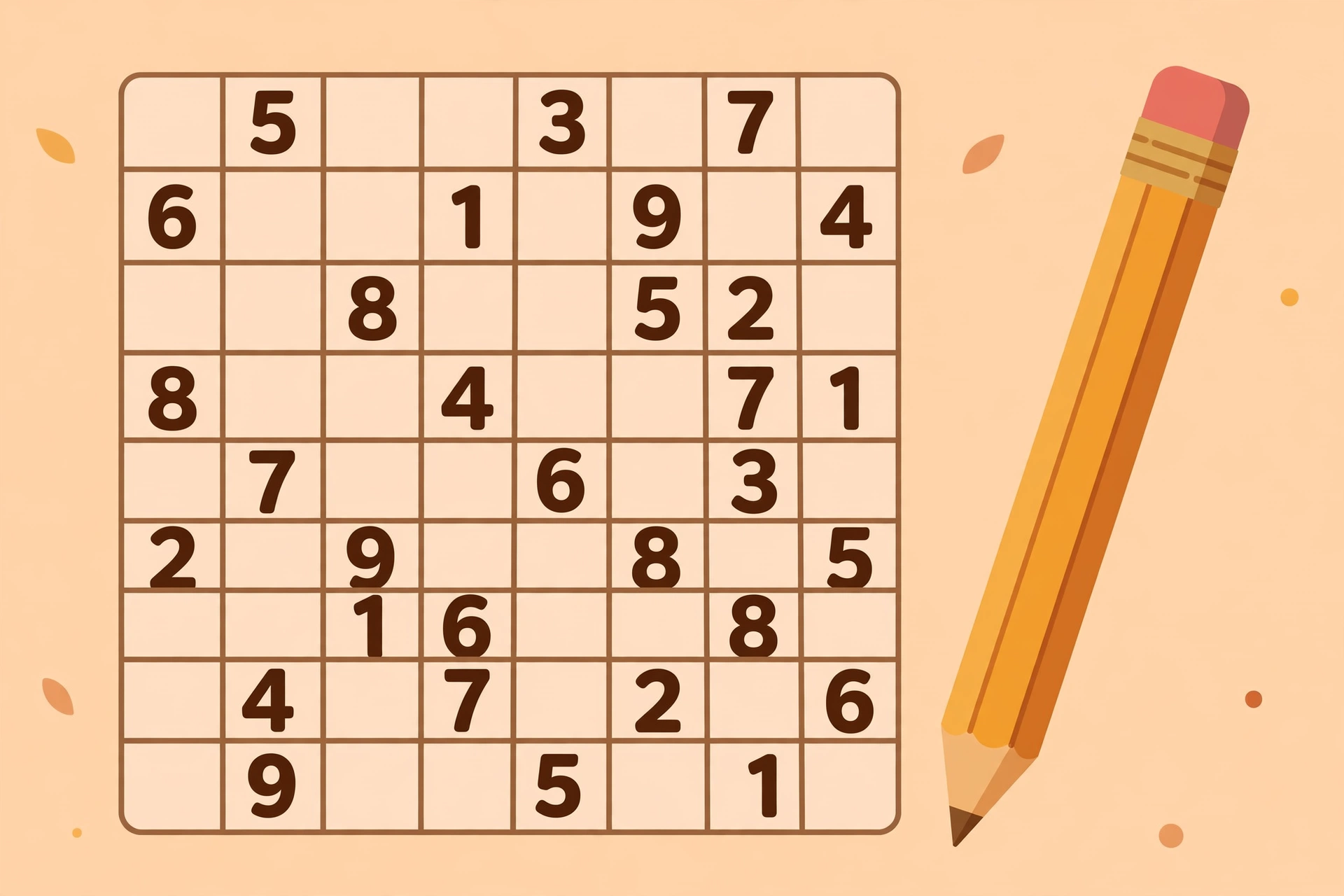
Sudoku is a logic puzzle played on a 9×9 grid. Some squares start filled with numbers called givens, and your job is to fill every empty square so that each row, each column, and each 3×3 box contains the digits 1 to 9 exactly once. No maths is involved — just logic, patience, and a pencil.
The Three Rules of Sudoku
Everything in this number-placement logic puzzle follows from three simple rules:
- Each row must contain the digits 1 through 9, with no repeats.
- Each column must contain the digits 1 through 9, with no repeats.
- Each 3×3 box (the nine bold-outlined squares) must contain the digits 1 through 9, with no repeats.
That is the entire game. Every technique, from the simplest scan to the most advanced pattern, is just a clever way of applying these three rules. A proper sudoku always has exactly one solution (Wikipedia's Sudoku article notes that well-formed puzzles are solvable by logic alone), and it can always be found by logic alone — you never need to guess.
Know Your Grid: Rows, Columns, Boxes and Cells
Before your first puzzle, learn the vocabulary solvers use:
- Cell — one of the 81 small squares.
- Row — a horizontal line of 9 cells.
- Column — a vertical line of 9 cells.
- Box (or block/region) — one of the nine 3×3 sections marked by bold lines.
- House — any row, column, or box (there are 27 in total).
- Givens — the numbers printed in the puzzle at the start.
- Candidate — a digit that could still go in an empty cell.
- Pencil marks — tiny notes of candidates written in a cell's corner.
How to Play Sudoku: Your First Puzzle in 5 Steps
Step 1: Scan for the easy wins
Look over the whole grid for any row, column, or box that is nearly full. If a row already has eight of its nine digits, the empty cell must hold the one missing digit — a free placement, sometimes called a last free cell. Easy puzzles hand you several of these at the start, and each placement changes the grid around it, often creating the next free cell immediately.
Step 2: Sweep one digit at a time (crosshatching)
Pick the digit that appears most often among the givens — say it is 7. Now look at each 3×3 box that does not yet contain a 7. Every 7 already sitting in a neighbouring row or column "shoots a line" through that box, ruling out cells. If those lines eliminate every cell in the box except one, the 7 goes there. Work through the digits 1 to 9 this way, and you will often place five to ten numbers without any advanced technique at all. This method is called crosshatching, and it is the workhorse of easy puzzles.
Step 3: Read cells instead of digits
When digit-sweeping stalls, flip your perspective. Pick an empty cell and look at its row, column, and box together. Cross off every digit that already appears in those three houses. If exactly one digit survives, the cell is solved — this is called a naked single. Late in a puzzle, naked singles appear constantly, and they chain: each number you place blocks that digit in up to 20 other cells, frequently creating the next naked single straight away.
Step 4: Use pencil marks
When a cell could be one of two or three digits and you cannot decide yet, write those digits tiny in the corner of the cell (or use the notes feature in a sudoku app). These pencil marks keep track of candidates so your brain does not have to. As you place numbers elsewhere, cross off candidates that become impossible. When only one candidate remains in a cell, write it in large.
Step 5: Repeat the cycle
Solving sudoku is a loop: scan for nearly-full houses, sweep digits, read cells, update pencil marks, repeat. Every placement rewrites the possibilities around it, so progress comes in cascades rather than a straight line. A cell that was impossible two moves ago often becomes trivial after you place a number on the other side of the grid.
Beginner Techniques Worth Learning Early
| Technique | What it is | When to use it |
|---|---|---|
| Last free cell | The one missing digit in a nearly-full row, column, or box | At the very start of every puzzle |
| Crosshatching | Sweeping one digit across boxes using row/column lines | Your main tool on easy puzzles |
| Naked single | A cell with only one possible candidate left | When sweeping stalls |
| Hidden single | A digit that can only fit in one cell within a house, even if that cell has other candidates | The step up from naked singles |
| Pencil marks | Noting candidates in empty cells | Whenever you feel stuck or overwhelmed |
Hidden singles, explained
A hidden single is slightly subtler than a naked single. Suppose you are looking at the middle row, and the digit 4 does not appear in it yet. You check each empty cell in that row: in eight of them, a 4 is blocked by a 4 already sitting in the same column or box — but in one cell, nothing blocks it. That cell must be 4, even if it also has other candidates pencilled in. The 4 was "hidden" among other possibilities.
Common Beginner Mistakes to Avoid
- Guessing. If you are choosing between two digits with no logical reason, stop. Re-scan the grid — you have missed something, or you need pencil marks to see the pattern.
- Forgetting the boxes. New players check rows and columns but forget the 3×3 boxes, which is where most early placements hide. The box rule deserves extra attention.
- Repeating a digit. Every placement must respect all three houses at once. Before writing a digit large, glance at its row, column, and box.
- Rushing. Sudoku rewards patience. Slow, methodical scanning beats fast, sloppy filling every time.
- Starting too hard. Begin with easy-rated puzzles and smaller grids if available. Jumping straight to hard puzzles teaches bad habits, like guessing.
Pencil Marks vs Guessing: What Is the Difference?
Beginners sometimes worry that pencil marks are "cheating". They are not — pencil marks are simply bookkeeping. Guessing means picking a digit with no logical justification and hoping. Pencil marks mean recording every digit that is still logically possible, then eliminating them one by one until logic forces an answer. Every serious solver uses them.
How Long Does a Beginner Sudoku Take?
An easy 9×9 sudoku typically takes a beginner 10 to 30 minutes. That is completely normal. Speed comes naturally as pattern recognition builds — most regular solvers find their times dropping sharply over the first few weeks. Do not time yourself at first; focus on accuracy and understanding.
Where to Practise as a Beginner
- Easy-rated puzzles in any newspaper or app — these are designed to be solvable with scanning and singles alone.
- 4×4 and 6×6 mini sudokus — the same rules on a smaller grid, perfect for learning the logic without the overwhelm.
- Puzzles with pencil-mark/note features — digital versions make candidate tracking effortless while you learn.
- One puzzle a day — a short daily habit builds pattern recognition faster than occasional long sessions.
Once easy puzzles feel comfortable, the next step is intermediate techniques like naked pairs and pointing pairs, and eventually advanced patterns like the XY-Wing. Medium-difficulty grids are the perfect training ground — see our medium sudoku guide for where to play them free. For a broader set of strategies, see our guide to hard sudoku strategies.
How do you play sudoku for the first time?
Start with an easy puzzle, learn the three rules (each row, column, and 3×3 box must contain 1-9 once each), then scan for nearly-full rows, columns, or boxes and fill in the missing digits. Sweep one digit at a time across the grid, and use pencil marks when you get stuck.
What is the basic rule of sudoku?
Each row, each column, and each 3×3 box must contain the digits 1 through 9 exactly once, with no repeats.
Do you need maths to play sudoku?
No. Despite using digits, sudoku is a pure logic puzzle — no arithmetic or calculations are involved. The digits could be replaced with colours or symbols and the puzzle would work identically.
What does it mean when a sudoku has only one solution?
A proper sudoku puzzle is designed so that logic leads to exactly one valid completed grid. This is why guessing is unnecessary — and why a guess that “works” temporarily will eventually contradict the rules.
Should beginners use pencil marks?
Yes. Pencil marks (small candidate notes in each cell) are the standard tool of every solver, beginner or expert. They turn a memory test into a logic puzzle and make patterns like hidden singles visible.
What is the easiest sudoku strategy?
Scanning for the last free cell — finding a row, column, or box with only one empty square and filling in the missing digit. Combined with digit-by-digit crosshatching, it solves most easy puzzles on its own.
How can I get better at sudoku fast?
Solve one easy puzzle daily, always use pencil marks instead of guessing, learn one new technique at a time (naked singles, then hidden singles, then pairs), and review puzzles you found hard to spot what you missed.