
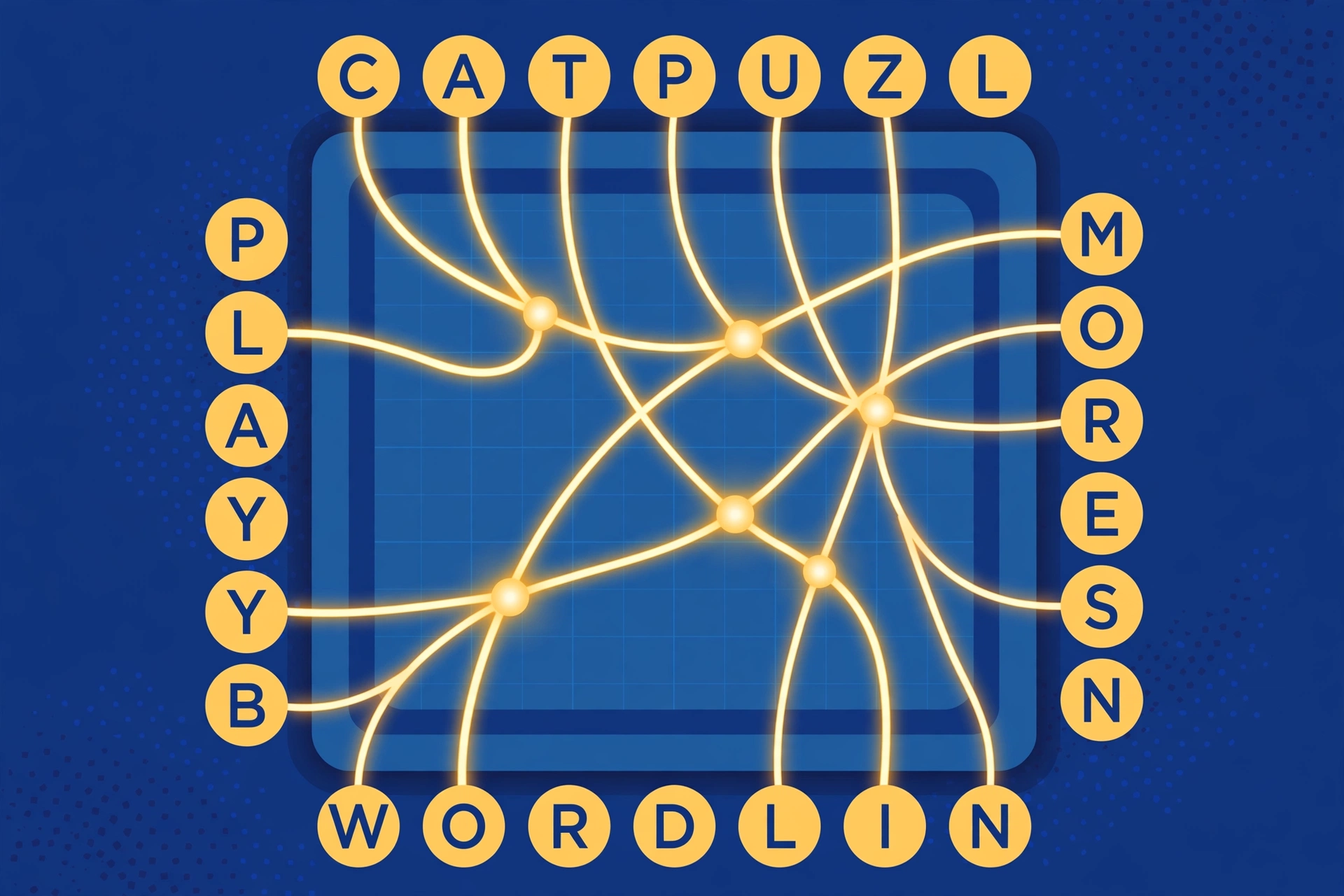
Letter Boxed is one of The New York Times' most elegant word puzzles: twelve letters sit around the edges of a square, and your job is to chain words together until every letter is used — in as few words as possible. It takes two minutes to learn and rewards genuine planning. Here is how to play it free, the rules, and the strategies behind those satisfying two-word solves.
What Is the Letter Boxed Game?
Letter Boxed is a daily word puzzle from NYT Games, launched on February 1, 2019, and edited by Sam Ezersky (beebom.com). It belongs to the same family as Wordle, Spelling Bee, Connections and Strands, but its mechanic is entirely its own: instead of guessing a hidden word, you build a word chain that consumes every letter on the board — a spelling game that rewards planning over luck.
Each puzzle shows 12 letters distributed around the four sides of a square — three letters per side. You form words by connecting letters, with one strict constraint: consecutive letters in a word cannot come from the same side of the square. The last letter of each word becomes the first letter of the next, and the puzzle is solved when all 12 letters have been used at least once.
Most puzzles can be solved in just two or three words, and chasing the two-word solution is the game's great obsession.
How to Play Letter Boxed: The Rules
The rules fit on an index card, but mastering them takes practice:
- Form words of 3 or more letters by tapping letters around the square in sequence.
- No two consecutive letters may come from the same side. This is the core constraint — every step of a word must jump to a different side of the square.
- Chain your words. The last letter of one word must be the first letter of the next word.
- Use all 12 letters. The puzzle is complete only when every letter on the board has appeared in at least one of your words.
- Fewer words is better. There is no guess limit and no penalty for trying combinations, so experiment freely — but the prestige solve uses as few words as possible, ideally two.
- A new puzzle drops daily at 3 a.m. Eastern Time.
Because there is no fail state, Letter Boxed is a sandbox: rearrange, restart and retry as much as you like until the chain clicks.
Letter Boxed Strategies and Tips
Hunt for the two-word solve. Start by looking for a long first word that uses letters from many different sides and ends on a versatile letter. If your first word covers 8-9 letters and ends on a common consonant, the second word often finishes the job.
End words on flexible letters. Letters like E, S, T, R and A open the most options for the next word's start. Avoid ending a word on Q, Z, X or J unless the board gives you no choice — they strangle the chain.
Use rare letters early. Q, Z, X and J are hardest to place because few words contain them in chainable positions. Build your opening word around the board's awkward letters rather than saving them for last.
Think in pairs, not words. The unit of Letter Boxed is the two-letter transition across sides. Scan the board for productive pairs (TH, CH, ST, ER, IN) that jump between sides — words assemble themselves around strong pairs.
Restart without guilt. There is no penalty for clearing the board. If your first word paints you into a corner, wipe it and try a different opener. Strong players restart constantly.
Study the side distribution. Since consecutive letters cannot share a side, vowels and consonants must alternate across sides. If all the vowels sit on one side, every word you build must bounce off that side repeatedly — plan accordingly. Our word puzzle strategies guide covers more pattern-spotting habits for grid games like this one.
Letter Boxed vs Strands: What's Different?
| Feature | Letter Boxed | Strands |
|---|---|---|
| Launched | February 1, 2019 | March 4, 2024 |
| Board | 12 letters around a square | 6×8 letter grid |
| Objective | Use all letters in chained words | Find theme words + spangram |
| Key constraint | No consecutive letters from same side | Words snake in any direction |
| Typical solve | 2-3 words | All theme words found |
| New puzzle | Daily, 3 a.m. ET | Daily |
Letter Boxed is the more structured, planning-heavy game; Strands is a looser themed word search. Both reward vocabulary, but Letter Boxed rewards foresight.
Where to Play Letter Boxed Free
Letter Boxed lives in the NYT Games lineup, playable on the New York Times website and in the NYT Games app on mobile. The daily puzzle is free to play; unlocking the archive of past puzzles requires an NYT Games (or All Access) subscription. If you want hints or to check your solve, several independent sites publish daily Letter Boxed answers and walkthroughs. For more free daily challenges, browse our list of daily puzzle games.
Why Letter Boxed Endures
Seven years after launch, Letter Boxed remains one of NYT Games' most quietly beloved puzzles. The reason is the two-word chase: the rules are trivial, but finding the perfect pair of words that devours all twelve letters feels like cracking a safe. It is the rare puzzle that is equally satisfying as a two-minute coffee ritual and as a deep strategic rabbit hole.
The Two-Word Solve: Chasing Letter Boxed Perfection
Most Letter Boxed puzzles can be solved in two words — the game is designed that way — but finding the pair is a skill unto itself. This section breaks down how two-word hunters think.
Start from the rare letters, not the common ones. Solvers naturally build around vowels and common consonants, but the rare letters (J, Q, X, Z, V) are the constraint that determines everything. Find words containing the day's rare letters first, then check whether the remaining unused letters can form a second word chaining from the first word's ending. If the rare letters cannot be paired, no two-word solution exists through that route.
Think in chains, not words. A two-word solve is really a single chain: word one's last letter is word two's first letter, and together they must cover all twelve letters. Practise seeing candidate pairs as one object. Write down promising first words with their ending letters circled, then brainstorm second words starting from each circled letter — the visual separation prevents the tunnel vision of word-by-word solving.
Use the side constraint as a filter. Consecutive letters cannot come from the same side of the square. When brainstorming, this rule eliminates most candidates instantly — internalise it as a reflex rather than checking it after the fact. Experienced solvers "feel" illegal pairs the way chess players feel illegal moves.
Accept the three-word solve gracefully. Chasing two words past the point of fun defeats the purpose. Solve in three, note the puzzle's trick, and move on — tomorrow's board is a fresh chance, and the pattern library you are building matters more than any single day's count.
What is the Letter Boxed game?
Letter Boxed is a daily word puzzle from The New York Times. Twelve letters are arranged around a square; you form chained words (each starting with the previous word’s last letter) until all 12 letters are used, aiming for as few words as possible.
Is Letter Boxed free to play?
Yes, the daily Letter Boxed puzzle is free to play on the NYT Games website and app. Access to the archive of past puzzles requires an NYT Games subscription.
What are the rules of Letter Boxed?
Make words of 3+ letters by connecting letters around the square. Consecutive letters cannot come from the same side, each word must start with the previous word’s last letter, and you must use all 12 letters.
How many words does it take to solve Letter Boxed?
Most puzzles can be solved in two or three words. The celebrated achievement is the two-word solve, which is possible on many — though not all — days.
When does the new Letter Boxed come out?
A new puzzle is released every day at 3 a.m. Eastern Time.
Who created Letter Boxed?
Letter Boxed was launched by The New York Times on February 1, 2019, and is edited by Sam Ezersky, who also edits Spelling Bee.
Can you restart in Letter Boxed?
Yes. There is no penalty for mistakes — you can delete words and restart the puzzle as many times as you like.
What is considered a good Letter Boxed score?
Two words is the celebrated solve — most puzzles are designed to allow one. Three words is a solid, respectable result. Anything beyond that means the puzzle (or the solver) had an off day; the NYT itself presents two-word solutions as the ideal.
Does Letter Boxed penalise long solutions?
No — there is no score, timer, or penalty. The game simply counts your words, and the satisfaction of a two-word solve is its own reward. Share your word count with friends if you want competition; the game itself stays pressure-free.