
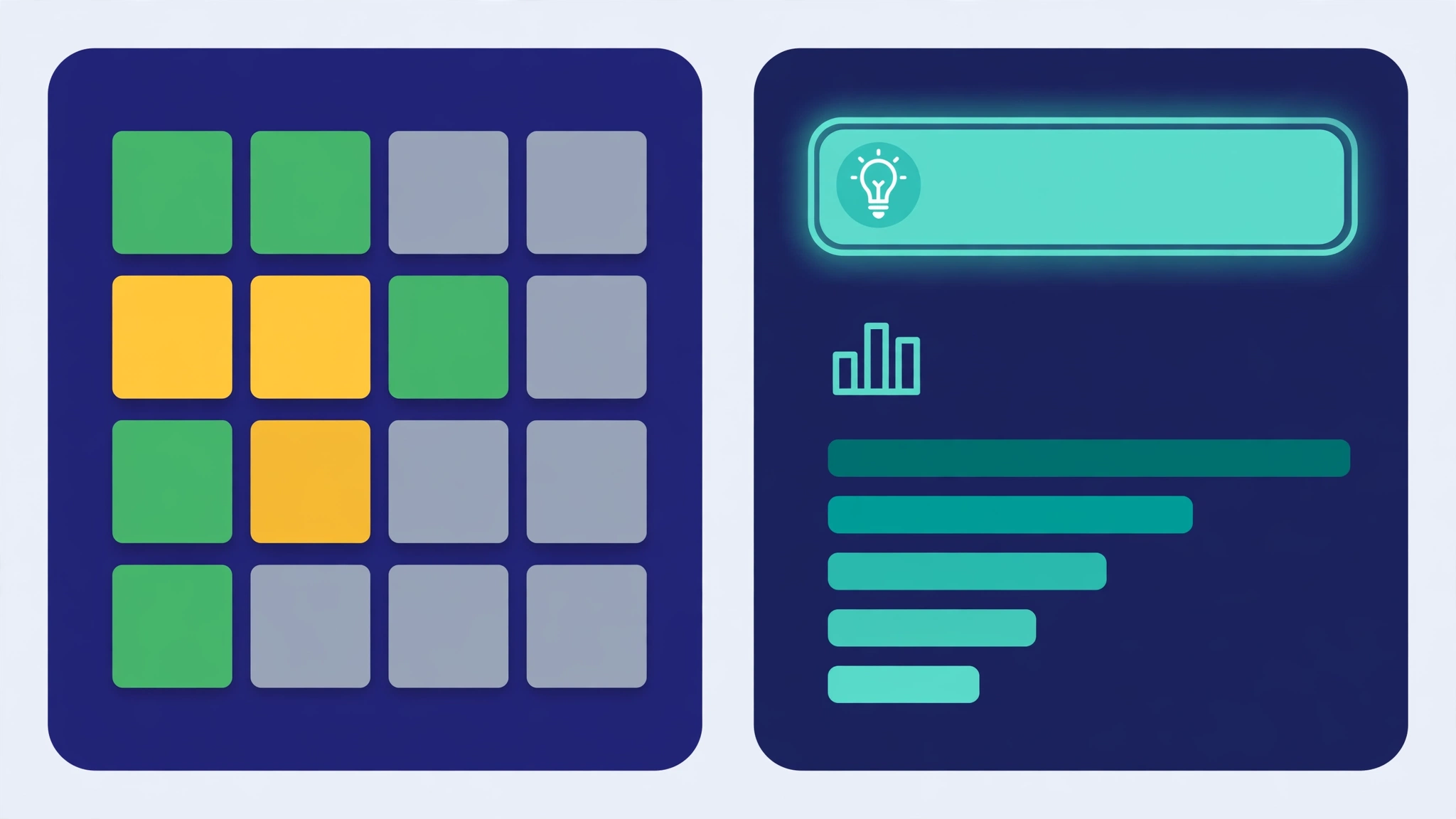
Scoredle is a free online tool that analyzes your Wordle games. Enter your guesses and the day's answer, and Scoredle shows how many possible words remained after each guess, what your best possible next guess was, and how your actual play compares to optimal strategy.
What Exactly Is Scoredle?
Scoredle is not a standalone word game. It is a companion analysis tool for Wordle players who want to understand — and improve — their guessing strategy. For a side-by-side look at Wordle and its daily-puzzle cousins, see our Plusword vs Wordle comparison.
Here is how it works: you play Wordle as normal, then open Scoredle and type in the day's correct answer and each of your guesses in order. After every guess, Scoredle runs its word-list algorithm against the feedback and tells you:
- How many valid words were still possible after that guess
- What the best possible next guess was, based on eliminating the most candidates
- A shareable breakdown of your full analysis once you finish
The result is a kind of report card for your Wordle game — it shows where you guessed well and where a smarter pick would have narrowed the field faster. For players who like probability and strategy, Scoredle turns an ordinary Wordle session into a study of optimal play [1][5].
How to Use Scoredle (Step by Step)
Using Scoredle takes less than a minute once you know the routine:
- Play Wordle first. Solve (or fail) the daily puzzle as you normally would, and note down your guesses in order.
- Open Scoredle in your browser. It is a web tool — no download, no sign-up, no app to install.
- Enter the day's Wordle answer in the "Today's Wordle Answer" box [1].
- Type in your guesses one by one, in the exact order you played them.
- Read the feedback after each guess. Scoredle displays the number of remaining possible words and highlights the best next move [1][9].
- Share your analysis. When finished, click the Share button to copy your results in several formats — a compact grid for social posts or a fuller breakdown for a group chat [1].
One thing to note: because Scoredle needs the correct answer to do its math, it is a post-game tool. It cannot help you mid-game — it judges the game you already played.
What the Numbers Actually Mean
The core of Scoredle is its "possible words" counter. After each guess, it applies the green/yellow/grey feedback to its full dictionary and filters out every word that can no longer be the answer.
For example, a strong opening guess like SLATE might leave around 100–200 possible answers; a weaker one could leave over 1,000. Scoredle also suggests the optimal next guess — not necessarily the answer itself, but the word that statistically eliminates the most candidates. This is the key insight: the best next guess is often a word you would never play to win, but one that splits the remaining possibilities most efficiently [5][9].
Scoredle's algorithm is described as a logic filter that measures the efficacy of each guess against its dataset, with the stated goal of maximizing your guessing strategy rather than just stumbling onto the answer [5].
Scoredle is part of a small ecosystem of Wordle analyzer tools that turned the casual daily puzzle into a serious study of optimal play. The underlying mathematics is information theory: each guess is judged by how much it reduces the space of possible answers, and the "best" guess is the one that maximizes expected information — which is why Scoredle sometimes recommends words that cannot possibly be the answer. Understanding that distinction is what separates players who solve Wordle from players who solve it efficiently.
Scoredle vs Wordle: What's the Difference?
| Feature | Wordle | Scoredle |
|---|---|---|
| What it is | The daily word-guessing game | An analysis tool for your Wordle games |
| Who runs it | The New York Times | Independent fan-made tool |
| Daily puzzle | One word per day, 6 guesses | No puzzle of its own — you supply past games |
| Cost | Free (with subscription options) | Free |
| Best for | Playing | Learning to play better |
| Share feature | Colored-square score grid | Detailed per-guess analysis |
Think of Wordle as the exam and Scoredle as the marking scheme — one tests you, the other explains exactly where the marks were won or lost.
Scoredle vs WordleBot: Which Analyzer Is Better?
WordleBot, the New York Times' own Wordle analyzer, is Scoredle's closest rival. The two overlap but differ in a few ways:
- Data source: WordleBot knows the official NYT answer list and the full allowed-guess list; Scoredle works from its own word dataset, which is broadly similar but not identical [5].
- Skill rating: WordleBot gives your play a skill score out of 99 and a luck score; Scoredle sticks to the objective math — possible words remaining and best moves.
- Access: WordleBot is behind the NYT ecosystem; Scoredle is a standalone web page you can open without an account.
- Tone: WordleBot judges with NYT branding; Scoredle is a neutral, numbers-first report.
Many serious players use both: WordleBot for the official verdict, Scoredle for a second opinion on alternative lines of play.
Why Use Scoredle? Five Ways It Improves Your Game
1. It teaches optimal openings. Compare your starter word's remaining-count against alternatives and you will quickly see why words like SLATE, CRANE, and ADIEU consistently outperform random picks.
2. It exposes lazy mid-game guesses. If Scoredle shows 40 words were possible but your next guess only eliminated 5, you left information on the table.
3. It settles friendly debates. Paste your analysis into a group chat and argue — with data — about whether that third guess was genius or luck.
4. It is perfect for advanced players. Scoredle is explicitly aimed at players who like analyzing probability and strategy rather than just guessing the word correctly [5].
5. It makes losing educational. Even a failed Wordle becomes a useful lesson when Scoredle shows the trap you walked into and the guess that would have avoided it.
Want to improve at daily word puzzles generally? Learn how to play Plusword.
Is Scoredle Free? Where Can You Use It?
Yes — Scoredle is free to use. It runs entirely in the browser with no account required.
A word of caution: Scoredle is popular enough that many gaming portals host their own Scoredle pages (word games portals, Wordle-variant sites). These mirrors describe the same tool, though some wrap it in unrelated advertising or garbled descriptions — one portal page even describes it confusingly as a sports-score game, which is not what Scoredle is [6]. If a page looks off, look for the clean version of the tool: answer box, guess entry in order, possible-words counter, and a Share button [1]. The tool itself is a fan-made project and is not affiliated with the New York Times.
One Name, Two Tools: Don't Confuse Scoredle With the Score Tracker
A quick disambiguation: there is also an unrelated open-source project called "scoredle" on GitHub (by brendanalbert) — a Netlify app for recording, tracking, and comparing friends' and family's Wordle and Worldle scores, complete with shared emoji grids [2][3].
That project is a scoreboard; the Scoredle most players search for is the guess-analysis tool described in this article. If you want to analyze your guesses, use the analysis tool. If you want a shared leaderboard for your family group, the GitHub project is what you are after.
7 Tips for Getting More From Scoredle
- Log your guesses honestly. Enter exactly what you played, including the embarrassing ones — the tool only helps if the data is real.
- Check the "best move" even when you won. Winning in 3 can still hide a suboptimal second guess.
- Test different openers across a week. Run a different starter through Scoredle each day and compare the average words remaining.
- Learn the value of "burner" words. Scoredle often recommends guesses that cannot be the answer but split the field — that is optimal play, not wasted guesses.
- Compare with friends. Share analyses and see whose strategy holds up; it is more instructive than comparing final scores.
- Pair it with WordleBot. Two analyzers, two datasets — where they agree, you have found real strategy truth.
- Revisit old losses. Dig up a past failed puzzle, run it through Scoredle, and find the exact guess where it went wrong.
Sources
[1] https://heardlewordle.io/scoredle
[2] https://github.com/brendanalbert/scoredle/blob/HEAD/README.md
[3] https://github.com/brendanAlbert/scoredle
[4] https://wordgames.gg/scoredle
[5] https://strands-nyt.org/scoredle
[6] https://wordletoday.io/scoredle
Is Scoredle a game or a tool?
It is a tool, not a standalone game. You play Wordle separately, then enter your guesses into Scoredle to analyze how well you played [1].
Do I need the Wordle answer to use Scoredle?
Yes. Scoredle needs the correct answer to calculate how many words were possible after each guess, so you can only analyze completed games [1].
Is Scoredle free?
Yes. It is a free web tool with no sign-up or download required.
Who made Scoredle?
Scoredle is a fan-made, independent project. It is not affiliated with the New York Times or the official Wordle game.
Can Scoredle help me during a Wordle game?
No — it is designed for post-game analysis. Entering a game in progress would not work since it requires the final answer.
What is the “best next guess” Scoredle shows?
The word that would have eliminated the most possible answers at that point, based on its word-list algorithm — not necessarily the actual answer [5][9].
Is Scoredle the same as WordleBot?
No. WordleBot is the New York Times’ official Wordle analyzer with skill and luck scores; Scoredle is an independent tool focused on possible-word counts and optimal moves.
Can I share my Scoredle analysis?
Yes. Once your analysis is complete, the Share button copies your results in several formats for posting on social media or in chats [1].