
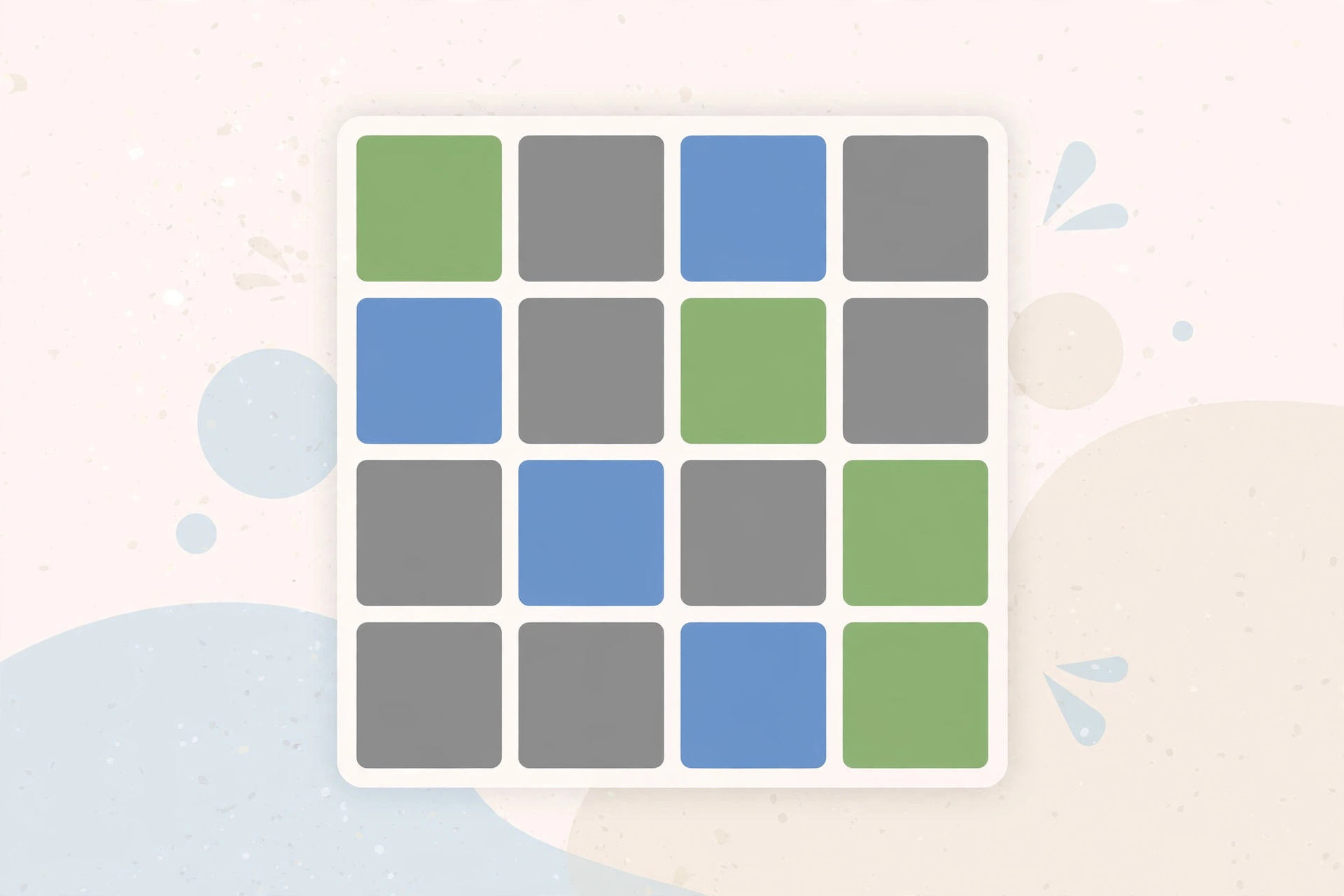
Lingle 4 is the 4-letter version of Lingle, the Wordle-style word-guessing game from thewordfinder.com that also comes in 5, 6 and 8-letter editions — a compact daily puzzle for fans of short-word deduction. You get six guesses to find a hidden 4-letter word, with a distinctive twist: misplaced letters turn blue instead of Wordle's yellow. Don't let the short words fool you — players consistently report that the 4-letter board is surprisingly tricky, making it a sharp daily word puzzle for deduction practice.
What Is Lingle 4?
Lingle is a "guess the word" word-guessing game in the Wordle family, published by thewordfinder.com and available on web, iOS and Android. While most Wordle clones stick to a single word length, Lingle offers a whole ladder: 4-letter, 5-letter, 6-letter and 8-letter boards, each playing as its own game.
Lingle 4 is the shortest rung on that ladder. Each puzzle hides a single 4-letter English word, and you have six guesses to uncover it. After every guess, the game flips each tile to tell you how your letters compare to the answer:
- Green means the letter is correct and in the right position.
- Blue means the letter is in the word but in the wrong position (Lingle's signature twist — most Wordle-likes use yellow here).
- Grey means the letter is not in the word at all.
The colour system is consistent across all Lingle variants, so skills transfer directly between the 4, 5, 6 and 8-letter games.
How to Play Lingle 4
- Enter any valid 4-letter word as your first guess. The game checks guesses against its dictionary, so made-up strings won't be accepted.
- Read the tile colours. Green locks a letter in place, blue tells you the letter exists somewhere else, and grey eliminates the letter entirely.
- Use your six guesses wisely. With only four letters to find, each guess should test as many new letters as possible early on.
- Solve the puzzle. Guess the exact 4-letter word within six tries to win the round.
- Play the Daily Challenge. Like Wordle, Lingle offers a daily puzzle where every player worldwide gets the same word, with shareable results for comparing with friends.
Beyond the core game, the Lingle app includes hints for when you're stuck, a hard mode (every guess must use all previously revealed letters), a colourblind mode for accessibility, and a ranking ladder that takes you from Lingle Novice up to Lingle Genius as you solve more puzzles.
Lingle 4 vs the Other Lingle Variants
| Variant | Word length | Guesses | Difficulty |
|---|---|---|---|
| Lingle 4 | 4 letters | 6 | Deceptively tricky — fewer letters means less information per guess |
| Lingle 5 | 5 letters | 6 | The classic Wordle-like experience |
| Lingle 6 | 6 letters | 6 | More room for deduction, longer words |
| Lingle 8 | 8 letters | 6 | The marathon — huge answer space |
Counterintuitively, many players find Lingle 4 harder than Lingle 5 or 6. With only four letter slots, each guess reveals less information, and the pool of possible 4-letter words is dense with near-identical options (think CARE/BARE/DARE/FARE style families). One wrong assumption can burn through your six guesses fast.
Strategies and Tips for Lingle 4
- Open with two vowels. Four-letter words are vowel-hungry. An opener covering A and E (plus common consonants like R, T, N, S) maps the word's skeleton immediately.
- Never repeat grey letters. Eliminated letters are dead. With only six guesses, every wasted tile hurts twice as much as in longer variants.
- Treat blue letters as gold. A blue tile tells you both that a letter exists AND where it isn't. In a 4-letter grid, that positional elimination is extremely powerful.
- Watch for double letters. Short words hide doubles often (BOOK, FEEL, BALL). If your common-letter guesses keep coming back grey, consider a double.
- Use hard mode to train. Lingle's hard mode forces every guess to include revealed letters. It is punishing, but it builds the discipline of never wasting a guess.
- Think in word families. If _AKE is confirmed, cycle mentally through BAKE, CAKE, FAKE, LAKE, MAKE, RAKE, TAKE, WAKE before committing guesses. Use spare guesses to test first letters rather than gambling.
- Save the hint. The app's hint feature can reveal a letter when you're truly stuck. Spend it on the position you're least sure about, not the one you've nearly solved.
Where to Play Lingle 4
Lingle is available in three places:
- Web. Play directly in the browser at thewordfinder.com, no download needed.
- iOS. The Lingle Word Game app on the App Store includes 4, 5 and 6-letter boards plus the daily challenge.
- Android. The Lingle Word Game app on Google Play, described as the first Android version of the game, with the same boards and daily puzzles.
All versions are free, and the daily challenge syncs the same puzzle to every player each morning. For more daily word games, try Plusword or work on your technique with our word puzzle strategies guide.
The Four-Letter Trap: Why Shorter Is Harder
New players assume Lingle 4 is the easy mode — fewer letters, simpler puzzle. Veterans know the opposite: the 4-letter board is widely reported as the trickiest rung on the Lingle ladder. Here is why shorter is harder, and how to adapt.
Less information per guess. A Wordle guess tests five letters; a Lingle 4 guess tests four — 20% less information per row, with the same six guesses to work with. That deficit compounds: you need proportionally more efficient guesses to reach the same certainty, which means your openers must be ruthlessly optimised.
The candidate space is denser. Four-letter English words cluster around common patterns (-ACK, -IGHT is five; think -AME, -ORE, -AND). When your tiles reveal a pattern, the remaining candidates are more numerous relative to your guesses than in longer games — the forks are thicker and the enumeration burden heavier. Never guess into a fork without listing candidates first.
Blue tiles demand positional discipline. Lingle's signature twist — blue for misplaced instead of yellow — changes nothing mechanically, but psychologically it helps: the distinct colour trains you to treat "right letter, wrong spot" as first-class information rather than a consolation prize. In Lingle 4, where every letter counts double, a blue tile is often the single most informative tile on the board.
Open with maximum distinctness. With only four slots, a repeated letter in your opener wastes 25% of the guess. Your first two guesses should contain eight distinct high-frequency letters — no doubles, no overlap. In the 4-letter game, opener efficiency is not optimisation; it is survival.
What is Lingle 4?
Lingle 4 is the 4-letter version of Lingle, a Wordle-style word game from thewordfinder.com. You get six guesses to find a hidden 4-letter word, with green, blue and grey tile feedback.
How is Lingle different from Wordle?
Lingle offers multiple word lengths (4, 5, 6 and 8 letters) instead of just 5, uses blue instead of yellow for misplaced letters, and includes extras like hints, hard mode, colourblind mode and player ranks from Novice to Genius.
Why are misplaced letters blue in Lingle?
Blue-for-misplaced is Lingle’s signature design choice, setting it apart from the yellow used by Wordle and most of its clones. Green still means correct position and grey means absent.
Is Lingle 4 harder than Lingle 5?
Many players say yes. With only four letter slots, each guess reveals less information, and 4-letter words cluster into dense families (BARE/CARE/DARE) that are hard to split apart within six guesses.
Is Lingle free to play?
Yes. Lingle is free on web, iOS and Android, with optional hints available in the app.
Does Lingle have a daily puzzle?
Yes. The Daily Challenge gives every player the same puzzle each morning, with results you can share and compare with friends and family.
Who makes Lingle?
Lingle is published by thewordfinder.com, which also offers the game as Lingle Word Game apps on the iOS App Store and Google Play.
What is a good starting word for Lingle 4?
Any common four-letter word with four distinct high-frequency letters. Think along the lines of SLATE-style logic adapted to four letters: cover the vowels and common consonants (E, A, R, T, S, N, L) across your first two guesses, with no repeated letters.
Can I play Lingle 4 on my phone?
Yes — Lingle is published by thewordfinder.com and is available on web, iOS, and Android, with the same colour system across all platforms. Your solving skills transfer directly between devices and between the 4, 5, 6, and 8-letter variants.