
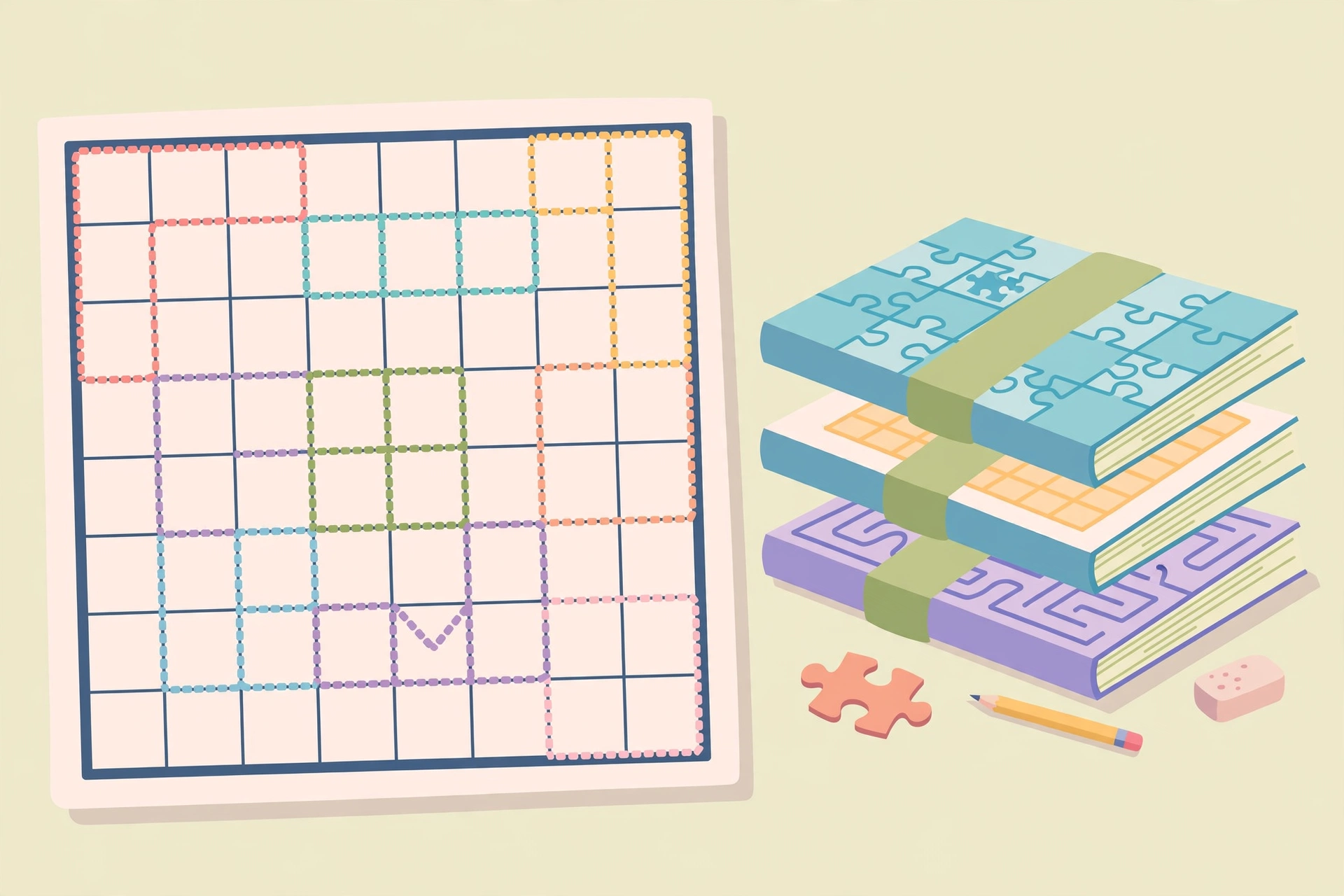
Puzzler Killer Sudoku is the killer sudoku offering from Puzzler, the UK puzzle publisher behind puzzler.com: a dedicated Killer Sudoku magazine, free online play, a daily puzzle app, printable puzzle packs and books. The puzzle itself blends sudoku with kakuro-style cage sums.
Who Is Puzzler?
Puzzler (puzzler.com) is a long-established UK publisher of puzzle magazines, books and online puzzles. Killer sudoku appears across its range: it has its own dedicated magazine title, features in several other Puzzler magazines, and is playable online in the browser and through the Puzzler App (puzzler.com).
How Killer Sudoku Works
Puzzler describes killer sudoku as an amalgamation of sudoku and kakuro that originated in Japan (puzzler.com). The rules:
- Solve it like a sudoku. Every row, column and 3×3 box must contain the digits 1–9 exactly once.
- Respect the cages. The grid is overlaid with irregular "cages", usually marked by dotted lines, each with a small number in its corner.
- Match the cage sums. The digits inside each cage must add up to that corner number.
- No repeats in a cage. No digit may appear twice within a single cage.
Puzzler notes that despite the fearsome name, simple killer sudokus can actually be easier than regular sudokus — it depends on your mental arithmetic (puzzler.com).
Also Known As
Killer sudoku travels under several aliases (puzzler.com):
| Name | Notes |
|---|---|
| Killer Sudoku | The common English name |
| Sumdoku / Sum Sudoku | Descriptive variants |
| Addoku | Another descriptive name |
| Samu Nanpure | Japanese-derived name |
| Sums Number Place | Descriptive variant |
| Tashizan Numpre | Japanese-derived name |
A Short History
According to Puzzler, killer sudoku first appeared in the UK in The Times in 2005 — the newspaper responsible for the "tasteless nomenclature", as Puzzler dryly puts it. The puzzle was the brainchild of Miyuki Nisawa, a pupil of the Japanese puzzle master Tetsuya Nishio (puzzler.com).
Where Puzzler Offers Killer Sudoku
Killer Sudoku Magazines
Puzzler publishes a dedicated Killer Sudoku magazine: a colourful collection of 100+ quality killer puzzles graded across five levels of difficulty, from mild to deadly, appearing 14 times a year. Issues also include other logic puzzles such as Galaxies, Hidoku, Kakuro, Killer Uncaged and MinuPlu, plus a competition with cash prizes (puzzler.com).
Killer sudoku also appears in Puzzler's other sudoku titles, including the flagship Puzzler Sudoku magazine, which mixes classic, 12×12, X-Factor and killer sudokus (puzzler.com).
Online Killer Sudoku
Prefer pixels to paper? Puzzler's website offers killer sudoku puzzles playable right now in the web browser — part of a large online puzzle selection (puzzler.com).
The Puzzler App
The Puzzler App offers a daily updated collection of puzzles and games, including killer sudoku alongside classic sudoku and suguru — expertly curated for on-the-go solving (puzzler.com).
Printables and Books
- Tough Killer Sudoku printables: a 16-page PDF pack with 50 of Puzzler's most difficult killer puzzles plus solutions, available as an instant download to print at home (puzzler.com).
- "Puzzler Killer Sudoku" book: 130 top-quality puzzles across three difficulty levels, opening with a complete walk-through of how to solve killer sudoku (bookhype.com).
If print puzzles are your thing, our roundup of sudoku puzzle books and crossword books for adults covers more collections worth a look.
Solving Tips: The 45 Rule
Puzzler's own killer sudoku guide highlights one principle above all: the 45 rule. Because each row, column and 3×3 "nonet" must contain the digits 1–9, the digits in each always sum to 45 (1+2+…+9). So if the cages fully inside one box sum to 45, everything is consistent — but if a cage spills over the box's edge by one cell, that cell's digit equals the cage sums minus 45 (puzzler.com).
Practical tips that follow from this:
- Learn the unique cage combos. A two-cell cage totalling 3 is always {1,2}; totalling 17 is always {8,9}; a three-cell cage totalling 6 is always {1,2,3}.
- Look for innies and outies. Cells where cages cross region boundaries are pure gold — the 45 rule often determines them outright.
- Combine sudoku and kakuro thinking. Use cage sums to place candidates, then ordinary row/column/box elimination to finish cells off.
- Work one region at a time. Pick the box, row or column with the most cage sums filled in and exhaust its deductions before moving on — killers unravel fastest when you concentrate your arithmetic.
Mild vs Deadly: Choosing Your Level
Puzzler's five difficulty grades run from mild to deadly, and they genuinely mean it. If you are new to the variant, start at mild: the cages are friendlier, the combinations more forgiving, and you can learn the 45 rule without drowning in arithmetic. Move up a grade when mild puzzles stop making you think. Deadly-level killers are a serious commitment — the kind of puzzle you solve with a sharp pencil and a free afternoon.
For a deeper dive, see our killer sudoku explainer.
Choosing the Right Difficulty: Puzzler's Grading Explained
One of Puzzler's strengths is its careful difficulty grading — the article mentions the "Mild vs Deadly" spectrum — and picking the right level is the single biggest factor in whether you enjoy killer sudoku or bounce off it. Here is how to use the grading system properly.
Start one level below your standard sudoku level. Killer sudoku adds an arithmetic layer on top of normal sudoku logic, so a solver comfortable with "hard" standard sudokus should begin at Puzzler's mild-to-medium killer range. The cage arithmetic consumes mental bandwidth that you would otherwise spend on pattern recognition, and starting easy lets the combination logic become automatic before the grids get demanding.
Use the magazine's progression deliberately. Puzzler's Killer Sudoku magazine typically orders its puzzles from gentler to deadlier through the issue. Work them in order rather than cherry-picking: the early puzzles teach the cage-combination habits — extreme cages first, the 45 rule on every row — that the later puzzles assume you have.
Know when to step up. You are ready for the next grade when you can solve your current level without writing out every cage combination — that is, when the common sums (like 2-cell 3, 4, 16, 17) are instant recall rather than lookups. If you are still consulting a combination table mid-solve, stay where you are; speed at one level transfers upward, but struggle does not.
Deadly is a different sport. At the top grades, killer sudoku stops being about arithmetic and becomes about advanced chaining — innies and outies across multiple units, locked sets spanning cages. Treat the deadly puzzles as study material: attempt, fail, analyse, and retry, rather than expecting clean solves.
What is Puzzler Killer Sudoku?
It is killer sudoku as published by Puzzler, the UK puzzle company behind puzzler.com — available as a dedicated magazine, online puzzles, a mobile app, printables and books (puzzler.com).
Is Puzzler’s online killer sudoku free?
Puzzler offers killer sudoku puzzles playable in the web browser on puzzler.com; magazines, printables and the app follow the site’s usual pricing (puzzler.com).
Who invented killer sudoku?
The puzzle was created by Miyuki Nisawa, a pupil of Japanese puzzle master Tetsuya Nishio, and first appeared in the UK in The Times in 2005 (puzzler.com).
What are the other names for killer sudoku?
Addoku, Samu Nanpure, Sum Sudoku, Sumdoku, Sums Number Place and Tashizan Numpre, according to Puzzler’s puzzle guide (puzzler.com).
Is killer sudoku harder than regular sudoku?
Not necessarily — Puzzler notes that simple killer sudokus can be easier than their regular counterparts, depending on your mental arithmetic abilities (puzzler.com).
How many difficulty levels does Puzzler’s Killer Sudoku magazine have?
Five, graded from mild to deadly (puzzler.com).
What is the 45 rule in killer sudoku?
Every row, column and 3×3 box contains the digits 1–9, so each sums to 45 — comparing cage totals against 45 reveals digits in cells where cages cross region boundaries (puzzler.com).
What do Puzzler’s difficulty grades mean for killer sudoku?
Puzzler grades its killer sudokus along a spectrum from mild to deadly. Mild puzzles use generous givens and simple cage combinations; deadly puzzles demand advanced techniques like innies and outies, locked sets, and multi-unit 45-rule calculations.
Is Puzzler’s Killer Sudoku magazine suitable for beginners?
Yes, if you start at the mild end. Puzzler notes that simple killer sudokus can actually be easier than regular sudokus, because the cage sums give you extra information. Beginners should work the magazine’s puzzles in order, from gentle to challenging.