
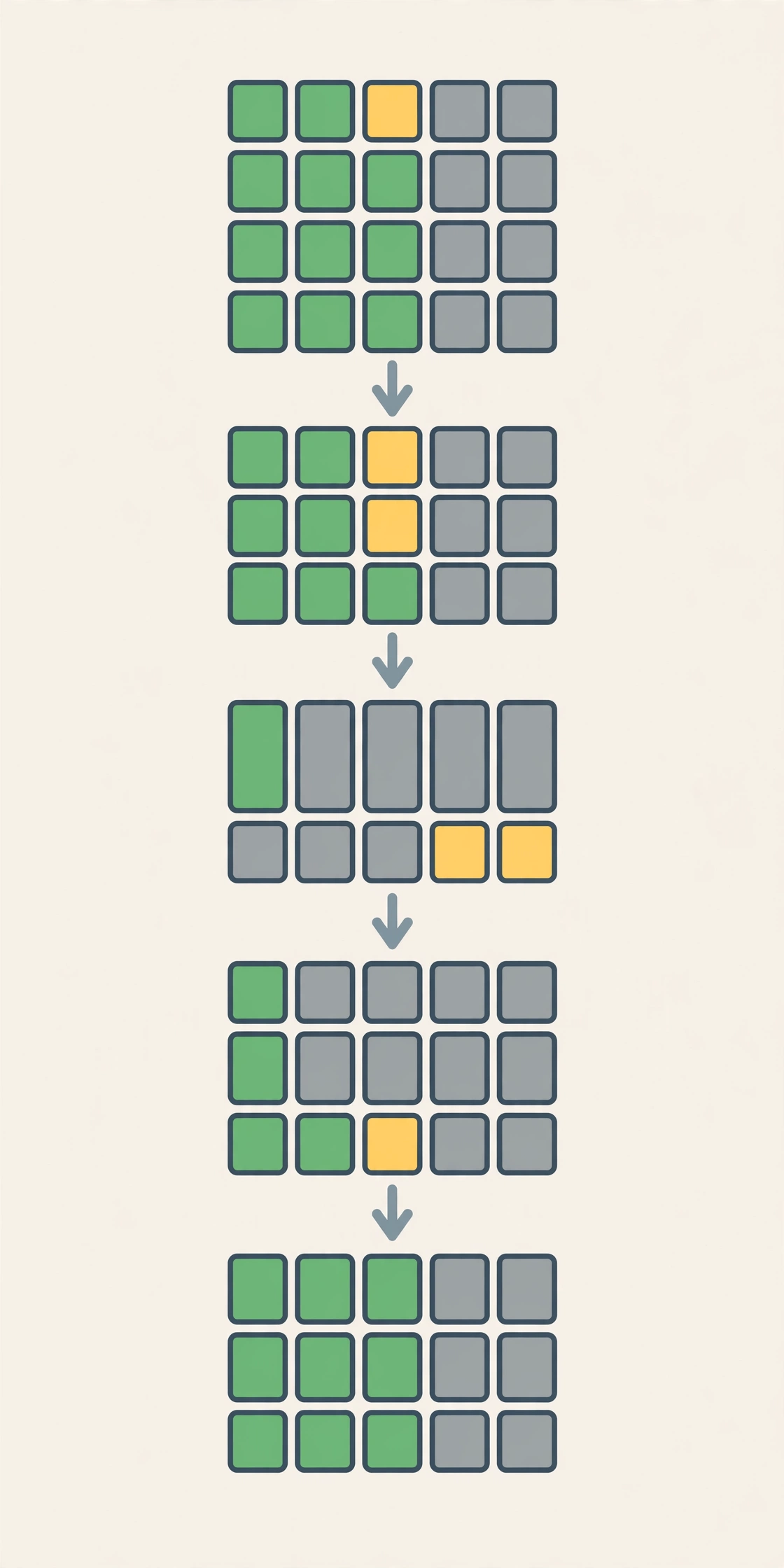
Sequence Wordle is a Wordle variant where, instead of guessing a single word, you solve a series of words one after another — each correct answer unlocking the next word in the sequence. Built on the familiar green/yellow/grey feedback of classic Wordle, it adds themes, rising difficulty, and a multi-stage challenge. Here is how it works and how to win.
What Is Sequence Wordle?
The Sequence Wordle game maintains the basic premise of Wordle but adds a unique layer: instead of guessing just one word, players are challenged to solve a series of words in sequence. Each correctly guessed word leads to the next, with each sequence typically revolving around a particular theme or increasing in difficulty. The variation tests not only vocabulary but also the ability to recognise patterns and themes (igamingindustry.org).
Where classic Wordle is a one-and-done daily puzzle, Sequence Wordle is a gauntlet. You might face three, five, or more words in a row — and every word must be cracked before you can move on. Some versions tie the sequence to a theme (for example, words linked by a topic), while others simply ramp up the difficulty as the chain grows longer (igamingindustry.org).
As one roundup of Wordle variants puts it, Octordle Wordle and Sequence Wordle add complexity by incorporating additional elements — Sequence Wordle specifically requires players to guess words in a specific sequence, adding an extra layer of challenge since players must consider the order of the words in addition to the words themselves (casinohouse.nz).
The sequential format appeals to a different kind of solver than the parallel multi-Wordle games. Quordle and Octordle reward breadth — managing information across boards at once — while Sequence Wordle rewards depth and stamina: each word is a full deduction puzzle in its own right, and the challenge compounds as the chain grows. It is the word-game equivalent of a ladder tournament rather than a round-robin, and players who find parallel boards chaotic often prefer the one-at-a-time focus.
How to Play Sequence Wordle
The mechanics will feel instantly familiar if you've played Wordle:
- Start with the first word in the sequence. Type a guess for the first five-letter word, just as in classic Wordle.
- Read the colour feedback. After each guess you receive colour-coded hints: green for correct letters in the right spot, yellow for correct letters in the wrong spot, and grey for incorrect letters (igamingindustry.org).
- Adjust and solve. Use the clues to narrow down your next guess until you land the word.
- Advance to the next word. Once the first word is correct, the game moves you to the next word in the sequence — often harder, or linked by the sequence's theme (igamingindustry.org).
- Finish the chain. The goal is to complete the entire sequence with the fewest guesses possible.
A daily-challenge format also exists: Daily Sequence Wordle presents a new sequence of words to guess each day, adding freshness and giving players a reason to return daily (casinohouse.nz).
Sequence Wordle vs Other Multi-Word Variants
Multi-word Wordle variants come in two flavours — parallel and sequential — and Sequence Wordle is firmly the sequential one:
| Variant | Format | How it works |
|---|---|---|
| Classic Wordle | 1 word | Six guesses, one word |
| Dordle | 2 words (parallel) | Solve both at once with shared guesses |
| Quordle | 4 words (parallel) | Solve four at once with shared guesses |
| Octordle | 8 words (parallel) | Solve eight at once with shared guesses |
| Sequence Wordle | Multiple words (sequential) | Solve word 1, then word 2, then word 3… |
In parallel variants like Quordle, one guess applies to all boards at once. In Sequence Wordle, you finish one puzzle completely before the next begins — so each word gets your full attention, but the total challenge keeps growing (igamingindustry.org; casinohouse.nz).
How Sequence Wordle Themes Work
The theme is Sequence Wordle's secret weapon — and its biggest tell. Most sequences are built around a connecting idea, and once you spot it, later words get dramatically easier:
- Topic themes. The most common: all words relate to one subject. A food sequence might run BREAD → PASTA → PIZZA → SALAD; a weather one might go STORM → CLOUD → RAINY → FLOOD. After two or three words, guess theme-first and let the letters confirm.
- Word-family themes. Sequences built on shared letter patterns — for example, every word ending in -IGHT, or every word starting with the same two letters. These reward pattern thinking over vocabulary.
- Difficulty ladders. No theme at all — just words that get progressively trickier, from common openers to obscure closers. Here the strategy is pure budgeting: solve early words fast and bank guesses for the end.
- Linked chains. The rarest and most satisfying: each word's letters hint at the next (for example, a sequence where the last letter of one word starts the next). Watch for these in themed daily versions.
The practical takeaway: after solving each word, pause and ask what it has in common with the ones before. Two data points are a coincidence; three are a theme — and themes are free guesses.
Strategies for Sequence Wordle
Open each word with a strong starter
Every word in the sequence is a fresh Wordle puzzle, so the classic advice applies each time: start with a word rich in common vowels and consonants. Letters you discover in earlier words don't carry over, so reset your thinking for each stage.
Watch for the theme
Sequences often revolve around a particular theme (igamingindustry.org). If word one is "OCEAN" and word two is "WAVES", the theme is probably water — use that to bias your guesses for word three toward related words.
Budget your guesses
If the game limits total guesses across the sequence, don't burn five attempts on an early word. Lock in quick wins early and save your careful deduction for the harder later words.
Keep a sequence log
Jot down each solved word. Seeing the chain written out makes theme-spotting much easier than trying to hold five words in memory.
Learn from parallel variants
The elimination skills you build in Dordle, Quordle, and Octordle transfer directly — but Sequence Wordle rewards patience more than parallel-solving speed, since each word is solved on its own.
For more word-game practice between sessions, try the daily puzzle on Plusword or read the site's explainer on Josh Wardle's Parseword.
What is Sequence Wordle?
Sequence Wordle is a Wordle variant where players solve a series of words in sequence — each correctly guessed word leads to the next, often around a theme or with increasing difficulty (igamingindustry.org).
How is Sequence Wordle different from regular Wordle?
Regular Wordle asks you to guess one five-letter word. Sequence Wordle asks you to guess multiple words one after another, adding the challenge of the sequence’s order and theme on top of the word-guessing itself (casinohouse.nz).
How do you play Sequence Wordle?
Guess the first word using classic Wordle rules and green/yellow/grey feedback; once solved, move to the next word in the sequence. The goal is to complete the whole sequence in as few guesses as possible (igamingindustry.org).
Is Sequence Wordle the same as Quordle?
No. Quordle is a parallel variant — you solve four words simultaneously with shared guesses. Sequence Wordle is sequential — you finish one word fully before the next begins.
Is there a daily version of Sequence Wordle?
Yes. Daily Sequence Wordle is a daily-challenge version presenting a new sequence of words to guess each day (casinohouse.nz).
What skills does Sequence Wordle test?
Beyond vocabulary, it tests pattern recognition and thematic thinking, since sequences often revolve around a theme or rise in difficulty (igamingindustry.org).
How many words are in a Sequence Wordle?
It varies by version — typically three to five words per sequence, though some versions chain more. Daily Sequence Wordle usually presents a fixed-length chain that refreshes each day.
Does Sequence Wordle have a time limit?
Most versions have no timer — the challenge is the guess budget across the sequence, not speed. A few arcade-style variants add one, but the classic format is untimed.
Where can I practise word games like Sequence Wordle?
The daily word puzzle at [Plusword](https://plusword.co.uk/) is a good training ground, and the site’s [Parseword guide](https://plusword.co.uk/what-is-parseword/) covers another modern word-game format.