
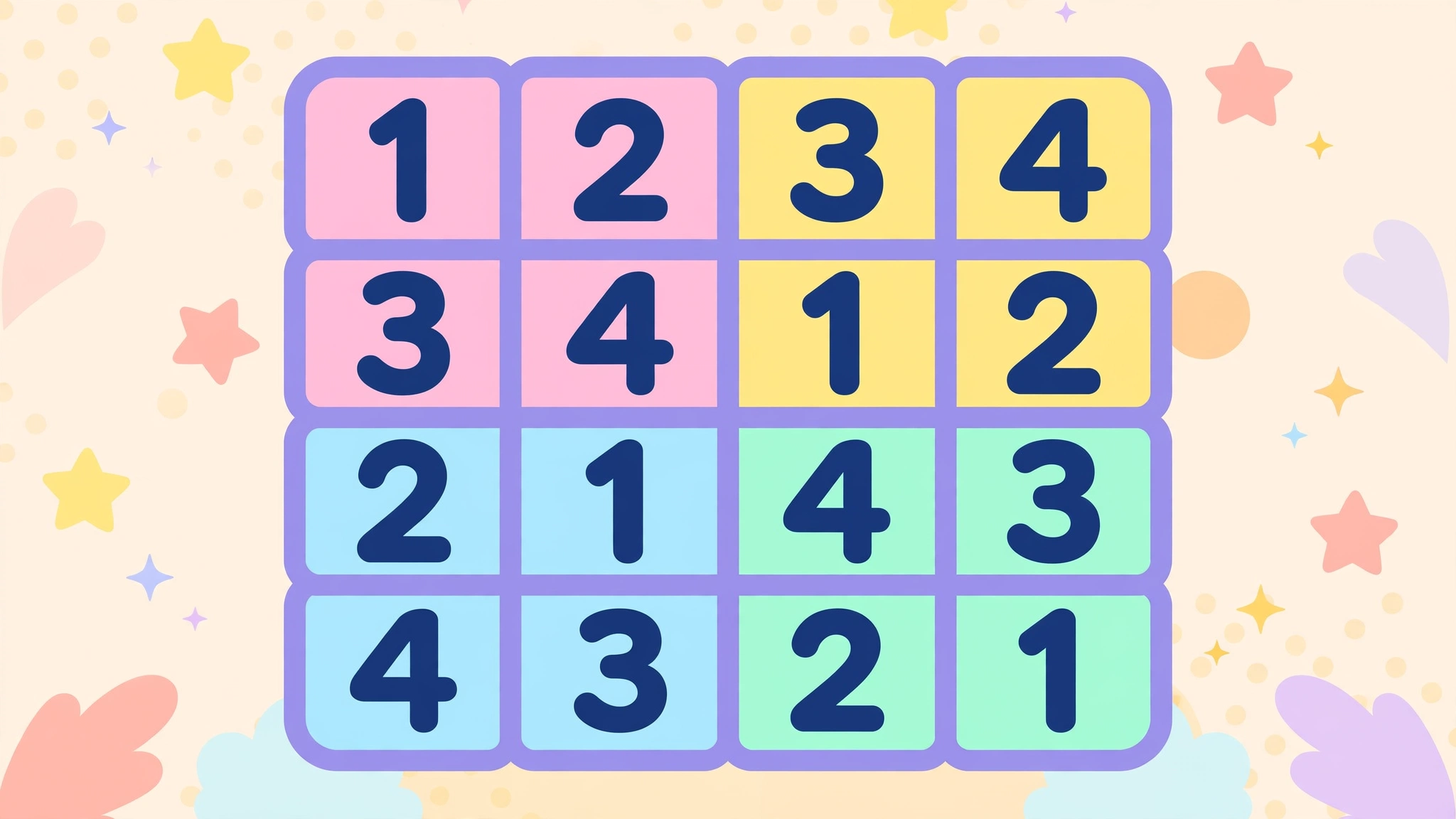
Sudoku for kids is a logic puzzle played on a smaller grid — usually 4×4 or 6×6 — where children fill each row, column and box with numbers so that no number repeats. There is no arithmetic involved, only pattern recognition, which is why children as young as four can learn the 4×4 version once they recognise the numbers 1 to 4. (Sources: Amazon — Easy Sudoku Ages 4 to 8, Sudoku Junior puzzle guide)
What Makes Kids' Sudoku Different from Adult Sudoku
Standard sudoku uses a 9×9 grid with the numbers 1 to 9. Kids' sudoku shrinks everything down: fewer cells, fewer numbers, bigger print. The logic is identical — every number appears exactly once in each row, column and box — but a 4×4 puzzle has just 16 cells to manage instead of 81, which keeps frustration low and confidence high.
Many children's puzzle books also swap plain numbers for pictures: animals, fruit, stars or cartoon faces. Picture sudoku teaches exactly the same "one of each in every row" logic, and it works for pre-readers who don't know their numbers yet. If your child can match shapes, they can do picture sudoku.
The Best Sudoku Grid Size by Age
| Grid | Numbers used | Box layout | Best starting age | Why it works |
|---|---|---|---|---|
| 4×4 | 1–4 | Four 2×2 boxes | 4–6 | Only 16 cells; children learn the core "no repeats" rule fast |
| 6×6 | 1–6 | Six 2×3 boxes | 6–9 | A real step up: more numbers, but still manageable |
| 9×9 (easy) | 1–9 | Nine 3×3 boxes | 8–12 | Full-size sudoku with generous givens; the natural graduation |
These are guidelines, not rules. Some five-year-olds fly through 6×6 grids; some nine-year-olds are happiest on 4×4. Follow the child's confidence, not the calendar. The progression most children's puzzle books use — 4×4, then 6×6, then easy 9×9 — exists because it mirrors how the skill actually builds (Sources: Amazon — Sudoku for Kids collection, Etsy — Beginners Sudoku for Kids).
The Rules, Explained the Way Kids Actually Understand Them
Forget "each digit must appear exactly once in every unit." Here's the child-friendly version:
- Every row gets one of each number. In a 4×4, each row needs a 1, a 2, a 3 and a 4 — like dealing a full hand of cards.
- Every column gets one of each number. Same deal going down.
- Every little box gets one of each number. Point at the thick lines and say "this square also needs the full set."
- No guessing needed. Every puzzle has a logical answer. If you're stuck, look again — don't guess.
The single most important sentence you can teach a child: "Look for the row, column or box that's almost full." A row with 1, 2 and 3 in it can only take a 4. That one insight solves most of the first 4×4 puzzle by itself.
A Step-by-Step Walkthrough: Teaching the First 4×4
Sit with your child for the first puzzle. This is a teaching moment, not a test.
Step 1 — Read the grid together. Look at the numbers already filled in. Count them out loud. Let the child point to each one.
Step 2 — Find the "almost full" row. Scan each row and ask: "Which row has the most numbers?" In a beginner puzzle, one row will have three of its four numbers. Ask: "What's missing?" Let them say "4" — then write it in.
Step 3 — Check the column. That new 4 also belongs to a column. Ask: "Now what does this column still need?" You're teaching them that one placement gives information in two directions.
Step 4 — Hand over the pencil. After two or three guided placements, let them find the next "almost full" row themselves. Resist correcting small hesitations — the logic clicks through doing, not watching.
Step 5 — Celebrate the finish. Check it together: run a finger along each row and count "1, 2, 3, 4." The ritual of checking builds the habit of self-verification.
Most children solve their first guided 4×4 in under ten minutes. The second one, they want to do alone.
Picture Sudoku: Sudoku Before Numbers
For ages 3–5, start with picture sudoku: a 4×4 grid using four pictures (for example: cat, dog, fish, bird) instead of numbers. The rule is identical — one of each picture per row, column and 2×2 box — but it removes the number-recognition barrier entirely.
Picture sudoku is also brilliant for children who find numbers intimidating. The logic skill transfers directly: a child who masters 4×4 picture sudoku usually walks straight into 4×4 number sudoku without a teaching step. Several popular kids' puzzle books mix picture and number puzzles in the same volume for exactly this reason (Source: Amazon — Easy Sudoku Ages 4 to 8).
Why Sudoku Is Genuinely Good for Kids
- No maths anxiety. Sudoku uses numbers as symbols, not quantities. Children who freeze at arithmetic often thrive at sudoku — and the confidence transfers back to maths class.
- Concentration training. A puzzle demands sustained attention on one task. Teachers consistently report that puzzle-playing children settle into focused work faster.
- Logical reasoning. "If this cell is 3, then that cell can't be 3" is deductive reasoning — the same muscle used in science and coding.
- Healthy failure. A wrong placement is discovered by logic, not by an adult saying "wrong." Children learn to check their own work, which builds intellectual independence.
- Screen-free focus. A printed puzzle book is one of the few activities that holds a child's attention for 20+ minutes with zero screen time.
Tips That Keep It Fun (Not Frustrating)
- Start easier than you think. The first puzzle should feel almost too easy. Early wins create the habit; difficulty comes later.
- Use pencil, always. Erasing a wrong number is painless; crossing out in pen feels like failure.
- One puzzle at a time. Don't hand over a book of 100 and say "go." Do the first few together, then let them choose.
- Time it only if they ask. Some kids love beating their own time; others find the clock stressful. Follow their lead.
- Large print matters. Small grids frustrate small hands. Children's sudoku books use big cells for a reason — if printing at home, print at 120%+ scale.
- Mix in variety. Alternate 4×4 grids with picture sudoku, mazes and spot-the-difference so it stays play, not homework.
- Don't teach advanced techniques yet. X-Wing and swordfish can wait. For kids, "almost full row" and "cross-checking" carry them all the way to easy 9×9.
Where to Find Good Sudoku Puzzles for Kids
The most reliable source is a printed children's sudoku book — they progress 4×4 → 6×6 → 9×9 by design, with large print and answer keys in the back. Look for books specifying "ages 4–8" or "ages 6–10" with 150+ puzzles, which usually cost less than a family takeaway (Sources: Amazon, Etsy).
Free options exist too: many educational sites offer printable 4×4 and 6×6 grids, and some general puzzle guides include a kids' section with picture-sudoku templates you can print at home. Whatever the source, check the answer key before handing a puzzle to a child — a puzzle with an error teaches them to distrust their own logic, which is the opposite of the point.
For parents who want to understand the full-size game their child is graduating toward, our guide to choosing a sudoku puzzle book covers difficulty levels and what to look for, and the Plusword homepage has daily word puzzles the whole family can play together.
What age can kids start sudoku?
Most children can start 4×4 sudoku around age 4, once they recognise the numbers 1 to 4. Picture sudoku works from age 3. The key readiness sign is the ability to spot “what’s missing” in a short sequence.
Is sudoku good for a 5 year old?
Yes. A 4×4 grid uses just the numbers 1–4 and teaches pattern recognition with no arithmetic. Keep sessions short (10–15 minutes) and celebrate completed puzzles.
What is 4×4 sudoku for kids?
It’s a 16-cell grid (4 rows × 4 columns) divided into four 2×2 boxes, using the numbers 1–4. Each row, column and box must contain all four numbers exactly once. It’s the standard starting point for young children.
How do you teach a child to play sudoku?
Start with the “almost full row” trick: find a row missing only one number and fill it in. Walk through the first puzzle together, then let the child take the pencil. Always use pencil so mistakes erase easily.
Does sudoku help kids with maths?
Indirectly, yes. Sudoku builds logical reasoning, concentration and pattern recognition — all foundational for maths — without any arithmetic pressure. Children who enjoy sudoku often approach maths with more confidence.
What comes after 4×4 sudoku?
Move to 6×6 grids (numbers 1–6 in 2×3 boxes) once 4×4 feels easy, usually around age 6–7. After 6×6, graduate to easy 9×9 puzzles with plenty of given numbers, typically around age 8+.
Are picture sudoku puzzles as good as number sudoku?
For teaching logic, yes — identical. Picture sudoku trains the same “one of each per row, column and box” reasoning without requiring number recognition, making it ideal for ages 3–5 or number-shy children.
Where can I print free sudoku for kids?
Many educational websites offer free printable 4×4 and 6×6 grids, and children’s puzzle books (often 150–300 puzzles for a few pounds) remain the best value. Always verify the answer key before giving a puzzle to a child.