

A good sudoku puzzle book is one of the simplest ways to build a daily brain-training habit: no screen, no adverts, just you and a grid. But not all sudoku books are equal. Some have 50 puzzles and a useless answer key; others have 400 graded puzzles that take you from beginner to expert.
This guide explains how to choose the right sudoku book for your level, which features actually matter, and the essential solving techniques that will carry you through any grid.
What Makes a Good Sudoku Puzzle Book?
Before buying, check these five things:
- Puzzle count. A book with 100 puzzles lasts a casual solver a few months; 200 to 400 puzzles is excellent value.
- Difficulty gradient. The best books start easy and ramp up gradually, so your skills grow with the puzzles.
- A complete answer key. Every reputable sudoku book prints full solutions at the back. Avoid any book that does not.
- Print quality. Thick, pencil-friendly paper and a binding that lies flat make solving far more pleasant — cheap newsprint smudges and bleeds.
- One puzzle per page (ideally). Cramped two-per-page layouts are harder on the eyes, especially in large-print editions.
Choosing the Right Difficulty
Sudoku books are usually graded Easy, Medium, Hard, and sometimes Expert or “Diabolical”:
- Easy: perfect for learning the rules. Most grids solvable with simple scanning in 15–30 minutes.
- Medium: requires basic techniques like pencil marks. The sweet spot for regular solvers.
- Hard: demands advanced techniques (pairs, triples, X-Wings). Genuinely challenging.
- Expert: for seasoned solvers who enjoy long logical chains.
Honest advice: buy one level below what your ego suggests. An “easy” book you finish builds momentum; a “hard” book that defeats you on page one gathers dust. Many solvers keep two books on the go — one comfortable, one stretching.
Key Features to Look For
Use this checklist when browsing:
- Difficulty label on every puzzle (so you can pick your mood)
- Full solutions section, clearly separated from the puzzles
- Large-print editions if you solve in low light or have tired eyes
- Spiral or lay-flat binding that stays open on the table
- A short “how to play” refresher at the front (useful for gifts)
Essential Solving Techniques
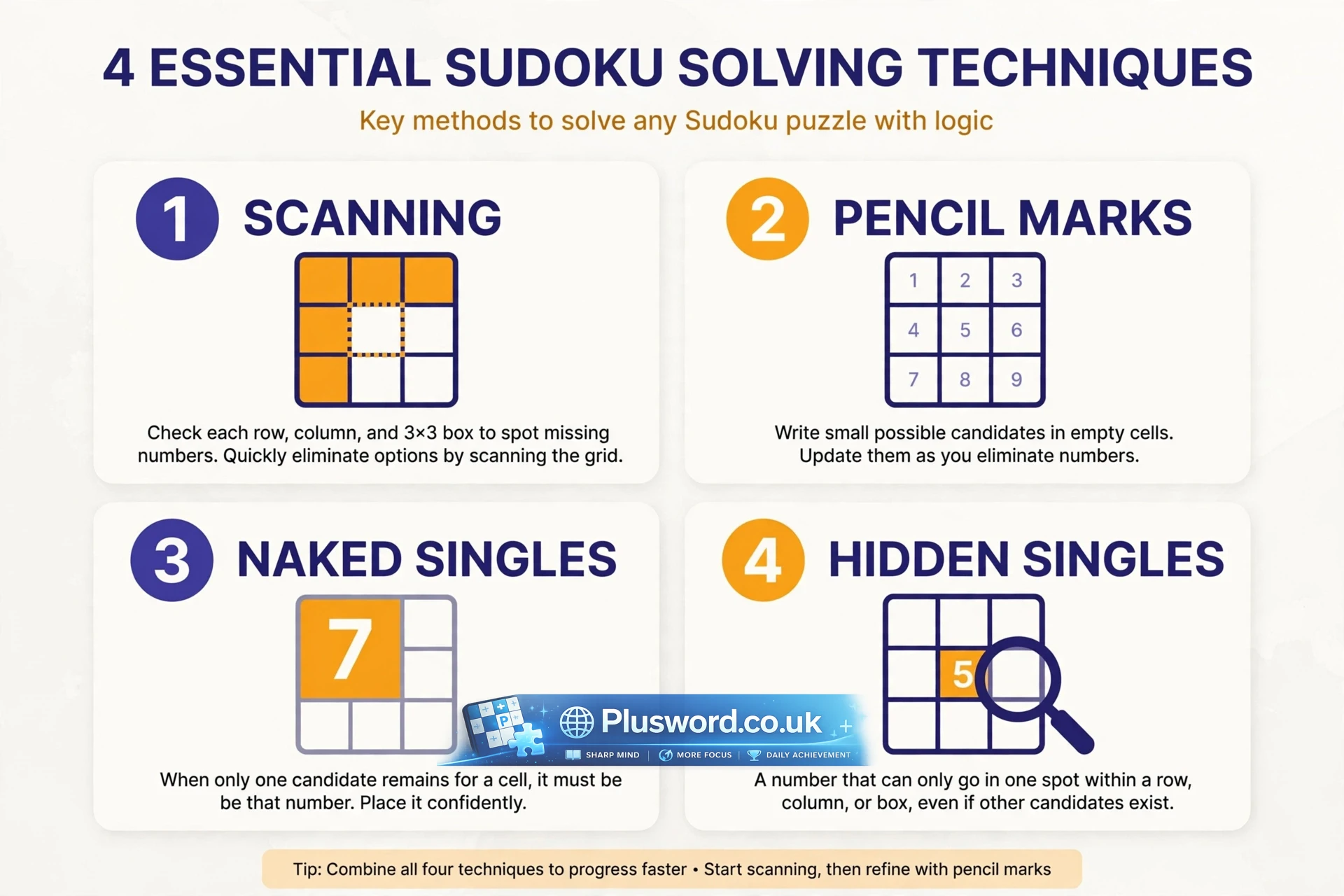
You do not need advanced maths — just these four techniques, in order:
- Scanning (cross-hatching). Look at each row, column, and 3×3 box. If the number 7 already appears in eight of the nine rows, the ninth row’s 7 can only go in one place. Work through the numbers 1–9 systematically.
- Pencil marks. Write tiny candidate numbers in empty cells. When only one candidate remains in a cell, it is solved. This is the single biggest leap from beginner to intermediate.
- Naked singles. A cell where your pencil marks leave only one possible number — fill it in immediately.
- Hidden singles. Sometimes a number can only fit in one cell within a row, column, or box, even though that cell has other candidates. Scan each unit asking “where can 5 go here?” rather than “what goes in this cell?”
Mini-example: imagine the top row reads 1-2-3-4-5-_-7-8-9. Scanning tells you the missing number is 6 — no pencil marks needed. Most easy puzzles are chains of exactly this kind of deduction.
Print Books vs Sudoku Apps
Both have their place:
- Books win on focus: no notifications, no adverts, and the satisfaction of a completed page. Ideal for travel, bedtime, or gifting.
- Apps win on convenience: infinite puzzles, automatic error-checking, and hints when you are stuck.
Many serious solvers use both — a book for relaxed solving and an app for practice on the move.
Frequently Asked Questions
Are sudoku puzzle books good for beginners?
Yes. Choose a book graded Easy with a “how to play” section at the front. You will learn the rules within a few puzzles, and the difficulty gradient carries you forward naturally.
How many puzzles should a good sudoku book have?
Look for at least 100 puzzles; 200 to 400 is excellent value. More important than the raw count is the difficulty gradient — a book that ramps up smoothly keeps you engaged far longer.
Do sudoku books include the answers?
Reputable ones always do, printed in a solutions section at the back. Check before buying — a book without full answers is not worth your money.
What is the difference between easy and hard sudoku?
Easy puzzles can be solved with scanning alone and have many starting numbers (“givens”). Hard puzzles have fewer givens and require techniques like hidden singles, pairs, and X-Wings to crack.
Is solving on paper better than using an app?
Neither is objectively better. Paper offers distraction-free focus and is easier on the eyes; apps offer hints, error-checking, and endless puzzles. Use whichever you enjoy — enjoyment is what builds the habit.
Final Thoughts
The best sudoku puzzle book is the one matched to your level: graded difficulties, a full answer key, and paper you enjoy writing on. Pair it with the four techniques above — scanning, pencil marks, naked singles, hidden singles — and even “hard” grids start to yield.
If you enjoy puzzles across the board, explore our guides to evening standard puzzles and metro puzzles online — and try our free daily Plusword puzzle for a different kind of daily challenge.