
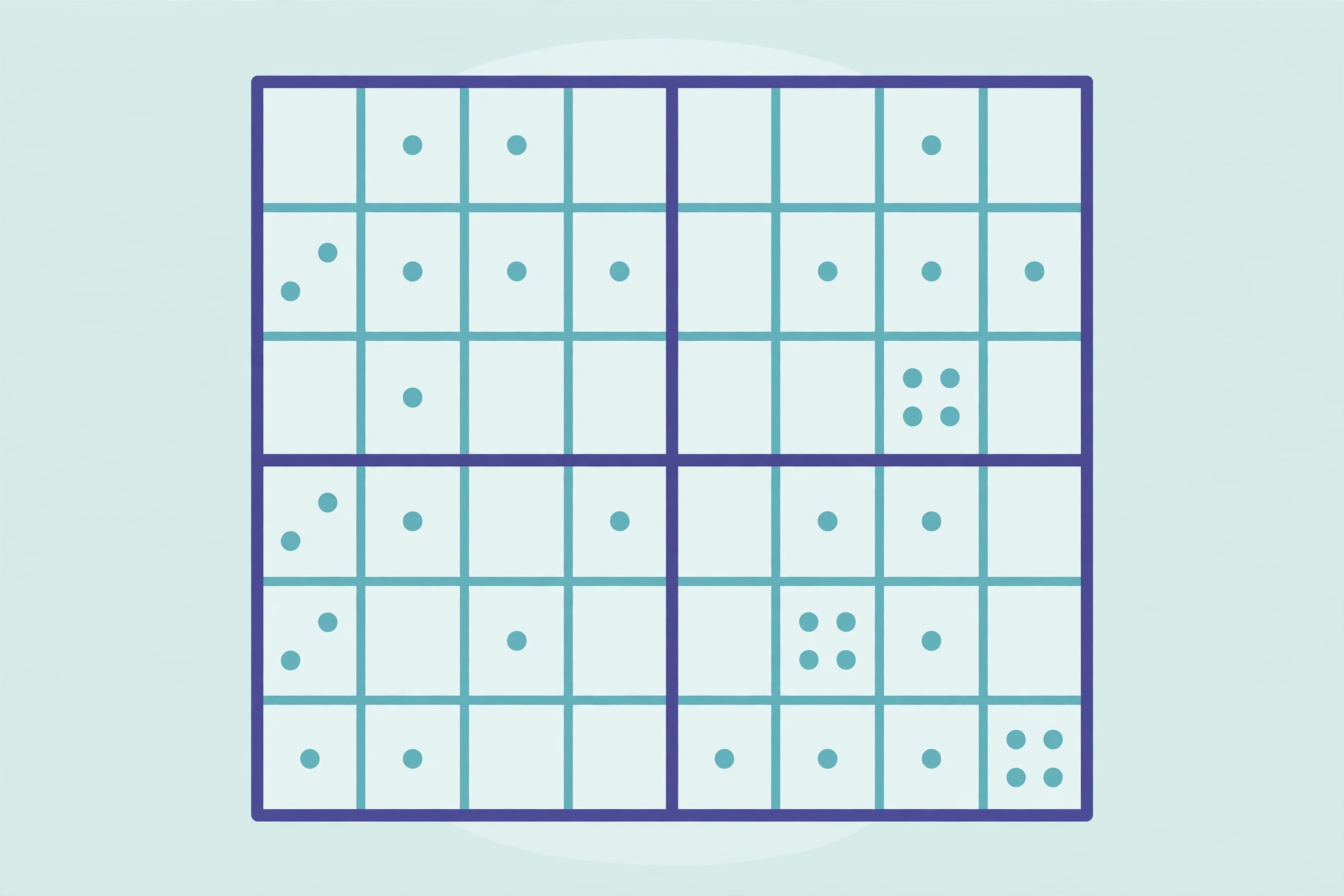
Sudoku puzzles are logic-based number placement puzzles played on a 9×9 grid. The goal is to fill every row, column and 3×3 box with the digits 1–9, with no number repeating within any row, column or box.
What Sudoku Puzzles Are
A classic sudoku puzzle consists of 81 cells arranged in nine rows and nine columns, grouped into nine 3×3 boxes. Some cells come pre-filled with numbers, known as clues or givens. Your task is to fill the remaining empty cells so that every row, every column and every 3×3 box contains each digit from 1 to 9 exactly once.
Despite involving digits, sudoku is not a maths puzzle — it is a pure logic puzzle. No arithmetic is required; the numbers could just as easily be replaced with letters, colours or symbols. What matters is the pattern of placement, not the values themselves.
The name "sudoku" is Japanese shorthand for sūji wa dokushin ni kagiru, meaning roughly "the digits must be single" or "the digits are limited to one occurrence" (Source: Wikipedia — Sudoku). The puzzle is now one of the most widely played logic puzzles in the world, printed daily in newspapers and played by millions online.
Sudoku's staying power comes from its unusual position in the puzzle ecosystem. Unlike crosswords, it needs no vocabulary or trivia — a beginner in any country can play the same grid as an expert — which is why it became the first truly global daily number puzzle. That universality spawned an enormous family of variants (Killer, Samurai, Thermometer, Hyper) and an entire generation of solver apps, yet the classic 9×9 grid remains the anchor: every solving technique, every difficulty rating and every variant is defined in relation to it.
How to Play Sudoku: The Rules
The rules of sudoku are deliberately simple — there are really only three of them:
- Fill every row. Each of the nine rows must contain the digits 1 through 9, with no repeats.
- Fill every column. Each of the nine columns must contain the digits 1 through 9, with no repeats.
- Fill every 3×3 box. Each of the nine bold-outlined 3×3 boxes must contain the digits 1 through 9, with no repeats.
That is the entire rule set. A well-constructed puzzle has exactly one unique solution, and every placement can be reached through pure logic — you should never need to guess.
For a valid 9×9 sudoku, mathematicians have proven that at least 17 starting clues are needed to guarantee a unique solution; no valid puzzle with 16 or fewer clues has ever been found (Source: The Sudoku Arena — History of Sudoku). Most published puzzles give between 22 and 32 clues, depending on difficulty.
How to get started
If you are new to sudoku puzzles, follow this simple workflow:
- Look for the easy placements first. Scan each row, column and box for digits that can only go in one place.
- Use pencil marks. Lightly note down candidate numbers in empty cells so you can track possibilities without losing them.
- Work slowly and recheck. Every number you place changes what is possible elsewhere, so revisit your pencil marks after each placement.
- Start with Easy puzzles. Beginner puzzles are solvable with basic scanning alone and build the pattern recognition you need for harder grids.
Sudoku Difficulty Levels
Not all sudoku puzzles are equal. Difficulty is controlled mainly by the number of starting clues and, more importantly, by how they are placed — a sparse puzzle with tricky clue placement can be far harder than one with fewer clues in friendly positions.
| Difficulty level | Typical clues | What to expect |
|---|---|---|
| Easy | 35+ | Solvable with basic scanning; ideal for beginners |
| Medium | 28–34 | Needs pencil marks, hidden singles and naked pairs |
| Hard | 20–27 | Requires advanced techniques and careful logic chains |
| Expert / Evil | Fewer than 20 | Very sparse grids needing advanced strategies |
Some publishers add extra tiers — "Very Hard", "Fiendish" or "Evil" (as on websudoku.com) — but the logic scale is the same: fewer clues and trickier placement demand more sophisticated techniques.
Sudoku Strategies and Tips
Beginner techniques
Scanning (cross-hatching). Pick a digit — say 7 — and scan every row and column that already contains a 7. In each 3×3 box missing a 7, the rows and columns you scanned often block off all but one possible cell. Place the 7 there, then repeat for every digit (Source: Sudoku a Day — Strategy Cheat Sheet).
Naked singles. If a cell has only one possible candidate left after checking its row, column and box, that number must go there. This is the simplest way to make progress and often unlocks a cascade of new placements.
Pencil marks. Write small candidate numbers in empty cells. Once every empty cell is pencil-marked, patterns become visible that are impossible to spot mentally.
Intermediate techniques
Hidden singles. After pencil-marking, check each row, column and box: if a digit appears as a candidate in only one cell within that unit — even though that cell has other candidates too — that digit must go there.
Naked pairs. If two cells in the same row, column or box contain exactly the same two candidates, those two digits are locked into those two cells. You can safely remove both candidates from every other cell in that unit, which often reveals new singles.
Pointing pairs. When a candidate appears exactly twice within a 3×3 box and both cells sit in the same row (or column), that candidate can be eliminated from the rest of that row (or column) outside the box.
Advanced techniques
X-Wing. When a digit can only appear in two cells in each of two different rows, and those cells line up in the same two columns, the digit must sit in opposite corners of the rectangle. That lets you eliminate the digit from all other cells in those two columns.
Swordfish. A three-row (or three-column) extension of the X-Wing idea, useful for cracking very hard puzzles.
Remember: expert-level puzzles are still solvable by pure logic. Guessing is a sign you have missed a technique, not a legitimate strategy. Our sudoku tactics reference covers every technique in depth, from scanning to Swordfish.
A Brief History of Sudoku
Although it looks Japanese, the modern sudoku was invented in the United States. In 1979, Howard Garns, a retired architect from Connersville, Indiana, designed a 9×9 number placement puzzle for Dell Magazines, where it was published as "Number Place". Garns published anonymously and died in 1989, before his creation became a worldwide phenomenon (Source: Wikipedia — Sudoku).
The puzzle reached Japan in 1984, when puzzle publisher Nikoli ran it in Monthly Nikolist under the long name sūji wa dokushin ni kagiru, later shortened to "sudoku" by Nikoli president Maki Kaji. Nikoli refined the puzzle style, insisting on no more than 32 givens and symmetrical clue patterns.
The global craze began in 2004, when Wayne Gould, a retired New Zealand judge who had discovered the puzzle in a Tokyo bookshop, persuaded The Times of London to print it daily. Within a year, newspapers across the world were running sudoku, and the first World Sudoku Championship was held in Lucca, Italy, in 2006 (Source: The Sudoku Arena — History of Sudoku).
How do you play sudoku for beginners?
Fill the 9×9 grid so each row, column and 3×3 box contains the digits 1–9 exactly once, without repeating. Start by scanning for cells that can only hold one number, use pencil marks for harder spots, and begin with Easy puzzles until the patterns feel natural.
Can you repeat numbers in sudoku?
No. Repeating a digit within any row, column or 3×3 box breaks the rules. However, each digit appears nine times across the whole grid — once in every row, column and box.
What is the hardest sudoku puzzle?
Hardness depends on clue placement rather than clue count alone. “Expert” and “Evil” puzzles from publishers like websudoku.com or Conceptis are among the toughest mass-market grids. Mathematicians have also designed puzzles requiring the longest logical solution paths, but for everyday players, anything rated Hard or above is a serious challenge.
Is sudoku good for your brain?
Sudoku exercises working memory, concentration and logical reasoning, and many players find it relaxing and satisfying. While puzzle games in general support mental engagement, treat specific “brain training” claims with healthy scepticism — the main benefits are focus, patience and pattern recognition.
Where can I play sudoku puzzles for free?
Many reputable sites offer free daily puzzles, including [websudoku.com](https://websudoku.com) (Easy to Evil levels), Conceptis Puzzles (conceptispuzzles.com) and the daily puzzles in most major newspaper websites. Numerous free apps for iOS and Android also offer unlimited sudoku with hints and pencil-mark tools. For printed practice, see our [sudoku puzzle book guide](https://plusword.co.uk/sudoku-puzzle-book/).
How long should a sudoku take to solve?
It depends on difficulty. An Easy puzzle typically takes a beginner 10–20 minutes and an experienced solver under 5 minutes. A Hard or Expert puzzle can take 30 minutes or longer, even for regular players. There is no correct time — steady progress is the point.
What is the difference between sudoku and killer sudoku?
Classic sudoku uses only the standard row, column and box rules. Killer sudoku adds “cages” — outlined groups of cells that must sum to a given total with no repeated digits — combining sudoku logic with arithmetic. It is a separate, harder variant — read our [killer sudoku guide](https://plusword.co.uk/what-is-killer-sudoku/) to learn it.