
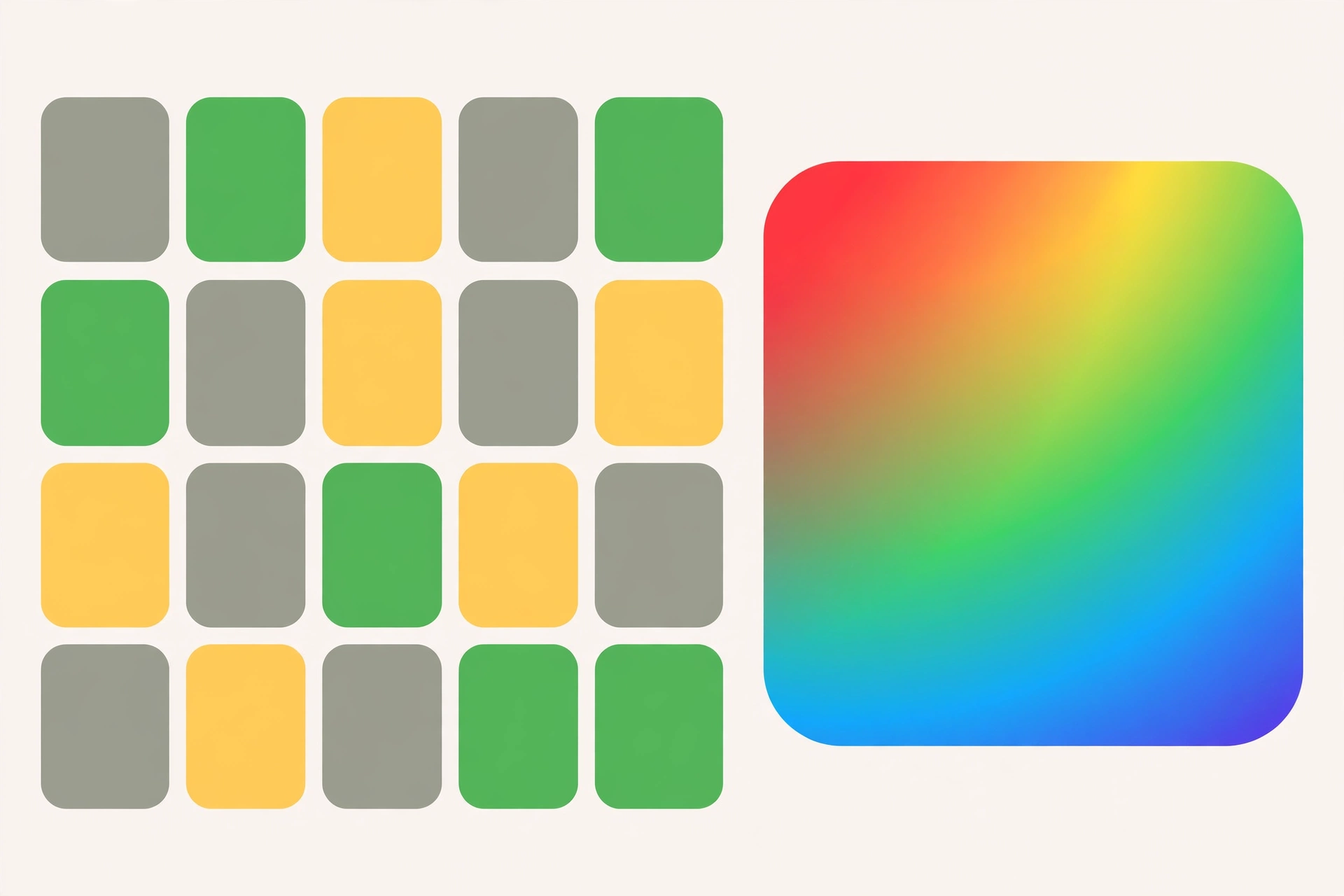
Colourdle is a free daily browser game that works like Wordle but replaces words with colours: you get six attempts to guess the exact RGB value of a target colour swatch, and each guess is scored with Wordle-style green, yellow and grey feedback. A new puzzle drops every day.
How Colourdle Works
The idea is simple. Instead of guessing a five-letter word, you are shown a colour and must work out its precise RGB (red, green, blue) code — the same three-number format designers use, like 255, 000, 128. Each of the three colour channels runs from 000 to 255, so a guess looks like nine digits arranged in three columns: the first three for red, the next three for green, the last three for blue, with leading zeros required (053, not 53).
After you submit a guess, the tiles flip to tell you how close you were:
- Green — the digit is exactly right in that position.
- Yellow — the digit appears somewhere in the target code, but not in that position.
- Grey — the digit does not appear in the target code at all.
This mirrors Wordle's feedback system exactly, which is why players describe Colourdle as "Wordle for your eyes." A "Last Guess" panel shows the colour you actually entered next to the target, so you can visually compare how far off your mix was.
The game was created by Mike, a UK-based developer who built it for fun and to practise his HTML, CSS and JavaScript coding skills after a friend named Sam suggested the idea. It lives at colourdle.co.uk and is free to play, with an optional "buy me a coffee" link for supporters; the source code is also open source on GitHub (source: colourdle.co.uk/about).
The Rules of Colourdle
- One puzzle per day. A fresh Colourdle appears daily, just like the original Wordle.
- Six guesses. You have six attempts to nail the RGB value.
- Nine digits per guess. Every guess must be a valid nine-digit code: three digits for red (000–255), three for green, three for blue. Leading zeros are mandatory.
- No repeats of feedback. Green means exact, yellow means present-but-misplaced, grey means absent — the same colour logic as Wordle.
- Win or reveal. Solve it within six tries to win; otherwise the target colour is revealed and you try again tomorrow.
A worked example
Say the target is a warm orange — RGB 255, 165, 000. Your first guess might be 200, 100, 050. The feedback tells you which digits are locked in (green), which digits exist but sit in the wrong channel (yellow), and which to discard (grey). From there you narrow the ranges the same way Wordle players narrow letter positions, except you are narrowing numbers instead of letters.
Colourdle vs Wordle: What's Different?
| Feature | Wordle | Colourdle |
|---|---|---|
| What you guess | 5-letter word | RGB colour code (9 digits) |
| Guesses per day | 6 | 6 |
| Feedback | Green/yellow/grey tiles | Green/yellow/grey tiles |
| Skill involved | Vocabulary, letter frequency | Colour intuition, number logic |
| Puzzles per day | 1 | 1 |
| Creator | Josh Wardle (now NYT) | Mike (independent, UK) |
The genius of the spin-off is that it keeps Wordle's addictive deduction loop while testing a completely different sense. You do not need a big vocabulary — you need an eye for colour and a head for numbers.
Strategies and Tips for Colourdle
Start with a spread guess
Open with a guess that covers a wide range of digits, such as 000, 128, 255. This immediately tells you roughly where each channel sits, the way Wordle players open with vowel-heavy words like ADIEU or STARE.
Learn common colour recipes
Memorise a few anchor RGB values and you will have reference points for every puzzle:
- Pure red: 255, 000, 000
- Pure green: 000, 255, 000
- Pure blue: 000, 000, 255
- White: 255, 255, 255
- Black: 000, 000, 000
- Mid grey: 128, 128, 128
- Orange: 255, 165, 000
- Purple: 128, 000, 128
Use the "Last Guess" panel
After each attempt, compare the rendered colour of your guess with the target swatch. If your guess looks too red, pull the red channel down; too dark, push all three channels up. Your eyes are a legitimate solving tool here.
Treat channels independently
The three RGB channels do not interact — red feedback never affects green. Solve each channel as its own mini-puzzle, then combine the results. This keeps the search space manageable.
Watch the leading zeros
The most common beginner mistake is entering 53 instead of 053. The game requires exactly three digits per channel, so pad with zeros every time. More deduction tactics are covered in our word puzzle strategies guide.
Other Colour-Guessing Games Worth Knowing
Colourdle is not the only game in this niche, and knowing the family helps you find the flavour you like best:
- Coloradle — a Colorado-themed Wordle variant (four-to-eight-letter words about the state), unrelated to colour guessing despite the similar name.
- Color Wordle (Chrome extension) — a colour-mixing puzzle where you blend colours to match a target in six tries, with unlimited practice mode.
- Colordle (MATLAB) — an open-source hex-code guessing game by developer weber1158, where you guess six-character hexadecimal codes with a twist: yellow means your digit is within ±3 of the target (GitHub).
- colourdle.ca — a separate open-source project by aebrer where you see a colour and type its name, scored by fuzzy name matching and colour distance (GitHub).
If you searched for "colourdle" and landed on one of these by accident, now you know which is which.
Where to Play Colourdle
The original daily game is at colourdle.co.uk and runs entirely in the browser — no download, no account, no cost. Because it is a simple HTML/CSS/JavaScript page, it works on phones, tablets and desktops alike. For more quick brain-teasers, browse our daily puzzle games roundup.
Final Thoughts
Colourdle is one of the cleverest Wordle spin-offs because it keeps everything people love about the original — the daily ritual, the six-guess tension, the shareable result — while testing colour sense instead of vocabulary. If you have ever argued about whether something is teal or turquoise, this is your game.
For more daily puzzle guides, check out our breakdown of Quordle and Josh Wardle's newer game in What Is Parseword.
Is Colourdle free to play?
Yes. Colourdle is completely free in the browser at colourdle.co.uk, with an optional donation link for players who want to support the developer.
Who created Colourdle?
Colourdle was created by Mike, a UK developer who built it as a coding project after his friend Sam suggested the idea. It is heavily inspired by Wordle, which was created by Josh Wardle and is now run by The New York Times.
How many guesses do you get in Colourdle?
Six guesses, exactly like Wordle. Each guess must be a valid nine-digit RGB code.
What do the green, yellow and grey tiles mean in Colourdle?
Green means the digit is correct and in the right position, yellow means the digit is in the target code but in the wrong position, and grey means the digit is not in the code at all.
Is Colourdle the same as Coloradle?
No. Coloradle is a Wordle clone with Colorado-themed words, while Colourdle is a colour-guessing game about RGB values. The names look similar but the games are completely different.
Can I play more than one Colourdle per day?
The original at colourdle.co.uk releases one puzzle per day. If you want unlimited practice, the open-source hex-code Colordle on GitHub lets you play as many rounds as you like.
Do I need to know RGB codes to play Colourdle?
Not in advance. The game teaches you the format as you play, and learning a handful of common colour recipes (like 255, 165, 000 for orange) quickly makes you competitive.