
If you loved Wordle, there is a new daily word game you need to know about. Parseword is the latest creation from Josh Wardle — the man behind Wordle itself — and it takes word puzzles in a completely new direction. Instead of guessing a five-letter word, Parseword teaches you to think like a cryptic crossword solver.
In this guide, we explain exactly what Parseword is, who made it, how it works, and how you can start playing today.
What Is Parseword?
Parseword is a free daily word puzzle game created by Wordle creator Josh Wardle. It launched in March 2026 and is built around cryptic crosswords — the style of puzzle where every clue contains both a definition and a piece of clever wordplay.
Instead of filling in a crossword grid, Parseword gives you a single clue each day. Your job is to “parse” the clue: break it down into its parts, figure out the wordplay, and arrive at the answer. The game is designed to make cryptic crosswords accessible to complete beginners, with an interactive tutorial, starter puzzles, and a built-in hint system that teaches you as you play.
Like the original Wordle, Parseword is free to play with one new puzzle every day, and it runs entirely in your browser — no app download needed.
Who Created Parseword?
Parseword was created by Josh Wardle, the Welsh software engineer who created Wordle in 2021. Wordle became a global phenomenon, reaching more than two million daily players before Wardle sold it to The New York Times in January 2022.
Wardle has said he found Wordle’s sudden viral success uncomfortable, and he had not played it since selling it. The idea for Parseword came after he heard Craig Mazin — the showrunner of The Last of Us — explain the appeal and logic of cryptic crosswords on a podcast. Wardle wanted to help guide new solvers into the world of cryptics, “reducing the problem space” for beginners.
He announced the game himself on X (Twitter) on March 10, 2026, writing: “I’ve released a new word game called Parseword, that tries to make cryptic crosswords more accessible.” Unlike Wordle’s accidental virality, Wardle says releasing Parseword is happening “more on my own terms.” The launch was widely reported by NME.
How Parseword Works
The core concept is simple, but the solving is deliciously tricky. Here is how a daily Parseword puzzle works:
- You are shown a single cryptic clue.
- The clue always contains two parts: a definition of the answer, and wordplay that tells you how to construct it.
- You analyse the clue, spot the wordplay technique being used, and work out the answer.
- Hints and explanations are available if you get stuck — the game genuinely wants to teach you.
For example, in a cryptic clue the words might instruct you to rearrange letters, remove letters, combine two words, or find a word hidden inside a longer phrase. Once you see how the pieces fit together, the answer clicks into place — and that “aha” moment is what makes the game so addictive.
How a Cryptic Crossword Clue Works
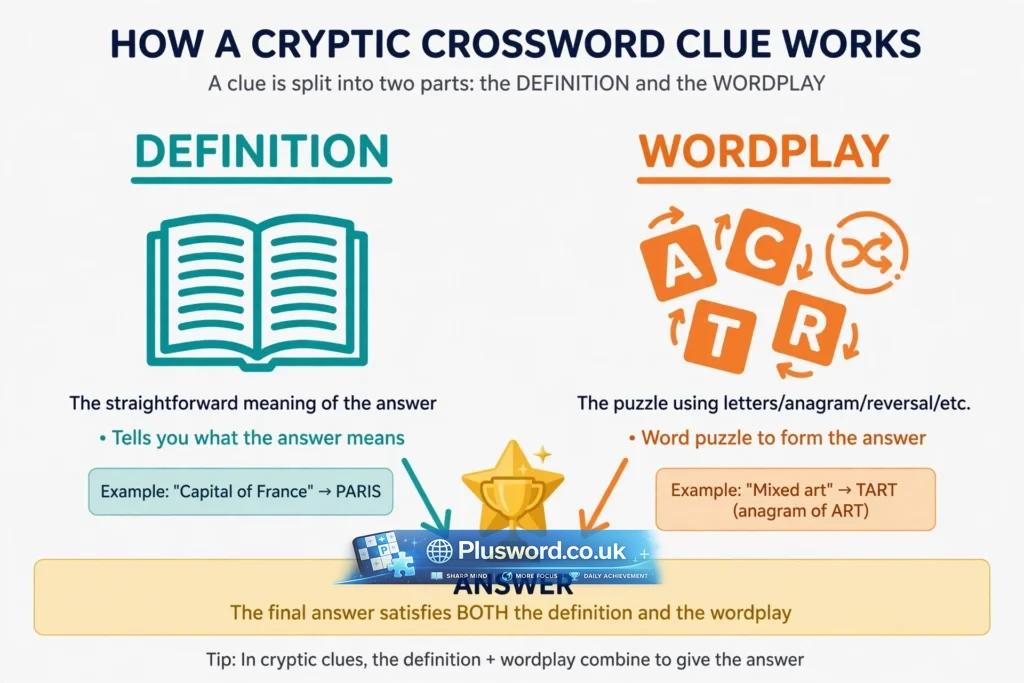
Every cryptic clue — in Parseword or in a newspaper cryptic crossword — follows the same golden rule: the definition and the wordplay must both lead to the same answer.
Common wordplay techniques include:
- Anagrams: letters rearranged, signalled by words like “mixed”, “confused”, or “broken”. Example: “Mixed art” gives TART (an anagram of ART).
- Hidden words: the answer hides inside the clue’s wording, signalled by words like “inside” or “within”.
- Homophones: words that sound alike, signalled by phrases like “we hear” or “say”.
- Reversals: a word spelled backwards, signalled by “back” or “returned”.
- Charades: two or more word parts joined together to build the answer.
- Deletions: removing the first or last letter of a word, signalled by “headless” or “endless”.
Learning to spot these indicator words is the key skill Parseword teaches you, one daily puzzle at a time.
The Three Game Modes
Parseword offers three difficulty modes, so you can start gently and work your way up:
- Learn mode: the easiest setting, with guided tutorials and generous hints. Ideal for complete beginners who have never solved a cryptic clue.
- Play mode: the standard daily puzzle experience — a fair challenge with hints available when you need them.
- Challenge mode: the hardest setting, for solvers who want to test their skills with minimal help.
This structure is one of Parseword’s smartest ideas. Traditional cryptic crosswords can feel intimidating, but the Learn mode walks you through the logic step by step until the techniques start to feel natural.
Parseword vs Wordle: What’s Different?
Although both games come from Josh Wardle and share the free daily puzzle format, they test very different skills:
- Wordle is about guessing: you get feedback on each guess and narrow down a five-letter word through trial and error.
- Parseword is about decoding: there is no guessing loop. Instead, you analyse language, spot wordplay patterns, and construct the answer through logic.
- Wordle takes about three minutes. A Parseword clue can take anywhere from two minutes to much longer while you are learning.
- Wordle rewards vocabulary. Parseword rewards pattern recognition, lateral thinking, and creativity with language.
If you enjoy the mental workout of anagrams, riddles, and lateral-thinking puzzles, Parseword will likely appeal to you even more than Wordle did.
Tips for Beginners
New to cryptic clues? These tips will speed up your learning curve:
- Find the definition first. It is usually at the beginning or the end of the clue. Everything else is wordplay.
- Look for indicator words. Words like “mixed”, “hidden”, “heard”, or “backwards” tell you which technique is in play.
- Count the letters. The answer length is your best friend — it tells you when a wordplay construction is complete.
- Say it out loud. Homophone clues become much easier when you hear the words.
- Use the hints. Parseword’s hint system is a teaching tool, not a cheat. Each hint explains the technique, so you learn for next time.
- Start in Learn mode. There is no shame in it — even experienced word game players need time to adjust to cryptic logic.
Frequently Asked Questions
Is Parseword free to play?
Yes. Like the original Wordle, Parseword is completely free to play, with one new puzzle released every day. There are no paywalls or subscriptions.
Who made Parseword?
Parseword was created by Josh Wardle, the creator of Wordle, and released in March 2026. Wardle built it to make cryptic crosswords more accessible to beginners.
How is Parseword different from a regular crossword?
A regular crossword gives you straightforward definition clues in a grid. Parseword gives you a single cryptic clue per day, where the clue contains both a definition and wordplay that you must decode to find the answer.
Do I need to know cryptic crosswords to play Parseword?
No. The game is specifically designed for beginners, with a Learn mode, interactive tutorial, starter puzzles, and hints that teach you the techniques as you play.
Where can I play Parseword?
Parseword runs entirely in your web browser on phone, tablet, or computer — no app download is required. Search for “Parseword Josh Wardle” to find the official game.
Is Parseword harder than Wordle?
In a different way, yes. Wordle is about efficient guessing; Parseword is about decoding wordplay, which has a steeper learning curve. Most players find the first week challenging, then it clicks.
Final Thoughts
Parseword is one of the most exciting word game launches in years — a daily puzzle from the creator of Wordle that opens up the wonderful world of cryptic crosswords to everyone. It is free, it is clever, and it genuinely teaches you a new way to think about language.
If you enjoy a daily word challenge, you will also love our own daily Plusword puzzle — a fresh word-deduction game every day, right here on this site.