
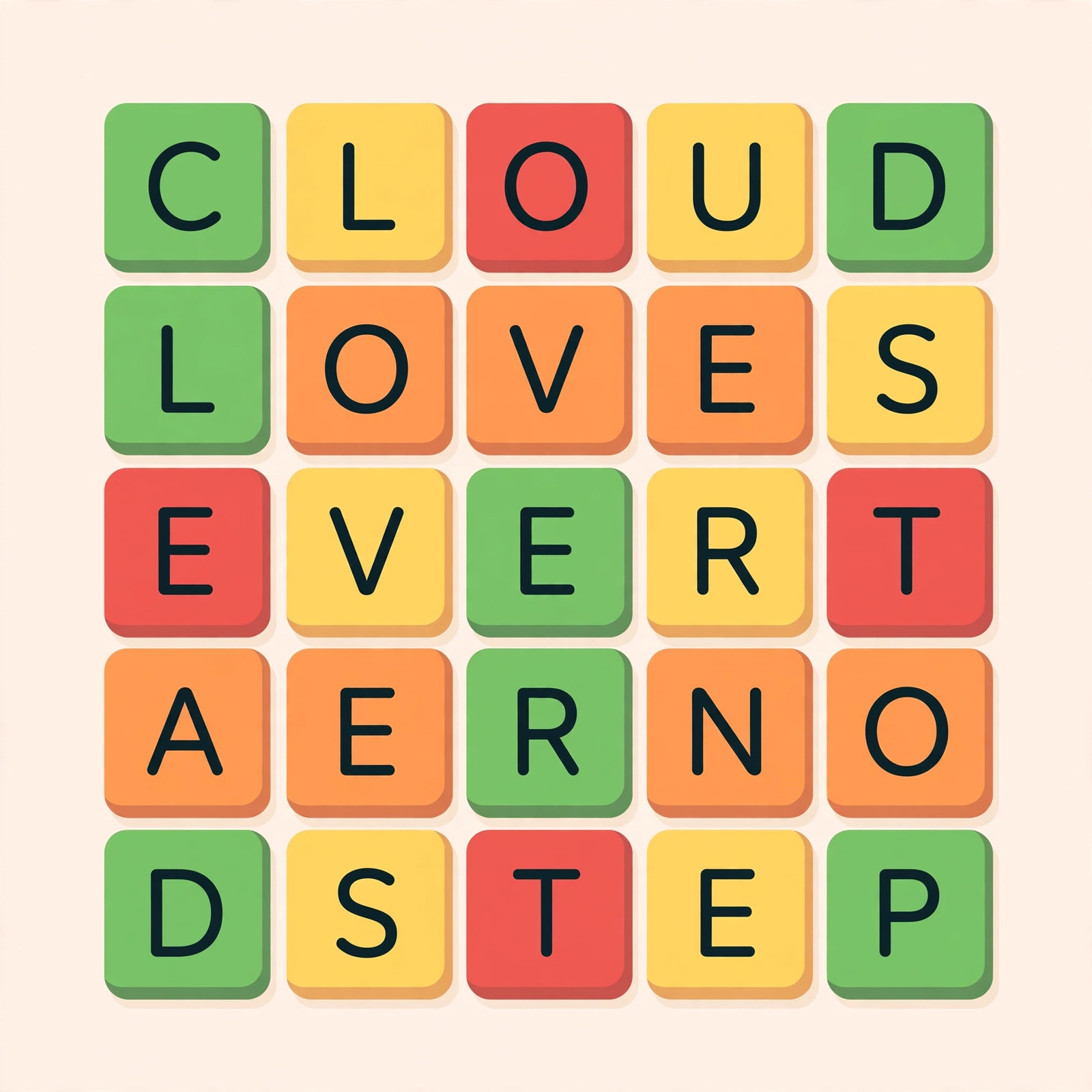
Squardle is a Wordle spin-off played on a 5×5 letter grid of interlocking words — a crossword-style word puzzle. Instead of guessing one word, you must solve six five-letter words that cross each other like a crossword, starting with only 10 guesses. Each guess fills in both a row and a column at once, and a five-color hint system tells you exactly where each letter belongs. Game databases list Squardle as a free browser game developed by Fubar Games (source). For more multi-word puzzles, read our Plusword vs Wordle comparison or browse best games like Plusword.
How to Play Squardle
- Type a five-letter English word using the on-screen or physical keyboard and hit Enter.
- Your guess populates a row and a column simultaneously. Every filled square lights up with a color-coded hint.
- Read the colors (explained in the table below) to learn where each letter really belongs.
- You start with 10 guesses. For each of the first five words you completely solve, meaning every square turns green, you earn one bonus guess.
- Win by solving all six words. A word counts as solved the moment all its letters turn green, even if you never typed that exact word as a guess.
The game automatically cycles where your next guess goes, skipping rows and columns you have already solved. Two arrows beside the grid show where the next guess will be entered.
What the Squardle Colors Mean
| Color | Meaning |
|---|---|
| Green | Correct letter in the correct square |
| Yellow | Correct letter, in the correct row but the wrong square |
| Red | Correct letter, in the correct column but the wrong square |
| Orange | Correct letter, in both the correct row and column but the wrong square |
| White | The letter is on the board somewhere, but not in this row or column |
This richer palette is what separates this word-deduction game from Wordle. A yellow tile does not just say "right letter, wrong spot" the way Wordle does; it tells you the letter belongs somewhere in that specific row. Red does the same for columns, and orange narrows it to the intersection of the right row and column. Learning to read these precisely is the core skill of the game.
Weekly Squardle Mode
In Weekly Squardle mode, when only one row or column still has no green letters, your guesses are confined to that area. This removes the frustration of chipping away at the last unsolved word one square at a time while protecting the strong start you have already built. It is effectively a mercy rule for the endgame.
Strategy: How to Win at Squardle
Open with information, not answers
Your first two guesses should maximize letter coverage, exactly as in Wordle. Strong openers packed with common consonants and vowels (think of words covering E, A, R, O, T, L, I, S, N, C) light up the whole grid with yellows, reds, and oranges, which is far more valuable than luckily solving one word early.
Think in rows and columns, not words
Because every guess fills a row and a column, each guess is really two experiments at once. Before submitting, check what the guess would tell you about both the row word and the column word. A guess that is useless for the row can still be golden for the column.
Spend bonus guesses wisely
You earn up to five bonus guesses, one per solved word, but only the first five solved words pay out. Prioritize finishing nearly-complete words to bank those extra guesses before you spend guesses probing the hardest row.
Use orange tiles as anchors
An orange tile means the letter is in the correct row and column but the wrong square, which massively shrinks the possibilities. Cross-reference orange tiles with green ones to pin down exact positions two or three guesses earlier than brute force would.
Do not neglect white tiles
White means the letter exists on the board but outside the current row and column. Players often fixate on yellows and reds and forget that white tiles are confirmed letters too. Keep a mental (or written) list of confirmed letters and make sure your later guesses include them somewhere useful.
Squardle vs Wordle vs Quordle
| Feature | Wordle | Quordle | Squardle |
|---|---|---|---|
| Words per game | 1 | 4 | 6 (interlocking) |
| Starting guesses | 6 | 9 | 10 (+5 earnable) |
| Grid | Single row | Four separate grids | One shared 5×5 grid |
| Hint colors | 3 (green/yellow/gray) | 3 | 5 (green/yellow/red/orange/white) |
| Daily puzzle | Yes | Yes | Weekly mode available |
| Difficulty | Casual | Moderate | Hard |
A Note on Other Games Called Squardle
The name Squardle is used by more than one project. The best-known is the 5×5 interlocking-words game described above. There is also an open-source Wordle-style variant by developer neallang on GitHub (five hidden words, 15 attempts, classic three-color feedback) and an unrelated daily word-grid game on WordGames.club where you link neighboring tiles to find hidden words. If a "Squardle" you find looks different from this article's description, you have likely found one of the alternate versions.
Bonus Guess Economics: When to Spend Your 10 Guesses
You start Squardle with 10 guesses for six words, earning one bonus guess per solved word (up to five bonuses). That economy — 10 guaranteed, up to 15 total — shapes every decision. Here is how to spend it well.
Budget two guesses per word, mentally. Ten guesses across six words is tight, but the bonus system refunds solved words. Think of it as: each of the first five words you solve pays for itself plus change. The practical rule is to never spend more than three guesses on a single word before moving on — the game auto-cycles to unsolved rows and columns, so a stubborn word can wait while you harvest easier ones.
Spend early guesses on coverage, not solutions. Your first three guesses should introduce maximum fresh letters across the grid, because every guess fills a row and a column simultaneously — each guess is really two guesses' worth of information. Words with no repeated letters and high-frequency consonants earn their keep fastest.
Treat orange tiles as the jackpot. Orange means the letter is in the correct row and column but the wrong square — the most precise hint in the game. When an orange tile appears, the letter's true home is usually one move away; prioritise resolving orange tiles before chasing new information, because they convert directly into solved squares.
Save your last two guesses for the endgame. Resist spending down to zero mid-game. The final unsolved word often needs a dedicated solving guess plus one spare for a fork — entering the endgame with an empty guess bank turns a won position into a loss.
What is Squardle?
Squardle is a word puzzle game played on a 5×5 grid of six interlocking five-letter words. You get 10 guesses (plus up to 5 bonus guesses) and a five-color hint system to solve every word on the board.
How many guesses do you get in Squardle?
You start with 10 guesses. Each of the first five words you fully solve earns you one additional guess, for a maximum of 15 total.
What do the colors mean in Squardle?
Green means the correct letter in the correct square; yellow means the correct row but wrong square; red means the correct column but wrong square; orange means the correct row and column but wrong square; white means the letter is elsewhere on the board.
Is Squardle harder than Wordle?
Yes, considerably. You are solving six interlocking words instead of one, with only slightly more guesses, and the five-color hint system takes practice to read fluently.
What is Weekly Squardle mode?
A mode where, once only a single row or column has no green letters left, your guesses are confined to that area so you can finish the last word without risking your solved rows.
Is Squardle free to play?
Yes. Squardle is free to play in the browser on the various game portals that host it, with no sign-up required.
How many bonus guesses can you earn in Squardle?
One per word for the first five words you fully solve — so up to five bonus guesses on top of your starting 10, for a maximum of 15 guesses to solve all six words. A word counts as solved the moment all its squares turn green.
What do the white tiles mean in Squardle?
White means the letter is on the board somewhere, but not in the current row or column. It is the weakest positive signal — useful for confirming a letter exists, but it tells you nothing about where it belongs.