
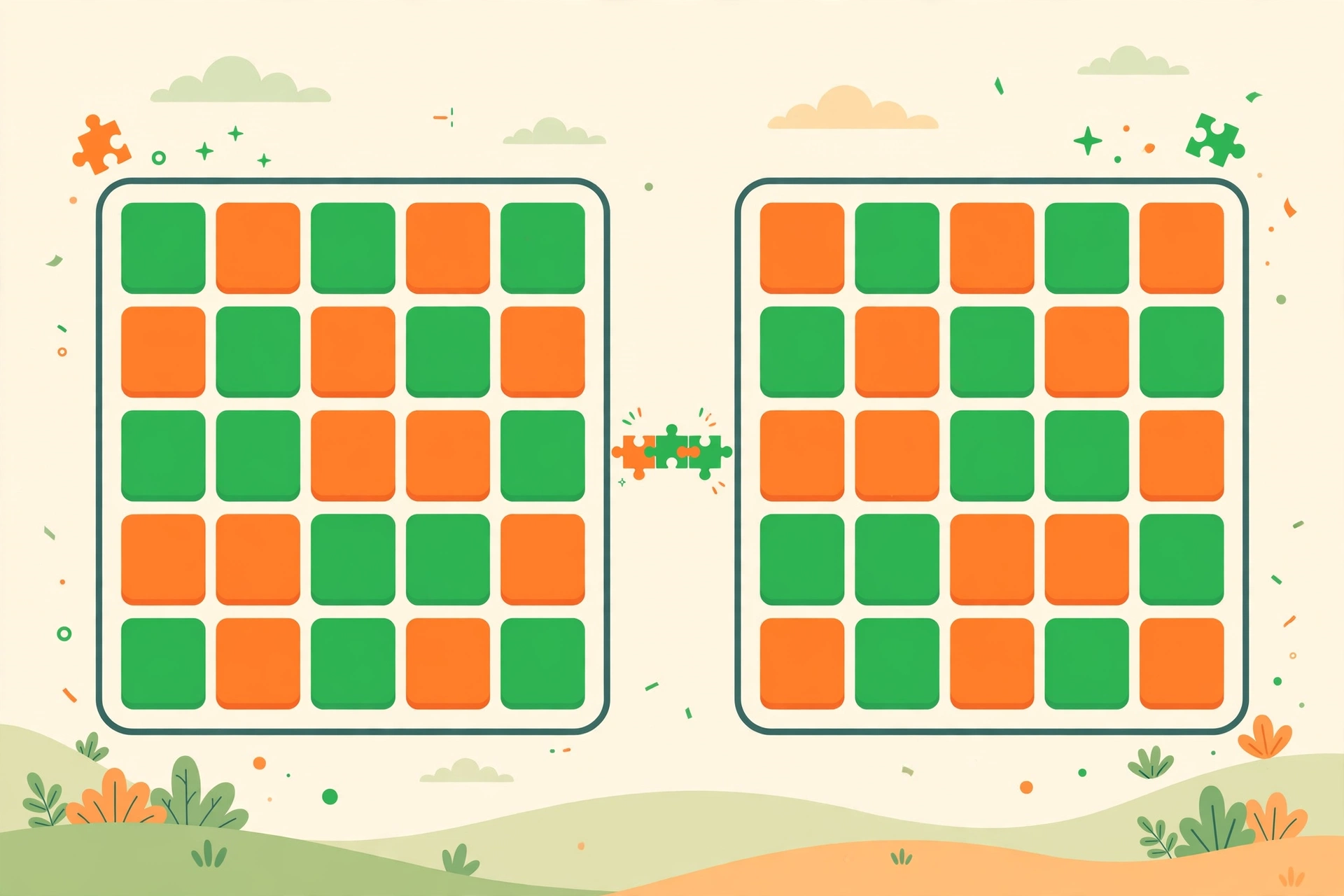
Twordsy — a portmanteau of "two words" and "puzzle" — is a daily word game with a twist on the Wordle formula. Instead of finding one five-letter word, you hunt a pair of five-letter words that are connected in some way, uncovering both the words and the hidden link between them. It was created by Cornwall-based entrepreneur Sam Burney, who works with Falmouth University's venture studio, Launchpad, and launched it publicly via twordsy.com.
What is Twordsy?
Each day, Twordsy presents a daily puzzle built around two concealed five-letter words. The words share a hidden connection — it might be synonyms, antonyms, a thematic link, or a linguistic pattern. Examples quoted by game guides include pairs like BEACH and SHELLS, CREPT and SNUCK, or BRAIN and LIVER.
Your job is twofold: guess both words through Wordle-style deduction, and work out what connects them. That double layer — the words plus their relationship — is what gives this word-guessing game its distinctive flavour among word association games. The game is free to play in any browser at twordsy.com, with a new pair published daily.
How to play Twordsy
- Two hidden words. The puzzle shows two concealed five-letter words. Your mission is to unveil them by guessing letters and their positions.
- Guess one word at a time. You make a guess for the first word, then alternate to the second word, and so on — the alternating pattern is one of the game's signature mechanics.
- Read the colour clues:
- Green — the letter is correct and in the right position.
- Orange — the letter is correct but in the wrong position (Twordsy uses orange where Wordle uses yellow).
- Five guesses per word. You have five attempts to crack each word, so every guess must earn its place.
- Find the connection. Once both words emerge, the final satisfaction is naming the link between them — the puzzle is only truly solved when the relationship clicks.
The rules at a glance
| Element | Detail |
|---|---|
| Words per puzzle | 2 (both five letters) |
| Guesses per word | 5 |
| Guess order | Alternating between the two words |
| Correct letter, right spot | Green |
| Correct letter, wrong spot | Orange |
| New puzzle | Daily |
| Connection types | Synonyms, antonyms, themes, word patterns |
Strategies and tips
Open with vowel-and-consonant-rich words
As with Wordle, your first guesses should cover the most common letters — E, A, R, T, O, S, N, L. Because you alternate between two words, a strong opener pays off twice, feeding information into both grids.
Let one word inform the other
The two words are connected, so progress on one narrows the other. If your first word turns out to be OCEAN, start thinking about sea-related five-letter words for the second grid before you even guess.
Guess the connection early
You do not need both words to start hypothesising. After two or three guesses, ask: what could link these fragments? If you suspect synonyms, your next guesses can target synonym pairs rather than random words.
Spend guesses on information, not answers
With only five guesses per word, resist the urge to solve on guess two. An early guess packed with untested common letters is worth more than a hopeful stab at the answer. Our word puzzle strategies guide explains how to maximise information per guess.
Watch the orange tiles
Orange (right letter, wrong spot) is easy to underuse. Actively reposition orange letters in your next guess — players who track them systematically solve far more often.
Play the daily, then stop
One puzzle a day is the whole game. The constraint is deliberate: it keeps the streak meaningful and the puzzle special. Come back at midnight local time for the next pair.
Twordsy vs Wordle: what's different?
| Feature | Wordle | Twordsy |
|---|---|---|
| Target | One 5-letter word | Two connected 5-letter words |
| Guesses | 6 total | 5 per word |
| Feedback colours | Green / yellow | Green / orange |
| Extra layer | None | Guess the hidden connection |
| Creator | Josh Wardle | Sam Burney |
If Wordle is a sprint, Twordsy is a sprint with a riddle attached — familiar mechanics, but the connected-pair concept demands lateral thinking as well as vocabulary. Fans of association-based puzzling may also enjoy Parseword, another Wordle-family game with its own twist.
About the creator
Twordsy was built by Sam Burney, a Cornwall-based entrepreneur working with Launchpad, Falmouth University's venture studio. After prototyping it with friends and family, he launched it more widely at twordsy.com, describing it as a side project born from a year surrounded by entrepreneurs. It has been covered as "Cornwall's answer to Wordle" by Tech Cornwall.
Common Twordsy Mistakes to Avoid
- Solving too early. With only five guesses per word, a hopeful stab at the answer on guess two is a wasted turn. Spend early guesses on untested common letters instead.
- Ignoring the orange tiles. Orange means the right letter in the wrong spot — the equivalent of Wordle's yellow. Players who actively reposition orange letters solve far more often.
- Treating the two words as separate puzzles. The words are connected, so progress on one narrows the other. If your first word is OCEAN, think sea-related words for the second grid immediately.
- Waiting too long to guess the connection. You do not need both words to start hypothesising. After two or three guesses, naming the suspected link focuses every subsequent guess.
Cracking the Connection: A Taxonomy of Twordsy Links
Finding the two words is only half the puzzle — naming their connection is the true solve, and connections fall into a small set of families. Learn the families and the link reveals itself faster.
Synonyms and near-synonyms. The most common family: two words meaning nearly the same thing (CREPT and SNUCK). When both words emerge, ask first whether they could substitute for each other in a sentence. If yes, you have your link — this family accounts for a large share of daily puzzles.
Antonyms and opposites. The mirror family: words pulling in opposite directions. These are often the most satisfying solves because the contrast clicks suddenly. If the two words feel related but not synonymous, test opposition before anything exotic.
Thematic pairs. Words linked by a shared world rather than meaning — BEACH and SHELLS, or two words from the same profession, hobby, or setting. For these, brainstorm the scene both words belong to rather than their definitions. The connection is a place or activity, not a dictionary entry.
Linguistic patterns. The trickiest family: words sharing a structural quirk — anagrams, shared roots, matching letter patterns, or rhymes. If meaning-based links fail, go structural: do the words share letters? Do they rhyme? Is one hidden inside the other?
Guess the connection early. Do not wait until both words are solved. From your first orange and green tiles, start hypothesising the link — a suspected synonym pair changes which letters you hunt for, because you start thinking in meaning-space rather than letter-space. The connection is a solving tool, not just a victory lap.
Double the words, double the fun
Twordsy takes the mechanic everyone knows and adds the one thing Wordle never had: a relationship to discover. If you enjoy word association as much as word guessing, it deserves a place in your daily rotation — alongside our own daily Plusword puzzle.
What is Twordsy?
Twordsy is a free daily word game in which you uncover a pair of connected five-letter words. You get five guesses per word, with green and orange clues, and the words share a hidden link — synonyms, antonyms, a theme or a word pattern.
Who created Twordsy?
Twordsy was created by Sam Burney, an entrepreneur based in Cornwall who works with Launchpad, Falmouth University’s venture studio. He launched the game publicly at twordsy.com.
How many guesses do you get in Twordsy?
Five guesses per word, ten in total. Guesses alternate between the two words, which adds a strategic layer to the game.
What do the colours mean in Twordsy?
Green means a letter is correct and in the right position; orange means the letter is in the word but in the wrong position — the equivalent of Wordle’s yellow.
Is Twordsy free to play?
Yes. It is a free daily browser game at [twordsy.com](https://twordsy.com), with one new puzzle each day.
What kind of connections link the two words?
The pairs can be linked by synonyms, antonyms, thematic associations or linguistic patterns — for example BEACH/SHELLS (theme), CREPT/SNUCK (synonyms) or BRAIN/LIVER (body parts).
How is Twordsy different from Wordle?
Instead of one word in six guesses, Twordsy gives you two connected five-letter words with five guesses each, alternating guesses between them, and asks you to find the hidden connection as well as the words.
What time does the Twordsy puzzle reset?
The new daily puzzle arrives at midnight local time — one pair per day, which keeps the streak meaningful.
What kind of connections link the two Twordsy words?
Connections include synonyms, antonyms, thematic links (words from the same world, like BEACH and SHELLS), and linguistic patterns like shared roots or rhymes. The puzzle is only truly solved when you can name the relationship, not just the words.